

The Winged Victory of Samothrace: what it is and where it is
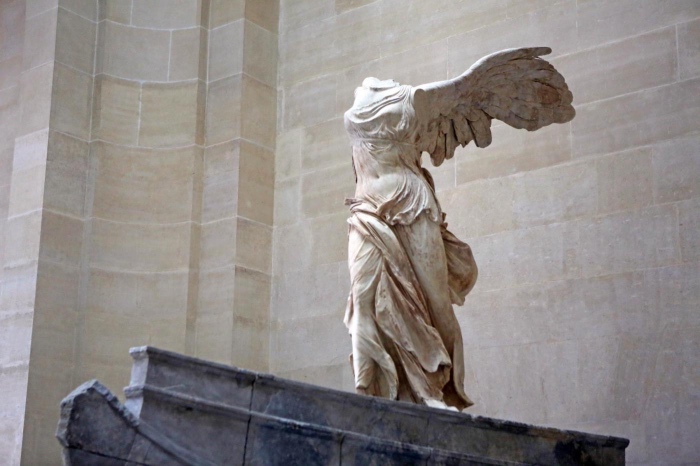
What makes the Winged Victory of Samothrace one of the most beautiful works of antiquity?
In my personal ranking of the most beautiful works of the ancient world, the Nike comes right after the Laocoon.
These are two wonderful works, and I believe that no one can fail to be enchanted by their perfection. Like the Laocoön, the Nike was rediscovered after centuries of obscurity, and its recovery has only added to its appeal.
In this post, you will find everything you need to know about the Nike of Samothrace, what it represents, who created it, when it was found, and where to see it.
NIKE OF SAMOTHRAKE: WHAT IT REPRESENTS AND WHERE TO SEE IT
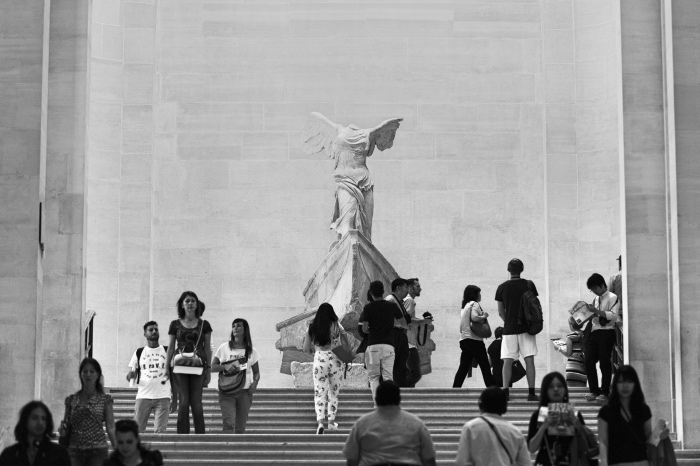
With its large wings and imposing dimensions, Nike is one of the most fascinating sculptures of the classical world.
The perfection of the forms of this female body, which represents the personification of Victory, blends with a theatrical and spectacular scene, which undoubtedly must have been astonishing.
WHAT DOES THE WINGED VICTORY OF SAMOTHRAKI REPRESENT?
The Nike of Samothrace celebrates the victory of the Delian League in the Battle of Eurymedon. This event was commemorated with the construction of a large temple in honor of the gods, on which Nike stood as she descended from the sky and landed on the bow of a ship, sounding her trumpet to announce the triumph in battle.
Its original location was intended to be on a ship surrounded by water, which created reflections on the pure white marble.
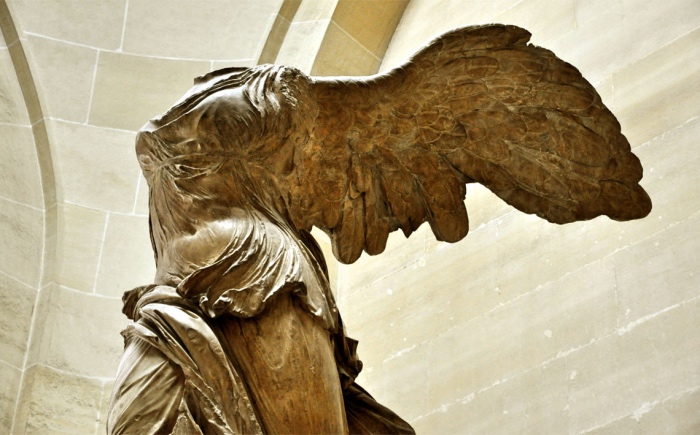
Nike’s clothes are blown by the wind and are a masterpiece of technique and beauty, because the marble has been sculpted in such a way that the dress seems to cling perfectly to the body, revealing its shape. The left arm was raised, probably in greeting, while the right arm was perhaps raised in the act of blowing a trumpet.
Studies carried out on this imposing sculpture (it is 2.75 meters high) have revealed that the wings, arms, and torso were made individually and then assembled. This certainly prevented damage during the working phase, as it was an imposing work.
The drapery perfectly hides the lines that mark the point of contact between one piece and another.
WHEN WAS THE WINGED VICTORY OF SAMOTHRAKE FOUND?
The Winged Victory of Samothrace was found in 1863 on the island of Samothrace during an expedition by archaeologist Charles Champoiseau.
It was a work already famous in ancient times, which had stood for a long time on the altar of the Great Gods of the island of Samothrace, but had been completely forgotten for centuries.
The French archaeologist immediately recognized the Nike described in historical sources among the hundreds of fragments into which it had been reduced by time and arranged for France to purchase it immediately.
WHERE TO ADMIRE THE WINGED VICTORY OF SAMOTHRACE
The Winged Victory of Samothrace is one of the great masterpieces of the Louvre and was transferred to France almost immediately after its discovery.
All the fragments of the work were reassembled at the Louvre in 1864, with other elements found in subsequent years being added.
Napoleon III wanted the Nike to be placed in the Louvre, at the top of the staircase connecting the Galerie d’Apollon to the Salon Carrè, where it still stands today.
Until the inauguration of the glass pyramid in 1989, this was the entrance to the Louvre, and the Nike therefore had a place of honor.

Follow me on:
About me
In this blog, I don't explain the history of art — I tell the stories that art itself tells.