

Opéra Garnier in Paris: tickets to visit it
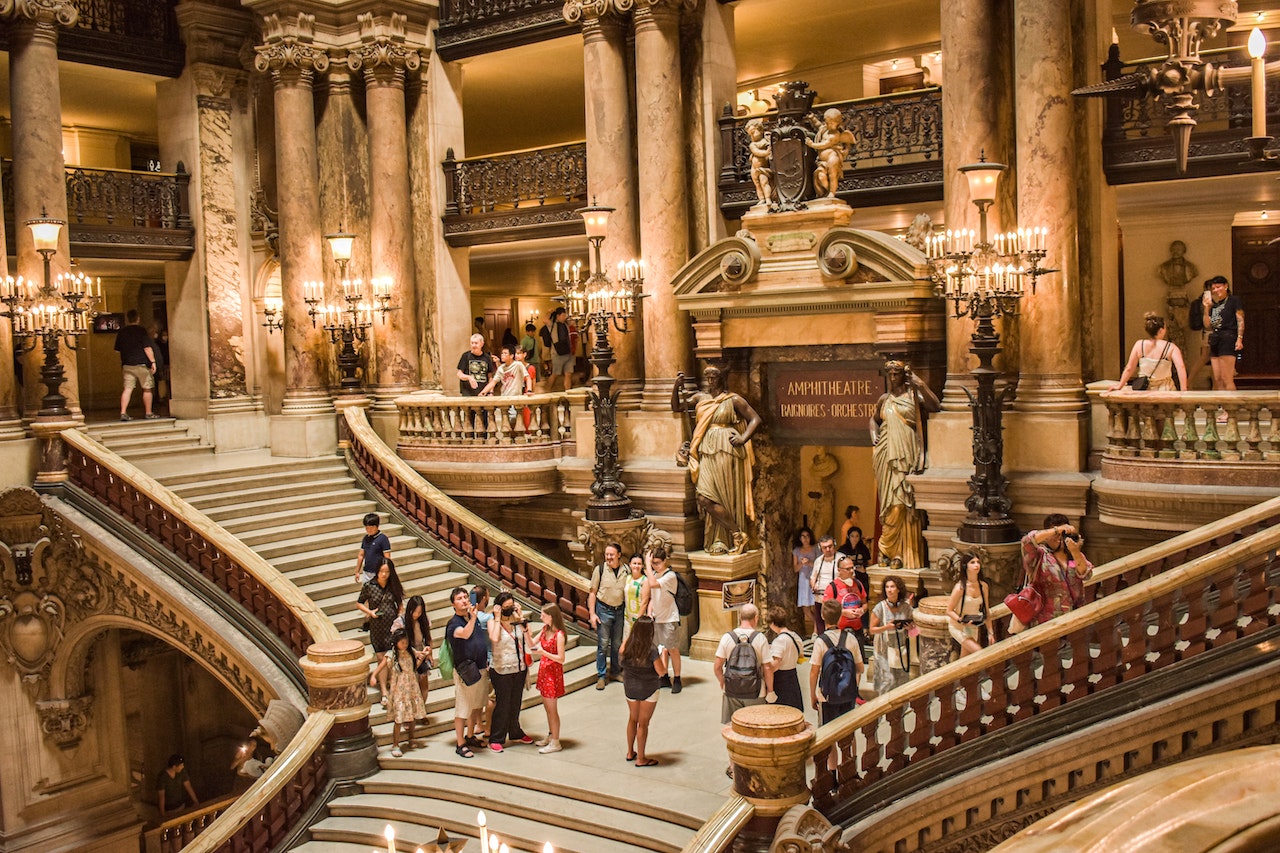
The Opéra Garnier in Paris is still home to the Opéra National ballet and is mainly used for performances by the company. Even for those who are not passionate about theatre and ballet, however, the Opéra remains a crucial stop on any tour of the city.
The Opéra district of Paris
Paris, divided by the Seine River into the Left Bank and Right Bank, has historically been a centre of fundamental importance for the cultural, artistic, political and economic development of France and all of Europe. Even today, Paris is synonymous with excellence in art, fashion and culture, and has never lost its aura as the most romantic city in the world.
An expression of past splendour, the Opéra district of Paris, in the 9th arrondissement, is home to some of the largest and most important palaces and theatres in the world. A standard visit can be combined with a trip to the Sainte Chapelle or Napoleon’s tomb, or even a relaxing panoramic cruise on the Seine.
Tickets for the Opéra Garnier in Paris
Known until a few years ago simply as the “Opéra de Paris”, when the Opéra Bastille was inaugurated in 1989, it took the name of the artist who designed it: Charles Garnier.
Its construction began in 1861 and fits in well with the atmosphere that still characterises the entire neighbourhood, one of the most prestigious in the city, where the Lumière brothers’ first film was screened in 1895 and where La Goulue, the muse of the painter Toulouse-Lautrec, danced to the cancan.
By purchasing tickets for the Opéra Garnier in Paris in advance, you can gain access by showing your ticket directly on your smartphone. The entrance is on the corner of Rue Scribe and Rue Auber. The theatre can be visited on Mondays, Thursdays, Fridays and Saturdays from 10 a.m. to 5 p.m., with last admission at 4:15 p.m. The ticket for the Opéra gives access to the palace and any temporary exhibitions, although some areas may be closed to the public for technical or artistic reasons.
Inside the Opéra, the monumental staircase leading to the Grand Foyer, designed as a salon for Parisian society and still striking today for its opulence, and the auditorium, with its nearly two thousand seats, stand out. In 1964, the original ceiling was covered by a work by Chagall, while the ancient (and heavy: seven tonnes!) crystal chandelier is still on display.
Combined ticket for the Opéra Garnier and Sainte Chapelle
A few minutes by metro from the Opéra Garnier in Paris, you can reach the Sainte Chapelle, a UNESCO World Heritage Site. Buying a combined ticket for the Opéra Garnier and Sainte Chapelle allows you to get a discount on the two separate tickets and visit two of Paris’ most iconic monuments. Tickets can also be booked on different days and the ticket for the Sainte Chapelle can be changed up to the day before your visit.
This chapel, now deconsecrated, is open to the public every day from 9 a.m. to 5 p.m., with last admission 40 minutes before closing time; it is also accessible to wheelchair users. To access the wonders housed in this chapel, you must pass through a security check at the entrance.
Commissioned by Louis IX as a palatine chapel for the Palais de la Cité, the residence of the kings of France until the 14th century, it is now considered an example of the Rayonnant Gothic style. Originally built as a chapel and reliquary, its symbolic function for Christianity earned Louis IX enormous power in religious circles. Built in a very short time, between 1241 and 1249, it housed, among other things, the relics of Jesus’ crown of thorns, which have now been transferred to the Church of Notre Dame. Visitors enter this chapel mainly to see the stained glass windows: more than a thousand, depicting stories from the Old and New Testaments, up to the arrival of the relics themselves in Paris.
Opéra Garnier and Musée de l’Armée
For history buffs, the perfect combination is a visit to the Opéra Garnier and the Musée de l’Armée, located within the architectural complex of Les Invalides.
The combined ticket for the Opéra Garnier and the Musée de l’Armée allows you to access the Opéra at the same times and under the same conditions as the theatre ticket, as well as the museum’s temporary and permanent exhibitions and Napoleon’s tomb.
The museum is open every day from 10:00 to 18:00 and on Tuesdays from 10:00 to 21:00. Access is facilitated for wheelchair users and people with reduced mobility. Tickets can be rescheduled up to the day before and allow you to skip the queue. The complex that houses the Musée de l’Armée is Les Invalides, accessible from the Varenne, École Militaire and La Tour-Maubourg metro stops. Inside, you can find weapons and trophies from the 17th century to the Second World War, including weapons used during the French Revolution. Designed by Louis XIV at the end of the 17th century as a hospice for war invalids, Les Invalides also houses a chapel, built between 1677 and 1706: this is the Église du Dôme, where the remains of Napoleon, who died in exile on St Helena forty years earlier, were transferred in 1861.
Visit to the Opéra Garnier with a cruise on the Seine
For incurable romantics, it is possible to combine a visit to the Opéra Garnier with a pleasant cruise on the Seine. The visit to the two attractions takes about three hours: after marvelling at Chagall’s ceiling and the crystal chandelier in the auditorium of the Opéra, the meeting point for the cruise is near the Eiffel Tower. With the combined ticket, you can skip the security checks and cancellation is free with a full refund up to the day before.
On board, an audio guide in thirteen languages, also available on smartphones, will accompany you along the route, which will pass in front of some of the city’s most important monuments, such as Notre Dame Cathedral, the Musée du Louvre and the Musée d’Orsay. In short, an experience that is a true mix of culture and relaxation.

Follow me on:
About me
In this blog, I don't explain the history of art — I tell the stories that art itself tells.