

Atalanta and Hippomenes by Guido Reni: analysis and interesting facts
If love is an obstacle course, Guido Reni immortalized it at the perfect moment: when intelligence surpasses speed, when beauty bows to destiny, when Atalanta is about to lose a race because someone had the brilliant idea of throwing an apple on the ground.
The painting Atalanta and Hippomenes is one of the most overwhelming of the Baroque period, and not only because of the athletic momentum of its protagonists. Reni tells us an ancient myth with such visual freshness that we can almost hear the rustling of fabrics and the sound of bare feet running. Ready to learn more about this masterpiece?
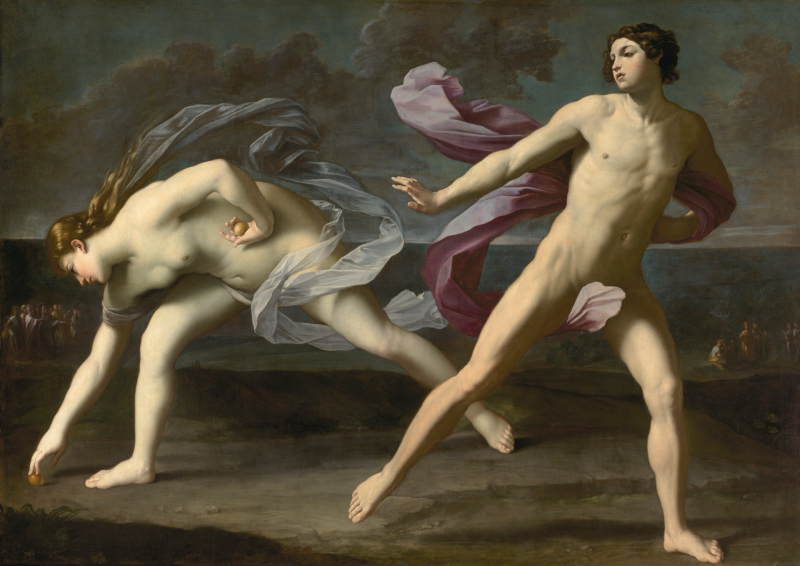
Guido Reni, Atalante e Ippomene
Atalanta and Hippomenes by Guido Reni: when love runs fast (but stumbles over a golden apple)
The myth comes directly from Greek mythology. Atalanta, an exceptional huntress and sprinter, has a small problem: she does not want to get married. To discourage suitors, she challenges them to a race. Whoever wins gets to marry her.
Ippomene is the one who wants to try to win the coveted prize: handsome, determined, and cunning.
To be sure of getting what he wants, he asks Aphrodite for help, who gives him three golden apples. During the race, he throws them one at a time, slowing Atalanta down. Curious and perhaps already in love, she stops to pick them up. The result: Hippomenes wins and love triumphs.
Guido Reni and the dancing Baroque
The painting is located in the Capodimonte Museum in Naples and is one of the most spectacular examples of how Guido Reni knew how to make myth legible, elegant, and decidedly theatrical.
The movements are not athletic, and the two protagonists of the story seem to be dancing. The dynamism is all in the bending of the body, the twisting of the hips, and the flight of the drapery. This is an example of Baroque painting that knows how to dance, that knows how to seduce with grace rather than clamor.
Looking at the painting, you immediately notice that it is a race within a visual spiral. The two bodies move in unison but in opposite directions: Atalanta looks back, attracted by the apple, while Hippomenes lunges forward, determined to win.
The colors are soft but precious: pink, gold, iridescent blues, as if every fiber of the dress were illuminated by an almost supernatural light. The landscape in the background is minimal, almost abstract, to leave room for the action.
There is movement, but also a poetic suspension. As if everything were frozen at the exact moment when destiny changes direction.
Meaning of the painting of Atalanta and Hippomenes
Beneath the ideal beauty of the bodies and faces, beneath the formal perfection, there is much more.
In this painting, Guido Reni not only recounts a myth, but also depicts the conflict between desire and rationality, between independence and love, between the race for oneself and the race towards the other.
Atalanta does not lose because of weakness, but by choice. She allows herself to be distracted, yes, but by something that has symbolic meaning: the golden apples are promises, seductions, openings to change.
So this painting is also a reflection on humanity: we can be strong, fast, determined… but sometimes it is precisely stopping that saves us.
Interesting facts and details not to be missed
Guido Reni painted this work in around 1620-1625, and there is also a similar version preserved in Madrid, at the Prado Museum.
Atalanta is portrayed with long, gathered hair, muscular and luminous, far from the image of a fragile maiden. Reni gives her strength and determination, without sacrificing grace.
Ippomene, on the other hand, looks like a Greek statue in flesh and blood: perfect, elegant, with his gaze fixed on the finish line. But not without emotion.
The apples are narrative objects, but also visual symbols: they stand out on the ground and catch the viewer’s eye, just as they catch Atalanta’s.
At the far ends of the painting are two mysterious groups of people, who are barely sketched and undersized. Who these figures are and what their function might be is still a matter of debate among scholars. Some argue that they are spectators and that Guido Reni included them to remind us that reality coexists with fiction.
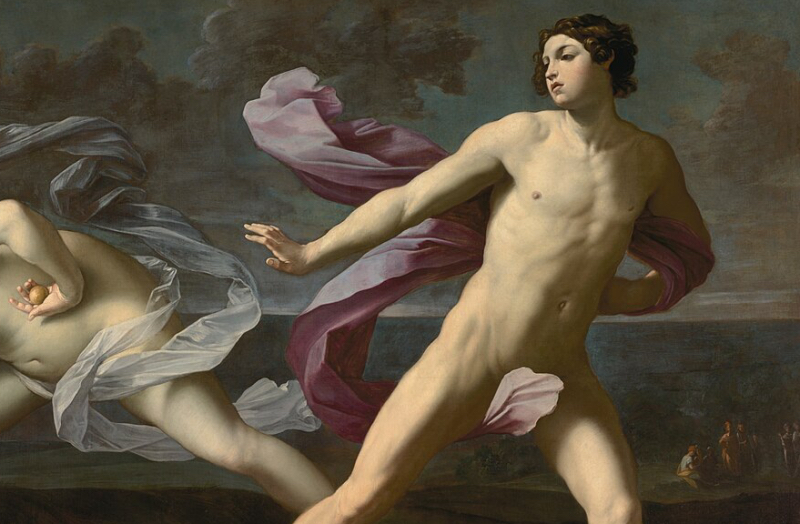
Atalanta and Hippomenes by Guido Reni is a painting that should be seen in person, if possible. However, even an image is enough to transport you into this story, which is described as a dance.
The elegant running, the bodies chasing each other, the perfection that Guido Reni was able to put on canvas are the characteristics that make this painting a masterpiece.
This is a work that speaks of love, myth, destiny, and even a little bit about us. Because, after all, who has never stopped in front of something as attractive as a golden apple?
Have you ever noticed a curious detail in this painting? Or have you seen the Prado version?
Write to me in the comments or share the article with a friend who loves art (and love stories).
🖌️ This article was published in 2013 and was updated on September 12, 2025 with new facts and insights.

Follow me on:
About me
In this blog, I don't explain the history of art — I tell the stories that art itself tells.