Maria Lai, the artist who sewed stories with needle and thread
Some artists paint with oil paints, others sculpt marble.
Maria Lai, on the other hand, chose needles, thread and fabric to tell her story of the world.
Hers is not just visual art, but a poetic gesture, an intimate narrative, an invisible connection between people, places and memories.
In this post, I will take you with me to discover an artist who has been able to give shape to fragility and beauty through the most humble and everyday materials.
Maria Lai, the artist who sewed stories with needle and thread
Maria Lai was born on 27 September 1919 in Ulassai, a small village nestled in the mountains of Ogliastra, Sardinia. Her childhood was marked by loneliness, illness and a deep connection with nature and the stories of her land.
She studied in Rome and Venice, training with great masters, but never abandoned her roots. On the contrary, it was precisely the popular traditions and the Sardinian territory that became the basis of all her artistic research.
For most of her life, Maria Lai remained a “niche” artist, little understood by the official art world. However, in recent decades, she has finally been rediscovered and recognised as one of the most original voices in Italian contemporary art.
Her most important works: from relational art to the thread of infinity
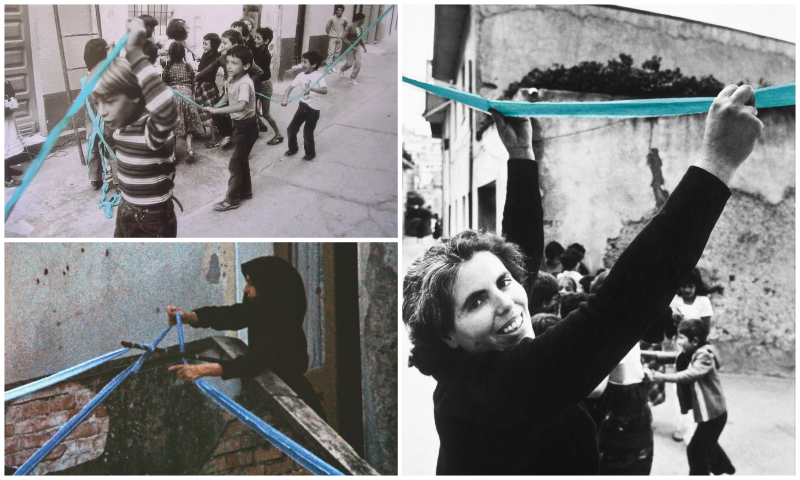
Among her most famous works, “Legarsi alla montagna” (1981) has become a manifesto. In this artistic intervention, Maria Lai ties the houses of her village together with a blue ribbon, symbolically uniting them with the mountain. An ephemeral, collective and poetic work that anticipates the practices of relational art.
Other works to remember:
Sewn books: volumes made of fabric and thread, without words, to be “read” with the fingers, the heart and the memory.
Looms and astral maps: complex weaves of threads, signs and symbols, in which each knot seems to contain a universe.
Sewn fairy tales: visual narratives inspired by Sardinian mythology and folklore.
Today, many of her works are preserved at the Stazione dell’Arte in Ulassai, an open-air and indoor museum that preserves her most authentic spirit.
A style made of poetry, silence and threads
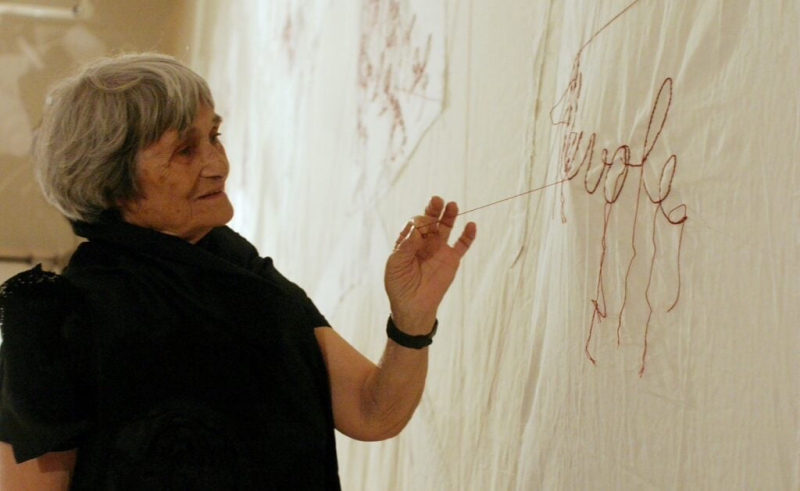
Maria Lai’s distinctive feature is her use of thread as a line, as a narrative gesture.
Her style is difficult to pigeonhole: it is conceptual art, but also craftsmanship; it is visual poetry, but also light sculpture; it is performance, but also embroidery.
Each work is a fragment of a larger story, an act of resistance against the speed, noise and ephemerality of the contemporary world.
Her art does not impose, but whispers and invites us to look with new eyes.
Interesting facts you may not know about Maria Lai
She loved silence and said that it is in the absence of sound that there are many words to hear.
She was deeply spiritual, but not religious in the conventional sense. For her, art was a form of prayer, a connection with the invisible, and the divine and the human coexist in Maria Lai’s works.
She inspired generations of artists with her freedom of expression and poetic consistency, even when female art was marginalised.
She was fascinated by constellations and many of her works reflect the theme of the universe, as if she wanted to embroider the sky itself.
Why Maria Lai’s works still have so much to say today
In an increasingly noisy world, Maria Lai teaches us to listen. In an age where we are perpetually connected, she reminds us of the importance of bonds, real ones.
With needle and thread, she has sewn together not only works of art, but also communities, memories and hopes. Visiting her works, or even just looking at them in photographs, is a bit like returning to childhood: when a thread was enough to invent worlds.
Perhaps this is her most powerful message: that art does not have to be grand, flashy or loud. It just has to be real.
If this journey into the world of Maria Lai has fascinated you, you can discover other artists who use unusual materials and tell stories through art.
Take a look at the article on Giulio Aristide Sartorio for more poetic and surprising ideas.
Have you ever seen a work by Maria Lai in person? Would you like to? Write it in the comments or share the article.
🖌️ This article was published in 2013 and was updated on 16 September 2025 with new curiosities and insights.

Follow me on:
About me
In this blog, I don't explain the history of art — I tell the stories that art itself tells.