Automatic writing: when art begins with a sentence without thinking
Have you ever tried writing without stopping, without thinking, without rereading? Just paper, pen, and an uninterrupted flow that flows from your fingers as if it came from a mysterious place?
Welcome to the magical (and slightly crazy) world of automatic writing, one of the most fascinating practices born out of surrealism.
Today, we find it in creative journaling, visual poetry, art therapy, and certain social media posts that seem to come straight from the unconscious. But it all began with a group of artists and poets who, a century ago, in the 1920s, decided to turn off their rational control and turn on their purest imagination.
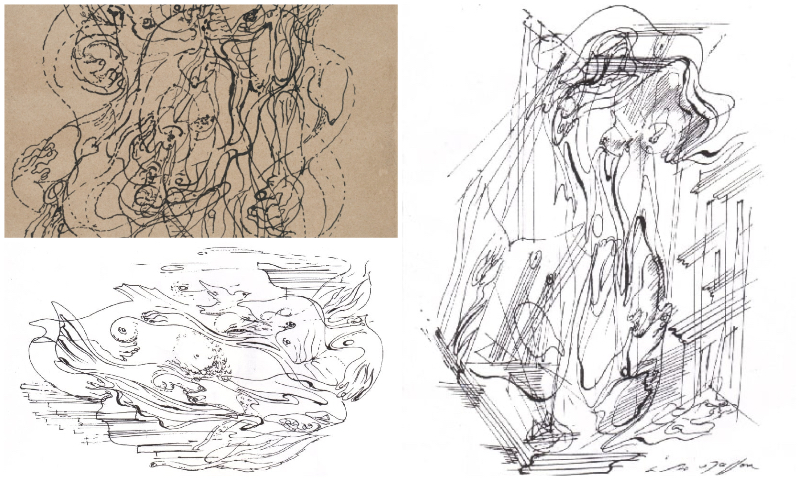
André Masson, alcuni esempi di disegni scrittura automatica
Automatic writing: when art begins with a sentence without thinking
Automatic writing is a technique that consists of writing without any filter, without reflecting on what you are saying, without worrying about form or logic. You write everything that comes to mind, in one go, as if in a light trance. No corrections, no judgments.
This type of writing was first theorized by the poet André Breton, founder of the surrealist movement, who described it as a tool for directly accessing the unconscious. For him (and many others), automatic writing was the most authentic way to free thought from all social, moral, or intellectual censorship.
Origins between Freud and séances
The idea that there is a deep level of the mind capable of generating images, words, and visions without conscious control originated with Freud’s psychoanalysis. The Surrealists appropriated this concept to construct a new artistic language that did not represent the external world, but the inner universe.
However, automatic writing also has its roots in 19th-century mediumistic practices, in which mediums wrote ‘under the dictation’ of spirits while in a trance. This was a suggestion that greatly fascinated the Surrealists: writing as if the hand were guided by another force, which is not rational but deeply true.
The Surrealist Manifesto and the birth of a new art
In the First Manifesto of Surrealism (1924), Breton declares automatic writing to be the founding act of the movement.
In that document, the word becomes fluid matter, a means of bringing out the dreams, instincts, and poetic madness that inhabit every human being.
Here is an emblematic passage:
“Write quickly, without preconceived ideas, fast enough not to hold back or discourage the words that come to you. The pen must flow by itself.”
The result? Pages full of sentences without punctuation, intersecting images, words that seem to have come out of a restless night.
An apparent chaos that, upon closer reading, reveals a deeper coherence: that of dreams.
Automatic writing in visual art
It is not just a matter of words.
Automatic writing has also profoundly influenced the visual arts.
Many surrealist artists sought a graphic equivalent of this practice, trying to draw or paint without thinking, letting their hands follow the flow of the subconscious.
Some examples:
André Masson: experiments with ‘automatic drawing’, creating rapid, seemingly random strokes that transform into complex and symbolic figures.
Joan Miró: inspired by automatic writing, he develops a visual language made up of signs, curves, and symbols free from logical constraints.
Max Ernst: transformed automatic gestures into frottage and grattage, techniques in which the material suggests the image, without planning.
Salvador Dalí: although more controlled in his paintings, he drew on automatic dream logic in his famous “paranoiac-critical methods.”
From automatic writing to action painting: when gesture becomes painting
Automatic writing not only influenced European surrealists, but also inspired American artists, becoming one of the deepest roots of action painting.
In the 1940s and 1950s in the United States, artists such as Jackson Pollock, Willem de Kooning, and Franz Kline began to explore a revolutionary idea: the gesture as language.
Canvases became territories of pure action, spaces in which the artist’s body moved freely, without a specific plan, in a dance between control and chaos.
Jackson Pollock, in particular, with his dripping technique, stated several times that he painted in an almost trance-like state, letting the paint “write” itself on the canvas.
An approach that strongly recalls the logic of automatic writing, albeit in a visual and physical form: no longer just the mind that frees itself, but also the body that acts as a vehicle for the unconscious.
Writing without thinking, painting without drawing, moving without a plan.
All this stems from the same spark, namely the desire to go beyond form to reach the origin of the creative gesture.
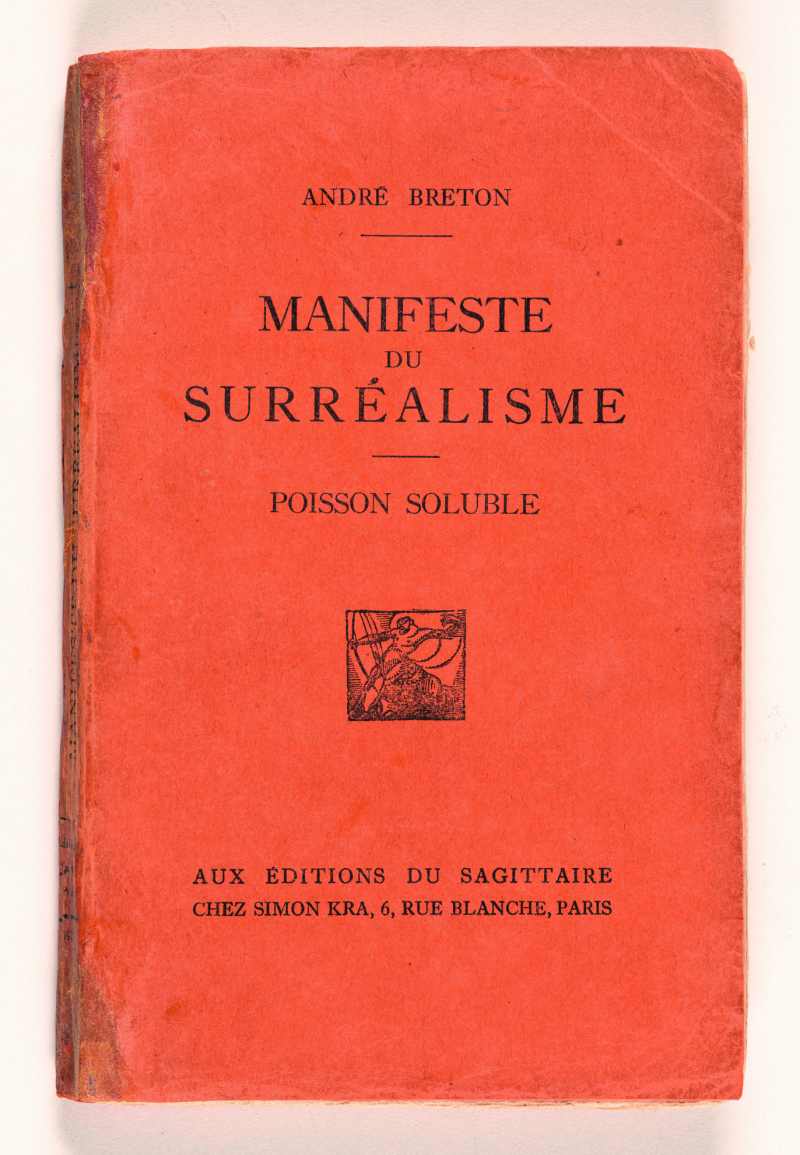
Breton, Manifesto del Surrealismo
Why (re)discover automatic writing today?
We live in an age of perfection, filters, and hyper-control. Every word is thought out, measured, edited.
Automatic writing is the perfect antidote: it invites us to make mistakes, to flow, to explore.
It teaches us that not everything has to make immediate sense, that beauty can emerge even from chaos.
It is an exercise that can become creative, liberating, even therapeutic.
Would you like to try it too? Here’s how to try automatic writing and maybe create a work of art.
All you need is a pen and paper. Turn off your cell phone. Breathe.
Write any word in the center of the page.
Start writing down everything that comes to mind. Don’t stop.
If you get stuck, rewrite the last word until another one comes to you.
After five minutes, reread it. You may be surprised by what you have written.
Turn the text into visual poetry, a sketch for a painting, a narrative suggestion… or just leave it there, like a postcard from a hidden place.
Automatic writing is not just a literary exercise, but a practice of inner listening, a pure art form, a window onto the mystery that dwells within us.
It was the beating heart of surrealism, but it can still be so today, in every diary, drawing, or poem written in the dark.
You don’t need to be an artist to try it. You just need the courage to let yourself go.

Follow me on:
About me
In this blog, I don't explain the history of art — I tell the stories that art itself tells.