Giulio Turcato: works, biography, and art as invention
Giulio Turcato (1912–1995) was one of the most innovative artists of the Italian post-war period. A leading figure in the abstract art scene, he was able to combine formal experimentation with political commitment, always maintaining a curious, radical, and open-minded outlook on the world.
In 1947, he was one of the founders of the Forma 1 group, alongside Carla Accardi, Pietro Consagra, and other leading figures of the Roman avant-garde.
The group’s manifesto claimed the autonomy of abstract art, in contrast to the figurative art imposed by ideologies. From that moment on, Turcato embarked on a personal and courageous journey that led him to explore unconventional materials, innovative textures, and a style of painting that continually challenged his own limits.
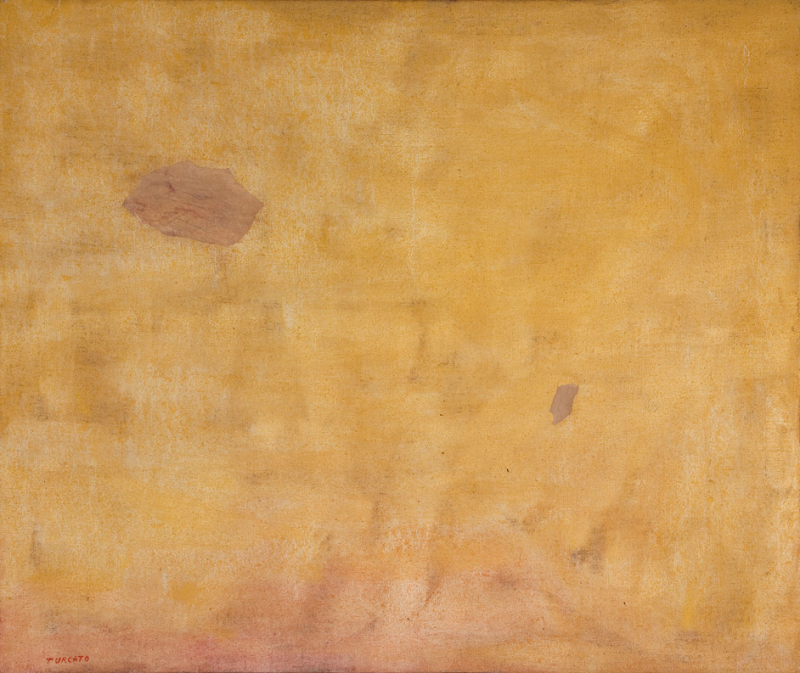
Giulio Turcato, Giallo pelle, 1961
olio, tecnica mista e collage su tela di iuta; 110 x 132 cm
Giulio Turcato: art as continuous invention
In 1962, during a trip to New York, Giulio Turcato came into contact with the most experimental circles of the American scene, including Robert Rauschenberg and Jasper Johns, strengthening his research on the boundary between painting and object.
In Italy, his works engaged in dialogue with artists such as Burri, Castellani, and Schifano, contributing to the redefinition of contemporary pictorial language.
Turcato’s works: monochromes, matter, and light
The heart of Turcato’s research revolves around the concept of monochrome, understood not as an exercise in subtraction, but as a space of infinite possibilities.
Starting in the 1960s, his monochromes became active, pulsating surfaces capable of accommodating heterogeneous materials: pills, coins, carbon paper, phosphorescent powders.
In the series Fuori dallo spettro (Outside the Spectrum) and Oltre lo spettro (Beyond the Spectrum), the artist explores color in its most extreme dimension, imagining colors that do not exist, chromatic fields beyond the limits of human vision.
The Cangianti, on the other hand, react to light and movement, becoming living, changing works in direct dialogue with the viewer.
There are also references to space and the cosmos. In fact, the famous Superfici lunari (Lunar Surfaces) evoke extraterrestrial landscapes, mysterious and inhospitable, in which matter becomes painting and painting becomes a sensory experience.
Where to see Turcato’s works: the exhibition at the Giuliani Foundation
From October 11, 2025, until January 2026, the Giuliani Foundation for Contemporary Art is dedicating an extraordinary solo exhibition to Giulio Turcato, curated by Martina Caruso and Adrienne Drake.
The exhibition traces almost thirty years of the artist’s production, with a selection of works that highlight his tireless ability to reinvent the language of painting.
Giuliani Foundation, Rome
Opening: Saturday, October 11, 2025, from 10:00 a.m. to 6:00 p.m.
Exhibition open until January 2026
An unmissable opportunity to rediscover one of the masters of Italian abstraction and to be surprised by a style of painting that never ceases to question reality and its mysteries.
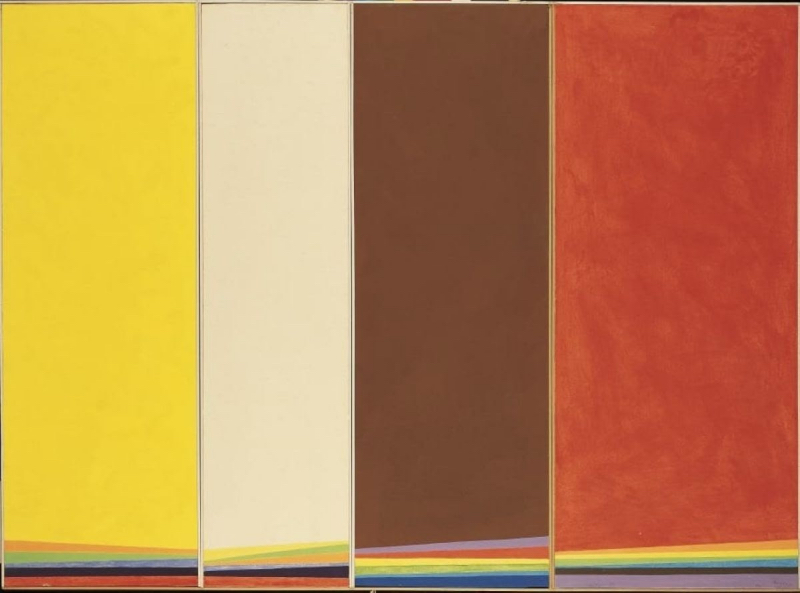
Giulio Turcato, Oltre lo spettro, 1971 olio, tecnica mista su tela; 120 x 160 cm
Giulio Turcato never sought definitive answers, but preferred to raise questions, create spaces for reflection, and transform matter into possibility.
His monochromes are not silent, but speak to those who know how to observe and invite them to look beyond the surface to discover a new world behind every shade.
If you love art that dares, that vibrates, that changes with the light… get ready to see colors as you’ve never seen them before.

Follow me on:
About me
In this blog, I don't explain the history of art — I tell the stories that art itself tells.