

Picasso, the language of ideas on display in Rome
If you think you’ve already seen everything Picasso has to offer, get ready to change your mind.
From October 4, 2025, to February 1, 2026, Rome is hosting a unique exhibition: “Picasso – The Language of Ideas,” at the Infantry Museum, just a short walk from the historic center.
You will find not only paintings, but also a surprising journey through engravings, ceramics, lithographs, photographs, and drawings that tell the story of the artist, the man, and the visionary.
This is not just an exhibition, but a journey into the creative universe of Pablo Picasso, one of the most revolutionary artists of the 20th century. An experience that will allow you to see his genius from a completely new perspective.
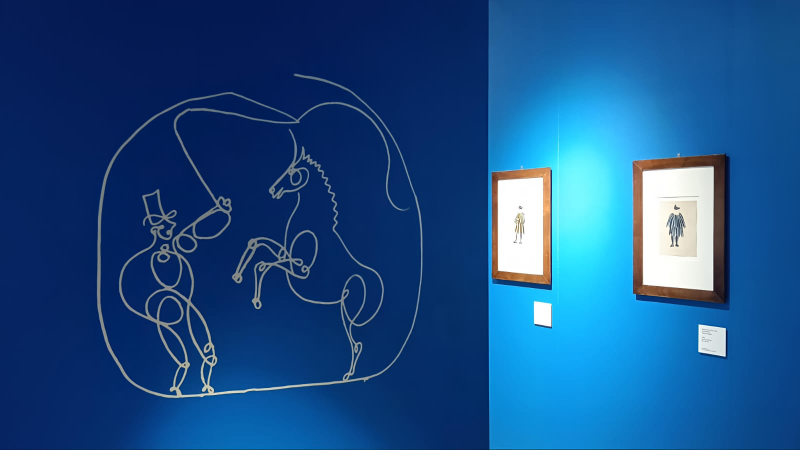
Picasso in Rome: 107 works that offer insight into the mind of a genius
The exhibition is curated by Joan Abelló, Marco Ancora, and Carlotta Muiños.
Divided into six sections, it brings together 107 works from private collections and international museums, offering a fascinating insight into the evolution of Picasso’s artistic thought: from his youth in Spain to his maturity on the French Riviera, from his early literary influences to his freer experiments.
What you will see in the exhibition (and why it is worth seeing)
1. Picasso, his friends, his women: Refined engravings, lithographs, and portraits that recount the artist’s personal relationships with poets, models, and friends, including Fernande Olivier and Àngel Fernández de Soto. Also on display are 12 engravings for Pierre Reverdy’s poetic text Sable Mouvant.
2. Linoleum, a new discovery: Between 1958 and 1963, Picasso became passionate about linoleography, and in Rome you can admire 20 color examples from the Linoleos series. A technique rarely seen in exhibitions and fascinating in its material simplicity.
3. Le Tricorne: An entire section dedicated to the Spanish ballet Le Tricorne, born from a collaboration with the Ballets Russes in 1917. There are 24 drawings, true stage designs on paper.
4. Late period Côte d’Azur: Intimate photographs and posters of the most significant exhibitions of Picasso’s late period, taken by photographers Edward Quinn and André Villers, witnesses to the artist’s daily life.
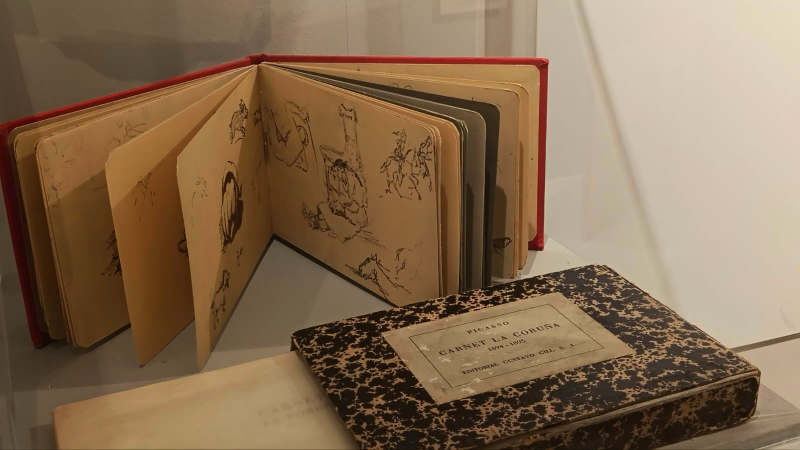
5. Carnet de La Coruña, 1895: A precious facsimile of Picasso’s notebook of early drawings, on loan from the Picasso Museum in La Coruña. A tender and brilliant glimpse into the childhood of a master.
6. Minor arts and experiments: Ceramics and lithographs from the 1940s and 1950s that reveal a curious and unconventional Picasso. In particular, his collaborations with the Madoura workshop in Vallauris revolutionized the very idea of ceramics as art and design.
Why visit the exhibition
What struck me when reading about the project was that this exhibition truly aims to portray Picasso in all his contradictions: the friend, the innovator, the provocateur, but also the man who sought new forms to express what painting alone was no longer enough to convey.
The exhibition is housed in a truly special location, the Infantry Museum, which has been transformed for the occasion into a house of ideas.
A small world within Rome, where Picasso returns to speak through ceramics, words, signs, images, and thoughts.
Information about the exhibition
Picasso – The Language of Ideas
Museo della Fanteria, Rome
From October 4, 2025, to February 1, 2026
Tickets: booking is recommended.
In conclusion
If you are fascinated by art that experiments, dares, and constantly reinvents itself, this exhibition is not to be missed. Picasso is not portrayed as an untouchable icon, but as a restless, lively, irreverent man.
I have already marked the date.
Are you coming?

Follow me on:
About me
In this blog, I don't explain the history of art — I tell the stories that art itself tells.