

Caravaggio’s La Buona Ventura: analysis and interesting facts
There are works of art that are unforgettable, not because they are the most famous or spectacular, but because they manage to say everything in a gesture, a glance, a small but significant scene from everyday life.
Caravaggio’s “La Buona Ventura” is one such work, and I would like to take you with me to rediscover it, right where it is kept: at the Capitoline Museums in Rome.
Caravaggio Buona Ventura
Caravaggio’s La Buona Ventura
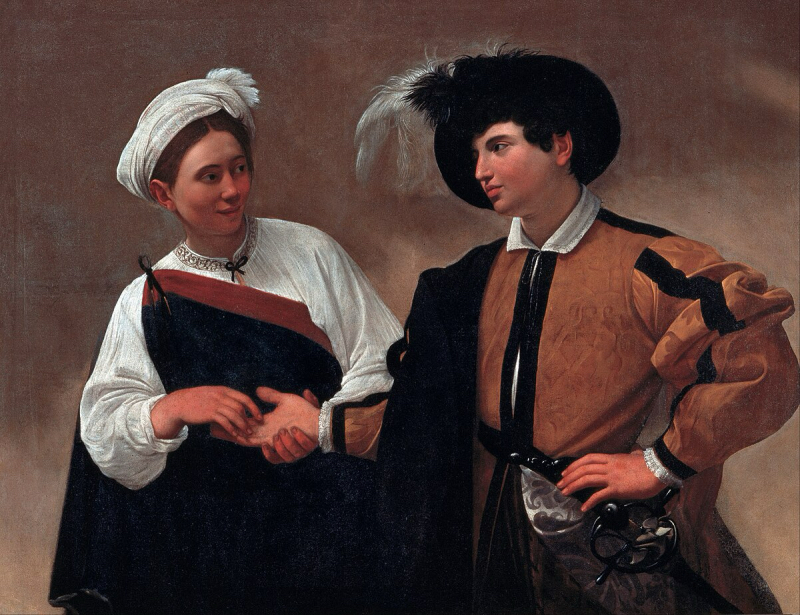
La Buona Ventura is one of Caravaggio’s earliest known paintings, created between 1593 and 1595, shortly after his arrival in Rome. The artist was still young, penniless, and searching for commissions and a unique, recognizable, and personal style. Yet, even though he was just starting out, Caravaggio was already Caravaggio: the scene is theatrical, the lighting is dramatic, and the characters seem alive.
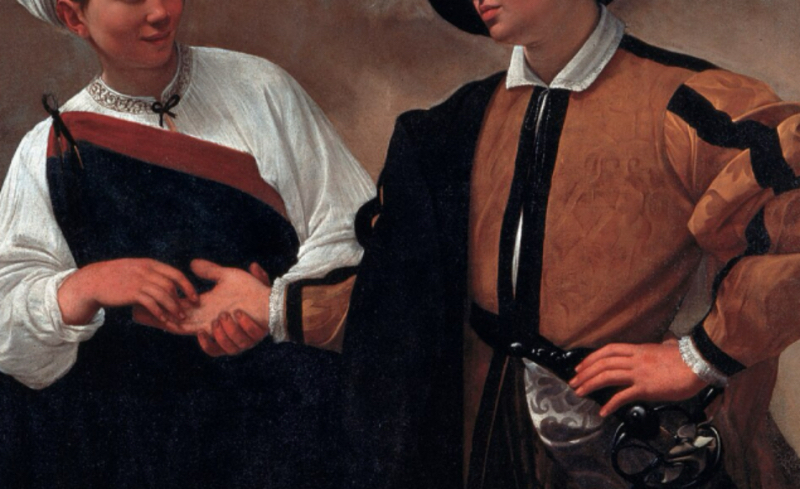
In the painting, we see a well-dressed young man, probably a nobleman or a bourgeois, having his palm read by a gypsy woman. She smiles, looks at him mischievously, and slips the ring off his finger.
It is a moment, a quick gesture captured by Caravaggio to tell us about the world.
Caravaggio and realism as revolution
What immediately strikes us in this work is the naturalness of the characters.
The gypsy woman and the young man are not idealized figures, but two real people, captured in an ordinary moment, as if Caravaggio had spied on this scene in the street.
This is one of the most revolutionary elements of his art: taking reality and transforming it into painting, without filters, without embellishment.
The sharp light that illuminates the faces and hands, the dark background that isolates the action, the attention to detail in the clothes and the gazes. Everything contributes to creating an almost cinematic intensity that draws the viewer in.
La Buona Ventura at the Capitoline Museums
La Buona Ventura is now located at the Capitoline Museums in Rome, which is one more reason to visit this extraordinary museum. Seeing it in person means grasping all the subtle irony of the painting, but also feeling the weight of reality that Caravaggio brings to the canvas.
This painting depicts a Rome populated by swindlers, a city that deceived and was rife with popular beliefs and ambiguous relationships. However, this is also a universal scene: who has never naively trusted someone?
It still happens today, and this is where Caravaggio’s genius lies. He knows how to speak our language today, even though he lived five centuries ago.
Some interesting facts about Caravaggio’s La Buona Ventura
There is a second version of La Buona Ventura, very similar, preserved at the Louvre in Paris.
Scholars are not entirely sure which is the first, but both clearly show the artist’s already mature talent.
According to contemporary accounts, Caravaggio painted directly from life and is said to have used models taken from the street. Perhaps this gypsy woman was also a woman he met on the street who swindled young people walking through the streets and alleys of Rome, or perhaps she was a friend of Caravaggio’s who frequented the same taverns as him.
Caravaggio Buona Ventura (dettaglio)
Why Caravaggio’s La Buona Ventura is a masterpiece
La Buona Ventura is a painting that appears simple, but is anything but. It speaks to us of trust and deception, naivety and cunning, and appearances that betray.
This painting by Caravaggio also conveys a new idea of art, which does not need heroic subjects to be great.
One glance is enough, and Caravaggio conveys this to us with a force that, after more than 400 years, still surprises us.
If you visit the Capitoline Museums, stop in front of this work to admire it and ask yourself questions about the world of yesterday and today. After all, Rome has never changed, or perhaps it is really different. I leave that reflection up to you.

Follow me on:
About me
In this blog, I don't explain the history of art — I tell the stories that art itself tells.