Shapes, colours and visions in the works of Alice Lotti – ARTIST’S STUDIOS
Some interviews are special from the outset.
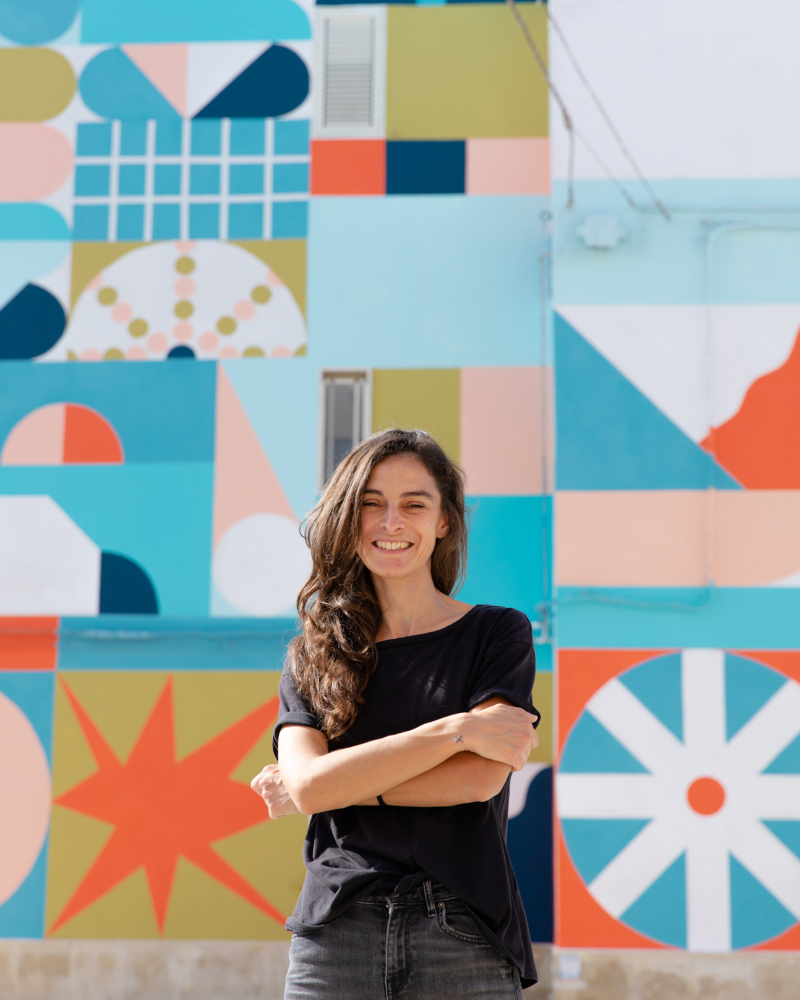
The interview with Alice Lotti is a dialogue that spans form, colour, the city and vision. It is the voice of a designer, illustrator and street artist who has managed to combine thought and mark, aesthetics and commitment, public projects and personal research.
She described her studio surrounded by nature, told us about her journey, her challenges and her way of transforming every space into language.
I am delighted to share this interview with you.
ARTIST STUDIOS
A journey through Italy to discover contemporary artists
edited by Laura Cappellazzo
I met Alice Lotti thanks to DOTS – Connecting Ostiense, an urban transformation project created to generate beauty in places of passage by building a spirit of belonging and participation among the communities of a specific territory. The first phase of this urban art project involved the Ostiense district of Rome, an area characterised by a lack of meeting places and human dispersion.
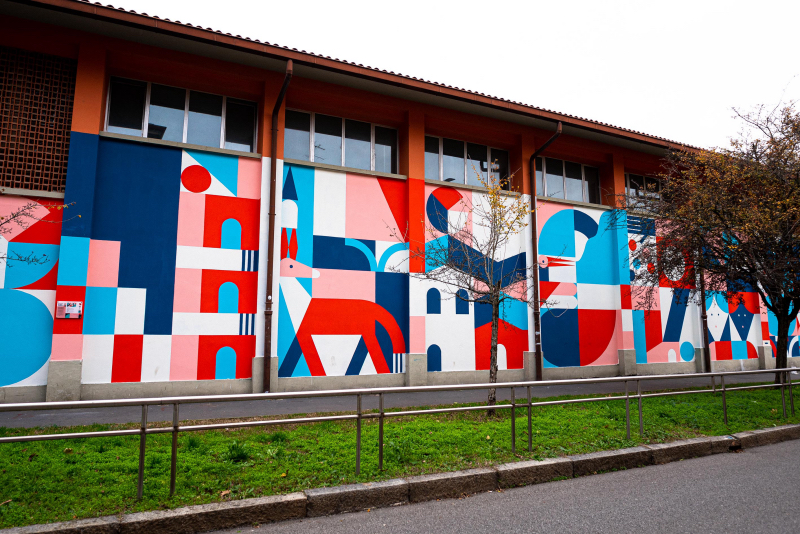
Alice Lotti is one of the artists who created these spaces of beauty; in particular, she worked on a walkable asphalt art project in the heart of the Ostiense district, along Viale del Campo Boario and Piazza Vittorio Bottego. The work winds its way along traffic islands and pavements and, in Lotti’s unique style, connects the history of the Roman Republic with the women of the partisan resistance who fought in those places.
But Alice Lotti lives and works in Turin, and that is where we caught up with her to introduce her to our readers. Lotti is a freelance graphic designer and illustrator. She works in publishing, illustration and wall painting, using a language that employs synthetic forms and clear compositions on the borderline between figuration and abstraction.
IN ALICE LOTTI’S STUDIO
Good morning, Alice, and thank you for agreeing to meet with us. Let’s start with you and your encounter with drawing and art. How did it happen, and when did you realise that they would become a fundamental part of your life?
Good morning to you! My encounter with art and drawing happened at an early age, with long drawing sessions on winter afternoons with my mother. After studying humanities, when it came time to enrol at university, I was lucky enough to come across ISIA in Urbino, the Higher Institute for Artistic Industries, a state institute for higher education in the field of design and visual communication, where I developed my skills in this area. It was at ISIA that I realised that graphic design and illustration were the right career paths for me.
Our column is called “Artist’s Studio”. Can you describe your studio?
My studio is currently located outside the city, in the hills of southern Piedmont, near Alba (CN). It is a large room with an entire wall made of glass, which allows for excellent natural light even on less sunny days. It is a space that is halfway between an office and a workshop, capable of changing shape according to need. My studio is a tidy space. Inside, there are papers, samples, books and many tools useful for drawing and paper craft. There are also many plants, which make the space seem like a continuation of the interior to the exterior and vice versa. In fact, in fine weather, the glass wall opens up and expands outside to become a larger space. Opposite the studio is a wood from which you can take a path that leads to the vineyards typical of this area and start walking. Travelling a lot for work, I have learned to make every place I live and my temporary studio my own, and often I need nothing more than my laptop to work on my projects.
Artistic expression is the common thread that unites the different sectors in which you work, while maintaining your own unique style. Can you tell us about the journey you have taken to arrive at the feeling that those shapes and colours are your very personal way of expressing yourself?
My professional career began in 2011. After completing my academic studies, I worked for several years in graphic design studios and communication agencies in Turin. I then embarked on a professional path that led me to practise my work independently.
I worked for many years in publishing and as an illustrator in the field of children’s publishing. I have always tried to evolve my language to abstract it from the figurative and arrive at a synthetic style focused primarily on the visualisation of concepts.
What techniques do you use and which ones do you feel most comfortable with?
I feel an affinity for the manual techniques of printing, collage and mural painting. However, I use digital technology a lot because it allows me to immediately visualise the output and finalise projects more quickly. When I have time, I also work with weaving and natural dyeing for personal research projects that help me to experiment with manual skills and the uncontrollability of results.
Let’s go back to Dots and urban art. You had already created works on walls, but what about asphalt? What was it like working on such a large “canvas” and, above all, with so many people walking nearby and perhaps stopping to watch?
I have created a few pieces on the pavement over the last few years. Unlike walls, working on asphalt presents more complex challenges in terms of creation and maintenance. During the design phase, it is very interesting to imagine immersive, large-scale subjects, while the creation phase is very physical work. Since these are works that exist in the environment, encounters with people are inevitable. The conversations that arise are spontaneous, unexpected encounters that punctuate the work with frequent coffee breaks, giving rise to ideas and visions of the places where people live. Often, coming from outside, it is not easy for us artists to understand the context in which we work, and these moments are very important because they are formative in validating the artistic intervention.
You often work with companies, and for many, the combination of art and manufacturing is something that makes them turn up their noses. You, on the other hand, manage to remain true to your style while working for different brands. Can you tell us about this part of your work?
I consider myself more of a designer than an artist; visual communication is my bread and butter. I am more interested in conveying a message than in personal expression. Using my work to convey content commissioned by companies is not a limitation for me, but rather a potential. I have always been greatly inspired by the period in the history of graphic design in Italy known as the Industrial Style, which developed around the 1950s. During those years, designers and industrial clients enjoyed a privileged relationship, giving rise to extremely interesting experiences in the field of corporate image. The synergy that was created was explosive, a lively environment of research and experimentation, made possible by the work of visionary clients interested not only in economic growth but also in the development of culture and knowledge.
In an interview a few years ago (in 2012, to be precise), you said that you were trying to become an illustrator. Now that your artistic identity is recognised and appreciated, I ask you: was it difficult to get to this point? How do you feel as an artist, a woman, an Italian?
All paths to professional growth are complex and require commitment and determination. Unfortunately, it is difficult in Italy to make a living from your artistic work and feel recognised as a professional. But 13 years after that interview, I feel I have built a solid foundation to consider myself as such. Furthermore, in recent years, the fact that I have embarked on a path that falls within the realm of urban and environmental art, which is often associated with male figures, is an important issue for me.
Being a woman, a freelancer and a worker is unfortunately still too difficult in Italy in 2025, a condition that requires daily questioning, but one that I am very happy to pursue and which I hope will serve as an example for others.
We usually conclude our interviews by asking if there is currently an artist in Italy who you would like to accompany us to continue our conversation about art. Who would you take us to see?
In addition to my work as a designer and illustrator, I teach design and methodology at the IED in Turin. I believe in the importance of education as a lively and generative environment. The stimuli that come from my students are always the best because they are veiled, still immature, but often give a glimpse of their development towards interesting future paths. I therefore feel I must pay tribute to them, to students in general, to those who are on a journey and in search of something. This is a condition that I hope I will never abandon myself.
Discover Alice Lotti’s work on Instagram and on her official website.
Post a cura di: Laura Cappellazzo

Follow me on:
About me
In this blog, I don't explain the history of art — I tell the stories that art itself tells.