Paris transforms the metro into a museum with Grand Paris Express
By 2030, Paris will inaugurate 68 new underground stations, transforming them into a veritable museum. This is the ambitious goal of the Grand Paris Express, one of the most visionary infrastructure and public art projects of recent decades, which combines innovation, architecture and international creativity to rewrite the face of the underground city.
Big names in contemporary art such as Anselm Kiefer, Michelangelo Pistoletto and Eva Jospin, together with new emerging voices, are ready to work side by side with architects and engineers to create unique environments. The result will be a free underground museum, accessible every day by millions of passengers.
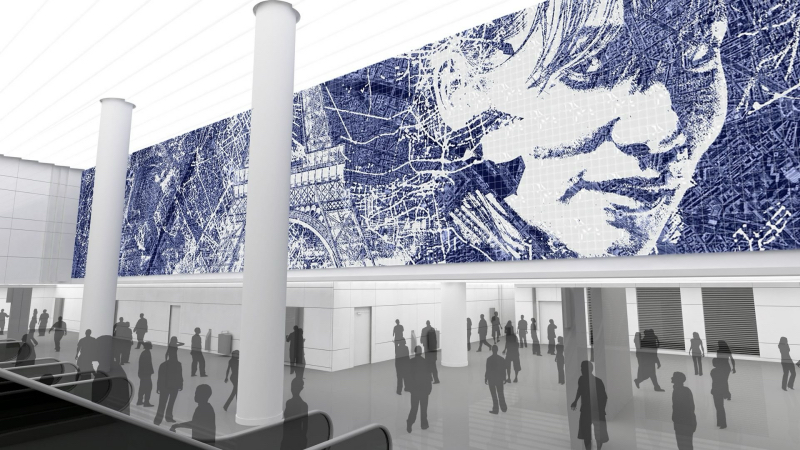
Paris transforms the metro into a contemporary art museum
The relationship between Paris and metropolitan art is certainly nothing new. As early as the beginning of the 20th century, Hector Guimard, architect and Art Nouveau designer, had given shape to the iconic metro entrances, some of which still dot the city today as portals to another world. A permanent museum dedicated to Guimard will open in 2028, inside the Hôtel Mezzara, which is currently undergoing renovation. The project is promoted by the Le Cercle Guimard association and supported by collector Fabien Choné.
The new cultural programme is called L’Art du Grand Paris.
The four lines planned for the Grand Paris Express will host over 70 permanent installations, designed not only as decoration but as true works of contemporary art in dialogue with the city and local communities.
The stations will become immersive exhibition spaces, capable of hosting events, performances and participatory projects.
Among the artists involved are Sophie Calle, JR, Noémie Goudal, Hicham Berrada and other big names on the international scene. Each work is site-specific, designed to interact with the neighbourhood that hosts it.
The official website Art du Grand Paris offers a detailed overview of each project.
Grand Paris Express: a plan to change the face of the city
The Grand Paris Express is much more than a transport network. With a total investment of €35 billion, Paris is preparing to build four new metro lines, 200 kilometres of track and 68 stations to facilitate travel between the suburbs and the city centre. In 2023, an exhibition at the Cité de l’Architecture et du Patrimoine recounted the evolution of this undertaking, from the origins of the metro to the construction sites currently underway and cutting-edge technologies.
The entire project has been described as “the largest urban construction site in Europe” and is set to radically change the mobility, architecture and visual identity of the French capital.
Public art as a sign of identity
The project’s curatorial team is led by José-Manuel Gonçalvès, former director of the Centquatre-Paris cultural centre. He has collaborated with experts, curators and conservators to select artists capable of recounting urban transformations in a profound and symbolic way.
The stated goal is ambitious: to create an underground museum open to all, capable of reflecting the diversity and richness of the areas crossed by the new metro.
In addition to the aforementioned Kiefer, Pistoletto and Jospin, Daniel Buren, Otobong Nkanga, Petrit Halijaj, Xavier Veilhan, Joana Vasconcelos, Loris Cecchini and Mona Hatoum are also participating. A reference station has already been identified for each artist, and the projects have been unveiled through models and renderings.

Grand Paris Express: some works not to be missed
At Le Bourget aeronautical centre station, Mona Hatoum will create a floating luminous sphere, evocative and poetic. Eva Jospin, inspired by Fellini’s film Roma, will enliven the Hôpital Bicêtre stop with her famous pressed cardboard sculptures. At Versailles-Chantiers, Anselm Kiefer will contribute a monumental 16-metre-long work, set within a transparent structure designed by Dietmar Feitchinger. Michelangelo Pistoletto will illuminate the Champigny Centre station with the phrase “Love Differences”, written in 16 languages and rendered in coloured neon letters.
Finally, at Saint-Denis Pleyel, the collaboration between Prune Nourry and Kengo Kuma will give life to 108 Venuses sculpted from local clay, a project that combines art, nature and architecture.
Paris has decided not to limit itself to building new metro lines but to transform them into a gigantic collective work of art. An invitation to slow down, observe and allow oneself to be surprised even in an everyday place like a metro station. Because when art inhabits the city, it changes the way we experience it.

Follow me on:
About me
In this blog, I don't explain the history of art — I tell the stories that art itself tells.