

The charm of the unfinished in art
There are works that seem incomplete, suspended, as if the artist had put down their brush for just a moment. Works that, instead of closing in on a definitive form, remain open to doubt, thought and imagination. This is where the unfinished comes into play, one of the most fascinating and complex categories in art history.
The unfinished is neither a lack nor a mistake. It is a choice, sometimes conscious, sometimes imposed by circumstances, which transforms the work into a visible process, a trace of creative thought still in motion.
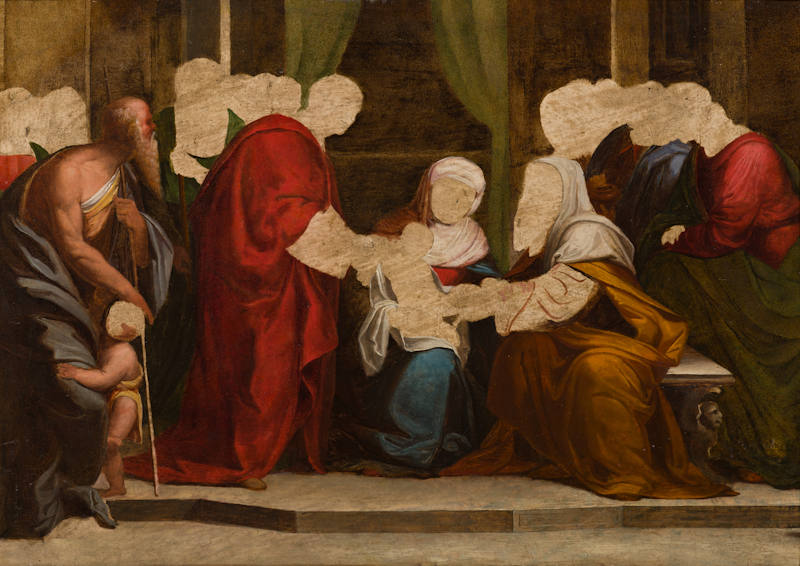
Benvenuto Tisi detto il Garofalo, Circoncisione
What is truly unfinished in art?
When a work remains open and speaks directly to the viewer
In common parlance, the term “unfinished” suggests something incomplete. In art, however, it indicates a poetic and conceptual condition in which the work shows its stages of construction, rethinking and corrections, allowing the artist’s gesture to emerge.
Since ancient times, the unfinished has been perceived as possessing a particular power.
Pliny the Elder recounts that Apelles’ Venus of Cos, which remained unfinished, was considered superior to many perfectly completed works in terms of expressive intensity. No one dared to complete it, because that apparent emptiness already contained everything.
From Michelangelo’s Pietà Rondanini, his last and unfinished work, to Guido Reni, the unfinished becomes a visual strategy capable of engaging the viewer. The work does not offer itself as an answer, but as a question. The observer is called upon to mentally complete what has not been defined, activating a profound imaginative process.
The unfinished as a space for creative thought
Observing an unfinished work means entering the artist’s studio and also means looking beneath the surface, picking up on traces of the preparatory drawing, variations in pose, and changes in meaning that occurred during the work.
In many unfinished paintings, revealing details emerge: a hand redrawn several times, a modified gaze, a shifted figure. All this tells us that art is never a linear gesture, but a continuous dialogue between idea and matter.
In this sense, the unfinished makes visible what usually remains hidden. The work becomes a thought in progress, not a finished object. Precisely for this reason, it often appears more alive, more restless, more contemporary.
Technique, pentimenti and invisible choices
Today, thanks to non-invasive diagnostic techniques such as X-rays, infrared reflectography and spectroscopic analysis, it is possible to literally enter inside paintings. These tools allow us to see what the eye cannot see: underlying layers, erased drawings, structural rethinking.
The unfinished does not only concern the visible surface, but also what lies beneath.
Scientific investigations show that many works considered “incomplete” are actually the result of long and complex processes, in which the artist continuously reworked form and content.
In some cases, the unfinished coincides with a transformation of meaning. A painting may have been modified to change the original message, deliberately leaving some parts unresolved.
The work thus becomes a stratification of times, intentions and meanings.
The role of the observer in front of the unfinished
When faced with an unfinished work, the viewer does not remain passive. The brain activates a compensatory mechanism, trying to complete what is missing. Observation becomes participation.
This involvement makes the unfinished surprisingly relevant.
The work does not impose a single interpretation, but invites us to construct it. Every glance adds something, every interpretation becomes part of the creative process.
Perhaps this is precisely why the unfinished runs through the entire history of art and continues into the contemporary world. In a world that seeks quick answers and perfectly defined images, the unfinished reminds us of the value of uncertainty and complexity.
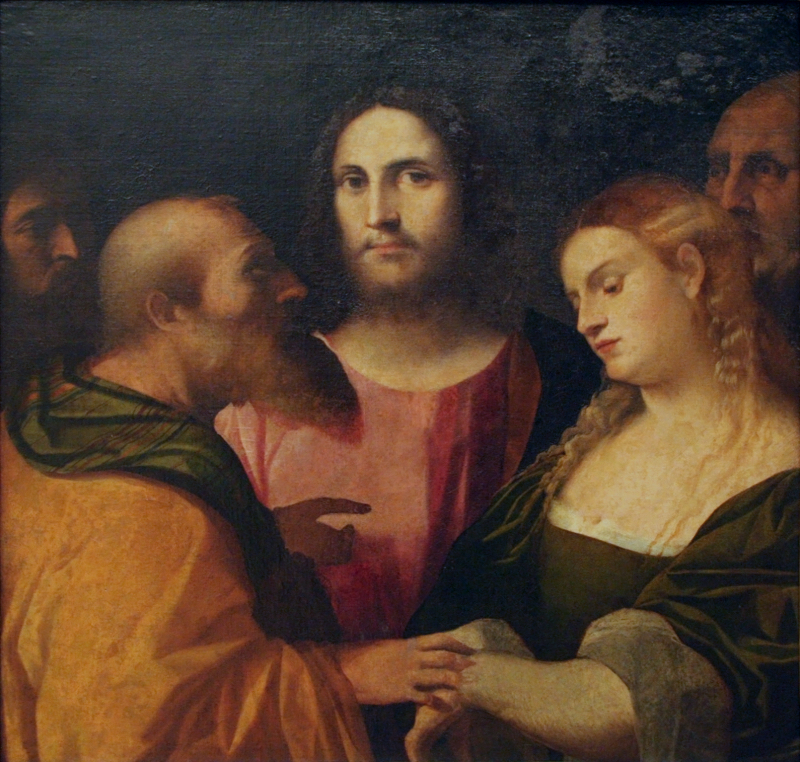
“Cristo e l’adultera” di Jacopo Palma il Vecchio.
From unfinished to reworked
‘Christ and the Adulteress’ by Jacopo Palma il Vecchio.
This work is a special case study: rather than simply being unfinished, it has been repainted to alter its original meaning. Left unfinished at the painter’s death, it was partially repainted at a later date, leaving some parts unresolved. Visitors can browse through digital images to see the results of digital radiography, infrared reflectography, UV fluorescence and MA-XRF, which highlight the modifications made to the work and the changes made to the adulteress’s gaze, her hair and the position of Christ’s hand.
Where to explore the theme today
The theme of the unfinished is at the heart of the exhibition project “Il non finito: fra poetica e tecnica esecutiva” (The unfinished: between poetics and technique), hosted at the Pinacoteca dei Musei Capitolini in Rome from 15 January to 12 April 2026.

Follow me on:
About me
In this blog, I don't explain the history of art — I tell the stories that art itself tells.