
Jack Vettriano: the painter of desire that critics never understood
The story of Jack Vettriano, born Jack Hoggan, seems to come straight from the pages of a novel from another era. Bornin 1951 in the county of Fife, on the east coast of Scotland overlooking the North Sea, he grew up in a modest family linked to the mining industry. From an early age, he worked to contribute to the household expenses. At sixteen, he left school and became an apprentice mining technician, embarking on a destiny marked by hard work and daily survival.
The turning point came unexpectedly at the age of twenty-one, when he received a set of brushes and watercolours as a gift. He thus began to paint as a self-taught artist, copying famous paintings and experimenting with his own subjects, driven by a deep need to tell stories through images. For him, painting was a refuge but also an escape: the path to a different life, made up of beauty, emotions and desire.
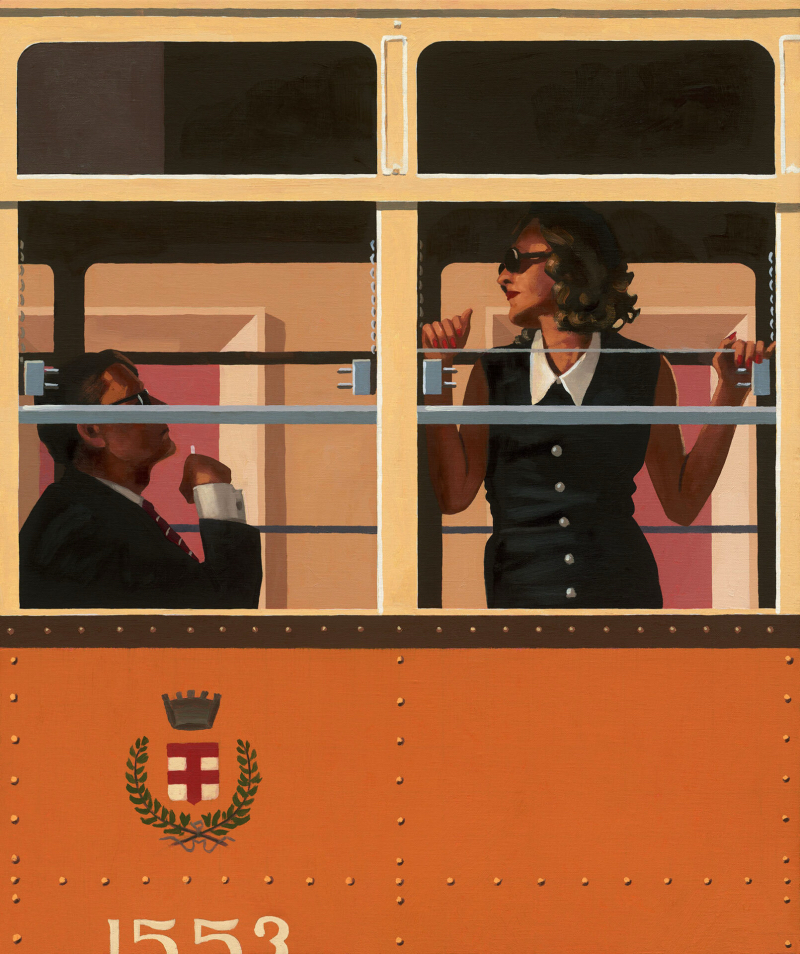
Jack Vettriano, The Look of Love, 63.7×73.7cm, opera su carta museale, 2010
Jack Vettriano: the painter of desire, between noir romanticism and cinematic atmospheres
His professional career only took shape in 1988, when he exhibited for the first time at the Royal Scottish Academy in Edinburgh. It was a dazzling debut: his two paintings were sold on the first day of the exhibition. From that moment on, his name began to circulate, but it was not the one he was born with.
To mark his new artistic identity, he chose an elegant and mysterious-sounding surname: Vettriano, taken from that of his mother, the daughter of an Italian emigrant from the province of Frosinone. He moved to Edinburgh and then to London, where he made a name for himself on the international market thanks to his recognisable and seductive style.
Despite this, his relationship with official critics remains stormy. He is often criticised for an aesthetic that is too commercial, illustrative, distant from the avant-garde and the codes of contemporary art.
Yet the public loves him. His works sell, prints of his paintings decorate homes and galleries, and his exhibitions attract record numbers of visitors. The reason is simple: Vettriano speaks to the soul, with images that seem to come from a dream, a period film or a noir novel.
Vettriano’s style: passion, mystery and poetry
Jack Vettriano’s pictorial universe is populated by men in tuxedos, charming women, nudes veiled in mystery and forbidden passions. His scenes take place in hotel rooms, sophisticated living rooms, private clubs or windy beaches, as in the famous work “The Singing Butler”: a couple dances on the shore, while a maid and a butler, armed with umbrellas, protect them from the rain. In the painter’s imagination, the butler sings Frank Sinatra’s “Fly Me to the Moon”, transforming the scene into a poignant hymn to romantic love.
Vettriano’s colours are warm and theatrical. The lighting is skilfully cut, as in a film set. Each painting is a story poised between eroticism and melancholy. His images seem like frames stolen from a Hitchcock film, a Raymond Chandler story or a bittersweet vintage dream.
The painter of restless love
The dominant theme in his works is love, but not the reassuring and serene kind.
Vettriano paints a restless love, made up of waiting, silence, unspoken tensions and unconfessable desires. His characters rarely look each other in the eye. They seem close but are actually distant, as if each were living their own inner drama. Sensuality is always present, never vulgar, always refined. The elegant clothes, measured gestures and attention to detail evoke a timeless aesthetic.
His women are strong, confident and dominate the scene. His men seem prey to unresolved emotions. The result is a fascinating visual world that combines seduction, nostalgia and poetry.
Popular success and official recognition
Vettriano’s commercial success peaked in 2004 when “The Singing Butler” was auctioned at Sotheby’s for almost £750,000, becoming one of the best-selling contemporary artworks in the United Kingdom. In the same year, Queen Elizabeth II appointed him an Officer of the Order of the British Empire (OBE) for his services to the visual arts.
Despite the scepticism of critics, his art continues to win over audiences around the world. His paintings speak a universal language: that of desire, memory and inner life.
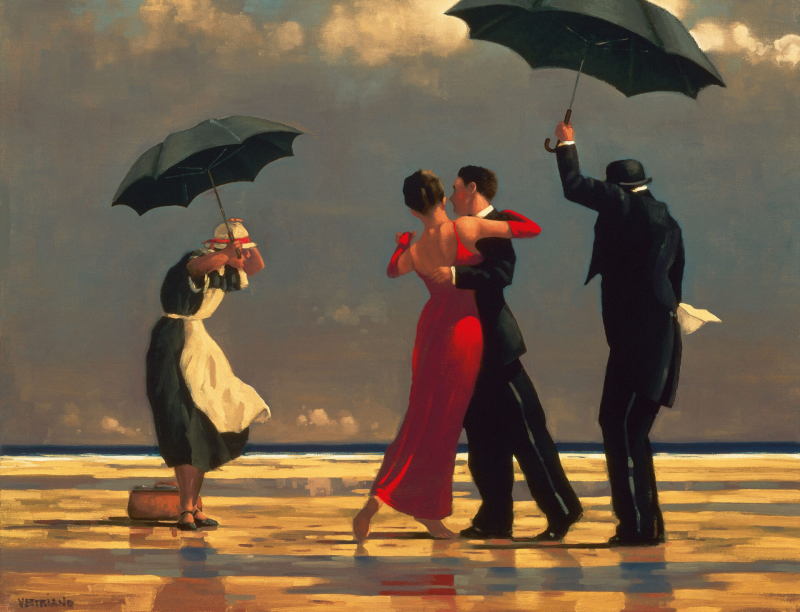
Jack Vettriano, The Singing Butler, 30×39 cm, opera su carta museale, 1992
Where to see Jack Vettriano’s works
There is a post from a long time ago on the blog featuring some of Jack Vettriano’s works. But if you want to see them in person, you will need to visit some private collections and museums in the United Kingdom.
The best way to get closer to his universe, however, is to visit the monographic exhibitions regularly dedicated to him in galleries in London, Edinburgh, Glasgow and major European capitals. Some of his paintings can also be admired in temporary exhibitions around the world, which celebrate his timeless style and imagery.

Follow me on:
About me
In this blog, I don't explain the history of art — I tell the stories that art itself tells.