

Giuseppe Bottani returns home: new exhibition at the Ducal Palace in Mantua
When I enter the rooms of a historic building and smell the scent of the recently completed restoration, it feels like I am breathing in time itself. This happens often in Mantua, but this time there is something more.
The Empress’s Apartment, inside the Old Court of the Ducal Palace in Mantua, reopens to the public with a new exhibition project entirely dedicated to Giuseppe Bottani, one of the protagonists of Italian Neoclassicism. A cultured, elegant artist, celebrated throughout Europe. But also an academy director who left a strong and lasting mark on the cultural life of Mantua.
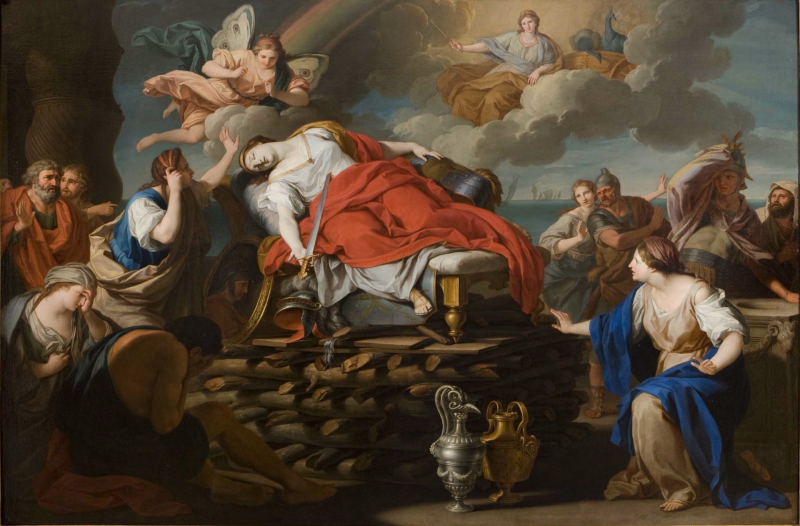
Giuseppe Bottani, Morte di Didone
The Empress’s Apartment: a restoration that tells a story
The project, curated by Ilaria Mensi, focused on the splendid tapestries in the Yellow Drawing Room, also known as Hercules’ Drawing Room.
The refurbishment, coordinated by director Stefano L’Occaso with the support of a team of art historians and architects, has restored elegance and coherence to the rooms, creating a true homage to the Cremonese painter who found his consecration in Mantua.
The exhibition, which is part of the regular tour of the Ducal Palace at no additional cost, brings together some of Bottani’s key works.
An exceptional triptych in Mantua to celebrate Bottani
The centrepiece of the new space is the canvas depicting The Death of Dido (circa 1770-1775), recently acquired thanks to the contribution of the General Directorate of Museums in Rome. Alongside it, two other masterpieces on free loan enrich the exhibition: Allegory of the Arts and Trades Revived by Maria Theresa (1771), on loan from the Fondazione Banca Agricola Mantovana, and The Birth of Venus (1770), on loan from Banca Monte dei Paschi di Siena.
In addition to these, there are four portraits from the Accademia Virgiliana, depicting Maria Theresa of Austria and senior officials of the Habsburg administration, as well as a rare self-portrait of the artist, on loan from the Galleria Mossini in Mantua.
The works on display allow visitors to explore the main genres addressed by Bottani: history painting, allegory and official portraiture.
This journey reveals the variety and refinement of his pictorial language.
Bottani: an artist between Florence, Rome and Mantua
Giuseppe Bottani was born in Cremona in 1717 and trained in Florence and then Rome, where he frequented influential artists such as Antonio Puglieschi, Vincenzo Meucci and Agostino Masucci.
During his career, he received numerous awards, including admission to the most important Italian academies.
In 1769, he was appointed director of the School of Painting at the Academy of Fine Arts in Mantua, where he worked until his death in 1784. His arrival marked a real turning point for the city.
He took over from Giuseppe Bazzani and brought with him a new artistic vision, linked to Enlightenment thinking and the rigour of Neoclassicism.
Bottani and painting as a discipline
With Bottani came a new style of painting to Mantua, no longer spiritual or ecstatic, but rational, with a specific educational function. It was an art that aligned itself with the ideals of the Enlightenment and the enlightened patronage of the Habsburg administration.
Under his guidance, the Mantua Academy became a renewed cultural centre, ready to train new artists according to rigorous but modern principles, capable of dialogue with Europe.
A collaborative project
The new exhibition is not only a tribute to an artist, but also a virtuous example of synergy between public and private institutions. The scientific project was curated by Stefano L’Occaso with Giulia Marocchi and Silvia Merigo, the restoration of the tapestries was directed by Daniela Marzia Mazzaglia, while the new exhibition layout bears the signature of architect Verena Frignani.
The result is an elegant, coherent space, designed to give visitors not only the works, but also the context and atmosphere of the period.
Have you ever heard of Giuseppe Bottani?
If you pass through Mantua, enter the Ducal Palace and let yourself be surprised. You will find yourself in front of an artist who made history, but whom we can finally rediscover with new eyes today.
Share this article with anyone who loves Neoclassicism, or with anyone who needs another excuse to return to Mantua.

Follow me on:
About me
In this blog, I don't explain the history of art — I tell the stories that art itself tells.