

Andrea Mantegna sculptor: the discovery of Saint Euphemia of Irsina
Among the many geniuses of the Italian Renaissance, Andrea Mantegna has also become a sculptor, thanks to a discovery made in 2006.
Until 2003, we only knew of his genius for his great paintings. With the restoration of a sculpture kept in the cathedral of Irsina in the province of Matera, and a careful study by Dr. Clara Gealo, a treasure hitherto unknown came to light: The Statue of St. Euphemia, an early work sculpted by Andrea Mantegna.
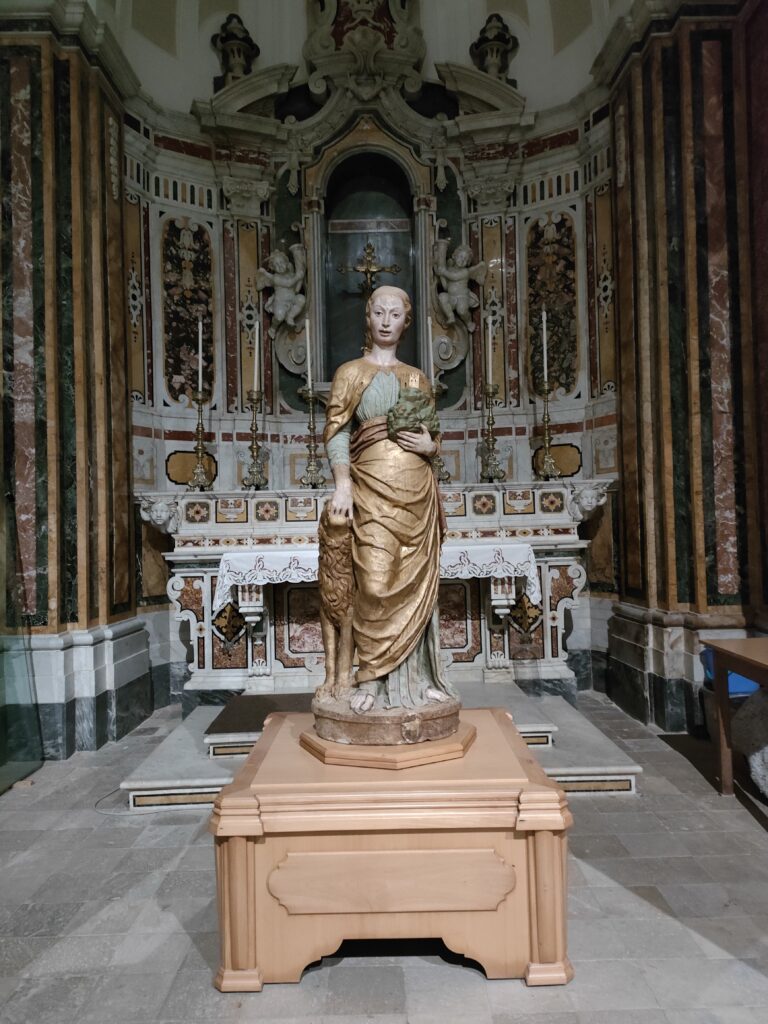
Andrea Mantegna, Sant’Eufemia di Irsina
Andrea Mantegna sculptor: the surprising discovery of Sant’Eufemia di Irsina
A heritage of great value, it is a very rare example of the sculptural work of the Renaissance artist, mentioned in historical sources.
The pride and gentleness in her gaze give the impression that the block of Nanto stone from which she was carved is moving and coming to life. The sculpture of Saint Euphemia of Irsina represents the perfect synthesis between Renaissance innovations and classical composure that coexist in Mantegna’s art.
Saint Euphemia, the Great Martyr, born into a Christian family in Chalcedon in Asia Minor, died in 303, martyred because she refused to renounce her Christian faith during the last persecution of Emperor Diocletian.
The imposing statue in the round, sculpted and painted around 1453 by Andrea Mantegna, is 1.72 meters tall and weighs approximately 3.50 kilograms.
The scholar recognized strong Mantegan characteristics in the sculpture, in the meticulous drapery and the construction of the classical face, comparable to the paintings of the great artist. The comparison with Saint Justina in the San Luca polyptych (now in Brera), painted in the same years, which shows the saint as very similar in both composition and drapery to the Lucanian sculpture, helped Gelao in her attribution.
The story of the discovery is fascinating, because the sculpture had been there, in the chapel dedicated to the patron saint of Irsina, since 1454, but no one before Gelao had noticed the charm and quality of the pose and workmanship. Neither the parish priests nor the faithful could have imagined that the object of their devotion had come from the hands of a Renaissance artist.
The sculpture was relocated in the 18th century to the beautiful chapel named after her, next to the high altar, at the end of the right aisle, covered with precious polychrome marble, in a gray marble niche that distinguishes it from the multicolored background.
Following the 18th-century refurbishment, the statue was repainted in its vestments and chiseled at the top of the head to allow for the placement of a silver crown, which has since been removed.
It remained in the altar niche until it was moved in 2006, when it was the star of the exhibition in Mantua for the 500th anniversary of Andrea Mantegna’s death. Today, it stands in the center of the same chapel on a wooden base, where it can be admired in its entirety.
The martyr is depicted standing, like a classical statue, with her right leg slightly forward, wrapped in a sage green dress and wearing a golden checkered pattern on her red wrists; The dress is gathered at the waist and is partly concealed by the beautiful golden mantle, with elegant drapery from which three symmetrical, smooth folds unfold, resting on the base and revealing the feet and finely carved shoes. The golden chlamys deserves a closer look. Starting from the saint’s neck and tightening at the waist, it falls softly over her body, hinting at her anatomy, and is elegantly tied at her left hip. On the cloak, above her chest, there is still a clearly visible slit that must have held a sword, perhaps made of silver, now lost, symbolizing one of the many martyrdoms she suffered.
Her left hand holds a model of the city of Montepeloso, with its walls and the three hills on which it stands clearly visible; her right hand, on the other hand, is inserted into the jaws of the lion next to her, the cause of the young saint’s martyrdom.
Her face is slightly turned to the right and hints at a faint, mysterious smile. Her gaze is attentive and her lips are parted, revealing just a glimpse of her teeth, giving the impression that the saint is about to speak and lending her an extreme naturalness.
The back is sculpted with extraordinary care and attention to detail. Her hair falls softly and lightly over her shoulders. The lion, fierce and imposing at the front, becomes docile at the back, with its tail between its legs, like the most docile of domestic animals.
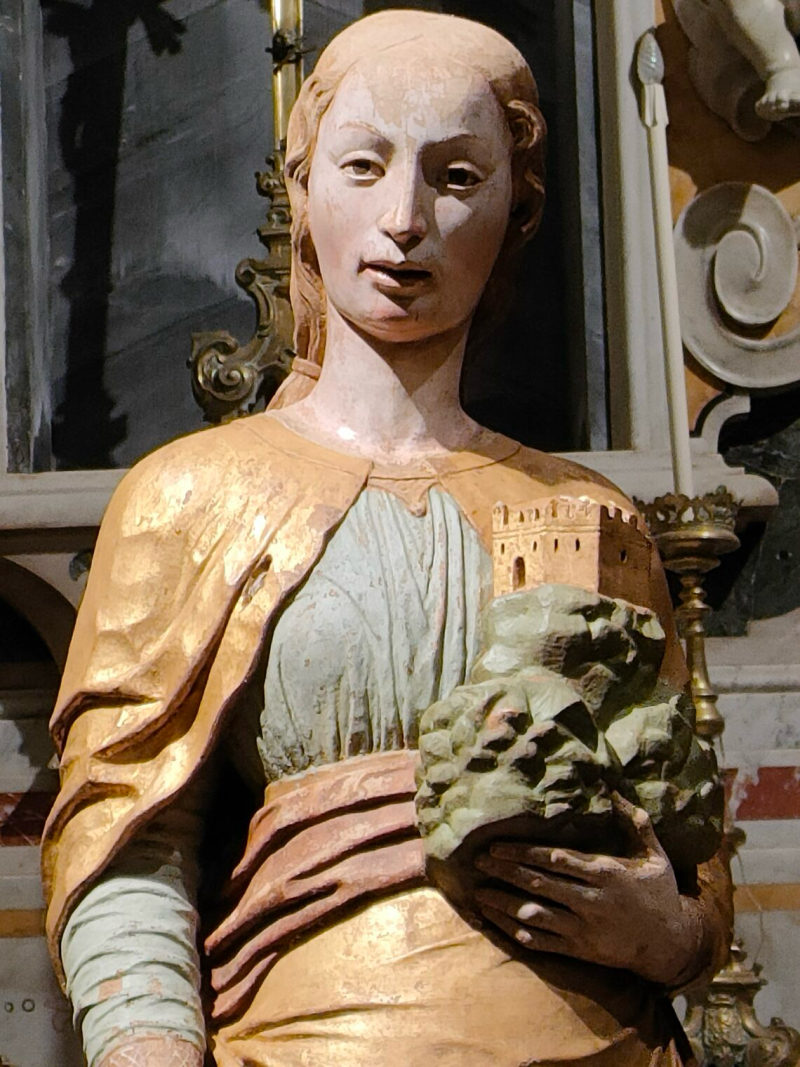
Andrea Mantegna Sant’Eufemia di Irsina, dettaglioIn 2008, the Louvre Museum also welcomed it, hosting it during the beautiful exhibition in honor of the Renaissance genius.
On the occasion of the Paris exhibition: Mantegna (September 22, 2008-January 16, 2009) curated by G. Agosti and D. Thiébaut, Louvre, Hall Napoléon; the Municipality of Irsina and the Basilicata Tourist Board commissioned LogicFilm (www.logicfilm.com) to produce a commercial entitled Irsina Parigi A/R by Antonio Rosano, which highlights not only the artistic beauty but also the visual charm of a Renaissance work that enchants the contemporary viewer.
Through his lens, the director has captured the serious and proud gaze of an ancient beauty, superimposing images that convey the movement of the body and the harmony of the garments. The direct light and 360° images give us the ideal of beauty in the classical manner, while the color of the wood, the folds of the dress, and the movement of the hair introduce her into a real dynamism in which even the soul of the saint gives us a slight and shy smile, despite the filter of the camera.
With the video, therefore, we gather unique emotions and sensations, bringing a work of art back to life and offering us an uncontaminated masterpiece of Italian art, despite the fact that there is a camera between us and the sculpture.

Follow me on:
About me
In this blog, I don't explain the history of art — I tell the stories that art itself tells.