

Banksy and the Migrant Child in Venice: a work to preserve or let fade away?
They cut it off like dangerous mold, claiming they had to save it. Banksy’s work Migrant Child, which appeared in Venice in 2019, has been removed from the wall of a building in San Pantalon and locked away in a climate-controlled vault, under the watchful eye of restorers, technicians, and officials.
However, I cannot be happy and cannot help but ask myself a question:
Are we sure it is right to save Banksy’s Migrant Child?
The Banksy case and Migrant Child in Venice
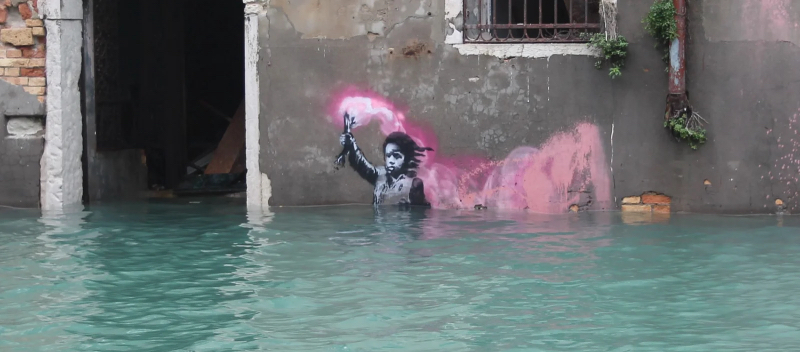
A child representing all children searching for a different future.
Let’s start here: Migrant Child is much more than a drawing on a wall, because it is a work designed to be fragile, exposed, subject to the Venetian tides, humidity, and salt air. This child, or perhaps it would be better to say migrant, is holding what looks like a pink signal rocket. A silent but visible cry for help.
In reality, if we look closely, it is not a smoke bomb but brushwood or roots, symbolizing uprooting from one’s homeland in an attempt to build a better future.
When the water rises with the tide, the child seems to be drowning, calling for help. When the tide goes out, the child seems to be miraculously walking on the lagoon. In any case, he looks at us, challenges us and disturbs us.
That child is asking for our attention in Venice, the tourist capital of the world, where thousands of people take selfies and sip spritzes, often unaware that, in the same waters of the Mediterranean, reality is drowning.
Migrant Child: a work that was destined to disappear
Banksy knew very well that this work was not meant to last. Like many of his works, Banksy created Migrant Child to be ephemeral, destined to disappear, to be corroded by time and salt. I believe that this was precisely the message: migrant children are asking for help, they shake us up, they outrage us for a moment, but then they vanish from our consciousness as quickly as waves erase a drawing on the sand.
It is our memory, rather than the plaster, that is fragile.
So I ask myself: what is the point of removing it from there on the pretext of saving it?
Taking it away, restoring it, preserving it in a temperature-controlled vault means betraying its nature, turning it into a collector’s item, a trophy to be displayed in a gallery.
A living work, designed to be at the mercy of the world, has become an untouchable relic, and to me, honestly, it hurts.
Is the rescue of Migrant Child protection or appropriation?
Of course, some will say, “But we’re saving a masterpiece!”
What exactly are we saving?
The pigment? The wall? Or the economic value that has skyrocketed in the meantime?
I have the feeling that the urgency to protect this work is not motivated by its message, but by its brand. It’s a Banksy, so it’s valuable. If it had been drawn by an unknown street artist, it would have been wiped away by the first restoration of the facade, with no climate-controlled vault waiting for it.
Furthermore, if we save her, why don’t we save the other children, the real migrants, the ones who actually cross the sea? The work was about them, who have no restorers, no vaults, no banks willing to protect them and spend the money necessary to offer them the better future they seek, even at the cost of their lives.
If you didn’t know, it is actually a bank, Banca Ifis, that now owns the work, having purchased Palazzo San Pantalon in 2024, on which Banksy created Migrant Child in 2019. The interest in purchasing the building was made possible by the presence of the work, which the bank claims it wants to protect and enhance.
However, doubts arise. Did the new owner get a bargain by purchasing the building or the artwork incorporated into it, which has now been removed but can be displayed to paying members of the public and loaned out for exhibitions and events?
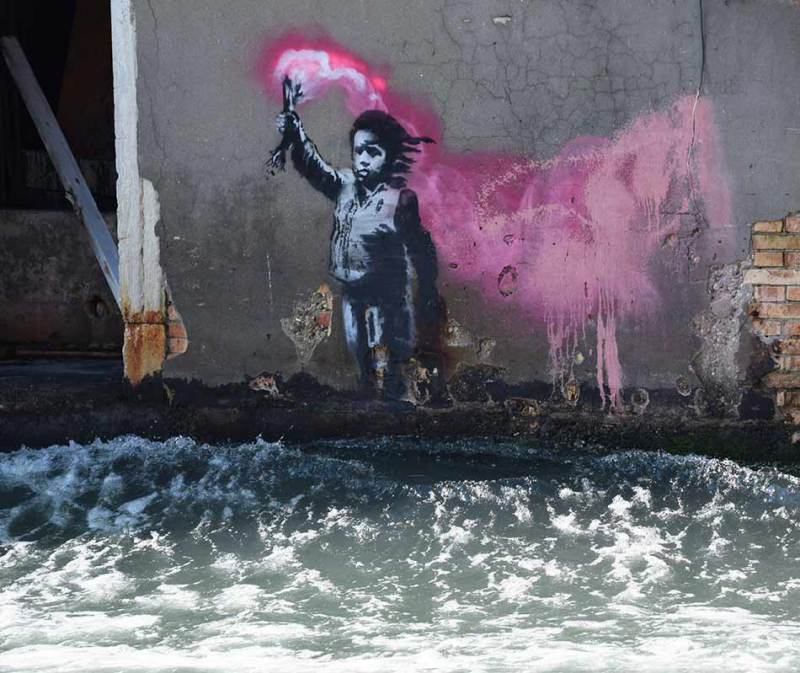
Banksy is not an artist for the living room. His works are not meant to be framed, but to make us uncomfortable, to be there, in the real world, with all their poetic and political power.
“Migrant Child” was a painful reminder that while we visit cities of art, there are those who die trying to reach them.
Now that reminder has been archived, rendered harmless, and it seems to me that we have lost something important. Moreover, it is no longer accessible to all those who visit Venice, but perhaps it will be in the future, only at the price of a ticket.
Who do we really want to save?
Perhaps this is the point: saving a work of art does not necessarily mean saving its meaning.
Migrant Child should have stayed there, fighting against the water, against time, and against our conscience. It should have disappeared before the eyes of tourists, just as the tragedies we forget too quickly disappear before our eyes.
Under the pretext of protecting it, it has been killed, and the message of a masterpiece has been anesthetized, and so… it is no longer a masterpiece but a relic, or a trophy to be displayed.
Meanwhile, outside the vault, the sea continues to swallow up stories that no one will ever restore.
What do you think? Is it right to ‘save’ a work of art that was meant to fade away?
Write to me in the comments: should art be preserved… or left to live and die like everything else that is human?

Follow me on:
About me
In this blog, I don't explain the history of art — I tell the stories that art itself tells.