

Bernini and the Barberini family in Rome, the Baroque exhibition
If you love Baroque art and want to truly understand how it came about, mark these dates in your calendar. From February 12 to June 14, 2026, the National Galleries of Ancient Art will present the major exhibition Bernini and the Barberini at Palazzo Barberini, a project that promises to rewrite the way you look at the works of Gian Lorenzo Bernini and 17th-century Rome.
This is not just an exhibition about an artist, but a journey into an alliance that changed the history of European art.
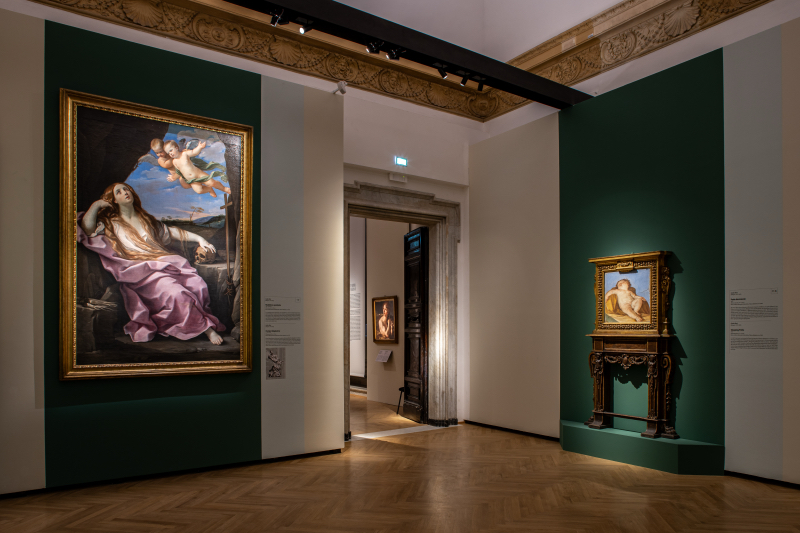
Bernini and the Barberini family in Rome, the exhibition that tells the story of the birth of Baroque
In 1623, Maffeo Barberini became pope under the name of Urban VIII.
Even before ascending to the papal throne, he had already recognized the extraordinary talent of a young sculptor, Gian Lorenzo Bernini. He supported him, encouraged him, and freed him from the shadow of his father’s workshop. With him, the prodigy became a universal artist.
The exhibition, curated by Andrea Bacchi and Maurizia Cicconi, reconstructs for the first time the personal, intellectual, and political relationship between Bernini and his great patron.
Coinciding with the 400th anniversary of the consecration of St. Peter’s Basilica, which occurs this year, the exhibition demonstrates that Baroque did not arise from a generic stylistic evolution, but rather from a precise and powerful relationship between artist and patron.
If you have ever wondered when Baroque really began, here you will find a clear and documented answer.
An exhibition event to enter the heart of Baroque
The exhibition is divided into six sections and follows Bernini’s creative evolution from his beginnings to full maturity.
From the very first rooms, you understand that the future Urban VIII was the true discoverer of Bernini’s genius.
Works created together with his father Pietro dialogue with autograph masterpieces such as San Lorenzo in the Uffizi and the monumental San Sebastiano, now in France, presented exceptionally in Italy.
It is precisely in the comparison between these sculptures that the emergence of a new language can be perceived. The sensual rendering of the marble, the naturalness of the poses, and the emotional involvement of the viewer anticipate the revolution we call Baroque.
A central section is dedicated to the construction site of St. Peter’s, the symbolic theater of the alliance between pope and artist. The Baldacchino becomes the fulcrum of a narrative that intertwines architecture, sculpture, and decoration in a single scenic machine. Drawings, models, and engravings accompany you inside Bernini’s creative workshop, making you understand how daring that undertaking was, entrusted to an artist barely over twenty-five years old.
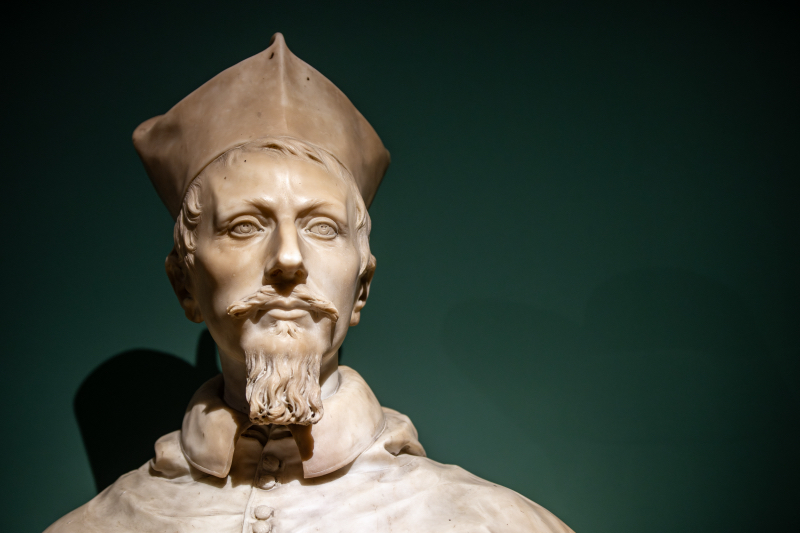
The exhibition continues with papal portraits, including marble and bronze busts from international museums. The series dedicated to Urban VIII, never before brought together in such a comprehensive way, allows visitors to observe how the pope’s face gradually transformed into the absolute image of spiritual and temporal power.
Palazzo Barberini as a manifesto of 17th-century Rome
One section is dedicated to Palazzo Barberini, the venue for the exhibition and symbol of Barberini’s Rome. Here, Bernini dialogues and competes with Borromini and Pietro da Cortona in a choral architectural project that blends urban palace and suburban villa.
Drawings, models, and paintings from the ancient Barberini collection recreate the cultural climate of a unique era.
The exhibition is enriched by an anthology of busts depicting the court of Urban VIII.
Cardinals, intellectuals, courtiers, and eccentric figures make up a surprising human mosaic. The comparison with artists such as Algardi, Duquesnoy, and Finelli highlights how lively and competitive the Roman scene was.
The last section tackles the most fascinating and delicate theme, that of Bernini’s creative freedom under the power of Urban VIII. Here you will find rarely exhibited works and the famous bust of Costanza Bonarelli, a portrait without a patron that conveys the intensity of a private relationship and marks one of the absolute peaks of Baroque portraiture.
Why visit the Bernini and the Barberini exhibition
This exhibition does more than just display masterpieces. It allows you to step into a decisive moment in European art history and understand how a human and political relationship gave rise to a language that would dominate the continent. It is a story that explores the role of Maffeo Barberini in the figurative culture of 17th-century art.
Rome in 2026 offers a unique opportunity to see works from museums and private collections, many of which are being presented for the first time in Italy. Booking your ticket in advance is a smart choice, especially if you want to avoid queues and enjoy your visit at your own pace.
Useful information
Bernini and the Barberini
curated by Andrea Bacchi and Maurizia Cicconi
National Galleries of Ancient Art – Palazzo Barberini
February 12 to June 14, 2026
If you want to truly understand how Baroque art came about and be amazed by one of the most powerful moments in art history, this is the exhibition to put on your calendar.
Buy your ticket, choose a date, and treat yourself to a total immersion in 17th-century Rome.
See you under the Baldacchino.

Follow me on:
About me
In this blog, I don't explain the history of art — I tell the stories that art itself tells.