

Children’s books
If you have opened this post, it means that you are looking not only for children’s books, but also for a way to explain art to your children and perhaps instil in them the idea that visiting a museum or an exhibition could also be fun.
The truth is that you hope to spend a pleasant Sunday at the museum sooner or later, with the hope of coming out feeling refreshed 😉
If, like me, you love art but the mere thought of visiting a museum with your children terrifies you, try to get them interested in art with children’s books first.
There are many books designed specifically for children but to be read together with them, to learn through play and to train their creativity and imagination.
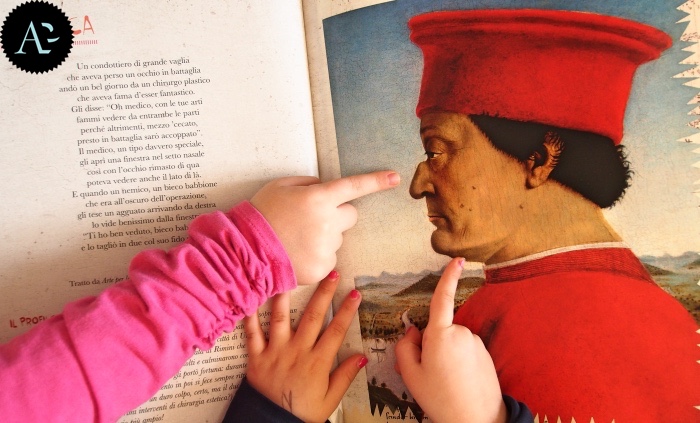
CHILDREN’S BOOKS: HOW TO EXPLAIN ART TO YOUR CHILDREN AND ENJOY VISITS TO MUSEUMS
When I think back to the first time I took my princesses to the museum, I have to laugh!
We went to the Doge’s Palace in Venice and, while I was trying to tell my eldest princess stories about the Republic of Venice, my husband did nothing but rush from one room to another with our youngest princess, who thought the palace halls were perfect for running around like crazy.
The result: I was disappointed, my husband saved on the gym that week, and the Princesses started crying halfway through.
I became convinced that you can’t just throw 2- and 6-year-olds into a museum without preparing them first.

La prima esperienza al museo: errori da evitare
Now my princesses are a little older, but when I read the book ‘Arte per crescere’ (Art for Growing Up) dedicated to Piero della Francesca with them, we spent a memorable afternoon and they asked me to take them to see the works of this artist, whom they had just discovered, in person.
The ‘Arte per crescere’ series is part of the ‘Creallenamente’ project, which aims to help children learn through play.
These children’s books are structured as fun brain teasers to train creativity but also the hands 🙂
How to explain art to your child
Each volume tells the story of the artist as if it were a novel, then focuses on their character and personality to better understand their style.
There will be plenty of questions, especially because your children will ask you the meaning of terms they have never heard before, such as “fresco” or “commission”, but each volume also includes a short dictionary to answer all their questions correctly and simply.
Finally, there is the practical section, a workshop to do with your children to help them better understand the artist.
In the book on Piero della Francesca, for example, there are step-by-step instructions on how to create a polyptych using white card.
My princesses made one together and when they saw a polyptych at the Uffizi in Florence, they recognised it immediately!
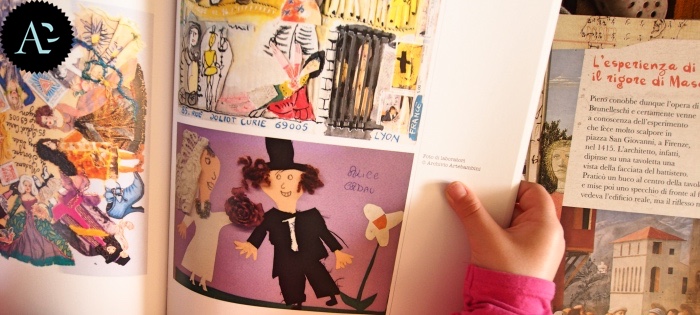
The editors of ARTE PER CRESCERE
The Creallenamente project follows pedagogical guidelines, and each volume is edited by Marco Dallari, professor of Pedagogy and Didactics of Art Education at the Academy of Fine Arts in Bologna and full professor of General and Social Pedagogy at the Department of Psychology and Cognitive Sciences at the University of Trento, and by Paola Ciarcià, lecturer and trainer in the field of pedagogy applied to art and cultural heritage.

Follow me on:
About me
In this blog, I don't explain the history of art — I tell the stories that art itself tells.