
Frottage: the technique loved by the Surrealists to make surfaces speak
Have you ever placed a sheet of paper on a coin and rubbed a pencil over it just to see what would appear?
Well, without knowing it, you were already doing frottage.
It’s not magic, but it’s close. Because frottage is one of those techniques that seem to have been created for fun, but which, in art, have had the power to unlock the unconscious, generate unexpected images, and give voice to the most anonymous surfaces in the world.
In this post, I want to tell you about it with the same amazement I felt when I first discovered it, in front of a work by Max Ernst that seemed to have come out of a dream.
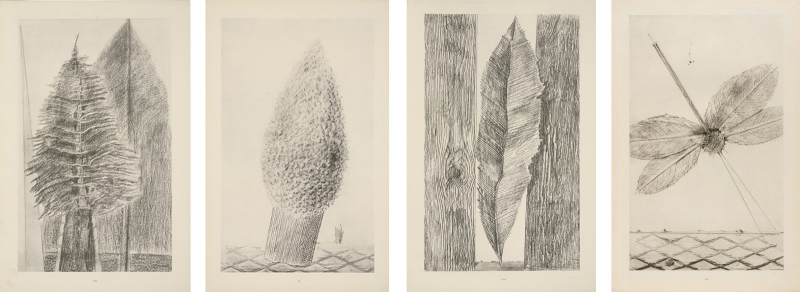
Bruno Munari, opere realizzate con la tecnica del frottage
Frottage: the secret technique, beloved by the Surrealists, for making surfaces speak
Frottage is an artistic technique that consists of rubbing a pencil (or other drawing tool) on a sheet of paper placed on a rough or textured surface.
From the French frotter (“to rub”), this practice allows the underlying textures to be transferred onto the paper,revealing often surprising shapes, lines, and patterns.
However, it is not just a matter of reproducing surfaces. In artistic frottage, in fact, the beauty lies in letting yourself be guided by the unexpected. The image that emerges is never entirely intentional, but is a dialogue between chance and intention, between matter and imagination.
Frottage as a gateway to the unconscious
The real revolution came in the 1920s, when Max Ernst, a Dadaist and Surrealist painter, discovered frottage in a hotel room.
He recounts that, observing the wooden floor, he began to imagine shapes hidden in the texture of the boards. He took a sheet of paper, placed it on the wood, and began to rub. That simple gesture became for him a key to unlocking the doors of the unconscious.
For Max Ernst, frottage was like a daydream: a way to free his imagination from any academic or rational constraints.
This led to the creation of a famous series: “Histoire naturelle” (1926), a collection of plates created using frottage that seem to illustrate the fauna and flora of another world, poetic and wild.
Who are the artists who have used frottage?
Although Max Ernst is its noble father, frottage has fascinated many other artists, each with their own personal style:
Hans Hartung: he used various tools to scratch and rub the surface of the canvas, creating visual effects very similar to frottage, often on a large scale.
Bruno Munari: in his workshops for children, he invited them to discover the world through frottage, combining art and play in an irresistible mix.
Giuseppe Penone: although he does not use frottage in the strict sense, his work with natural surfaces (bark, leather, leaves) captures its spirit: listening to the material and letting it speak.
Today, the frottage technique is also used in educational contexts, design, creative printing, and even street art by contemporary artists and illustrators.
How to try frottage (even at home)
Would you like to try it yourself? It takes very little and the results are always surprising.
What you need:
White sheets of paper
Pencils, charcoal or crayons
Objects with interesting textures: leaves, coins, fabrics, wood, metal grids, stones…
How to do it:
Place the sheet of paper on the chosen object.
Hold the sheet of paper steady.
With the pencil at an angle, rub lightly until the hidden image begins to appear.
Observe what emerges. Does it remind you of anything? You can complete it, modify it, transform it.
Be aware that frottage is not just a technique but a state of mind. It is listening, playing, surprise.
Don’t try to control it and let yourself be surprised.
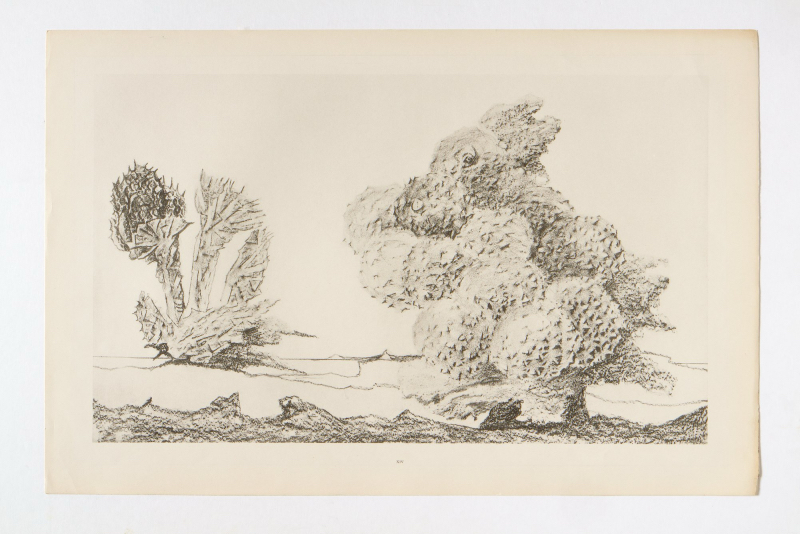
Max Ernst, Histoure naturelle
Why (re)discover frottage today
We live in a world where everything must be perfect, polished, predictable. Frottage, on the other hand, is an act of trust in chance, in matter, in imagination.
It is an invitation to slow down, to look at things in a different light, to find poetry in the details.
Finally, I want to write it down: there is something deeply liberating about rubbing a pencil and seeing an image emerge that we didn’t know we had inside us.
Frottage is an ancient yet very modern technique, used by extraordinary artists to explore the depths of the unconscious and give shape to the invisible.
Frottage is a simple, immediate, accessible… and very powerful technique.
I often use it when I need to reconnect with the material and with myself, and it surprises me every time.
Try it yourself and tell me what you discovered.
Have you ever used frottage in your drawings or creative projects? Write to me in the comments or tag me on social media with your artistic experiment!

Follow me on:
About me
In this blog, I don't explain the history of art — I tell the stories that art itself tells.