
Gastone Novelli: the artist and poet of Italian art
What happens when painting meets poetry, politics, philosophy and a touch of magic?
You discover Gastone Novelli.
A restless, visionary and profoundly free artist, Novelli was one of the most original figures in Italian art after the Second World War. Today, one hundred years after his birth, is the perfect time to rediscover him. His works seem to be written rather than painted, traced like cryptic messages for those whose eyes and hearts are attentive enough to decipher them.
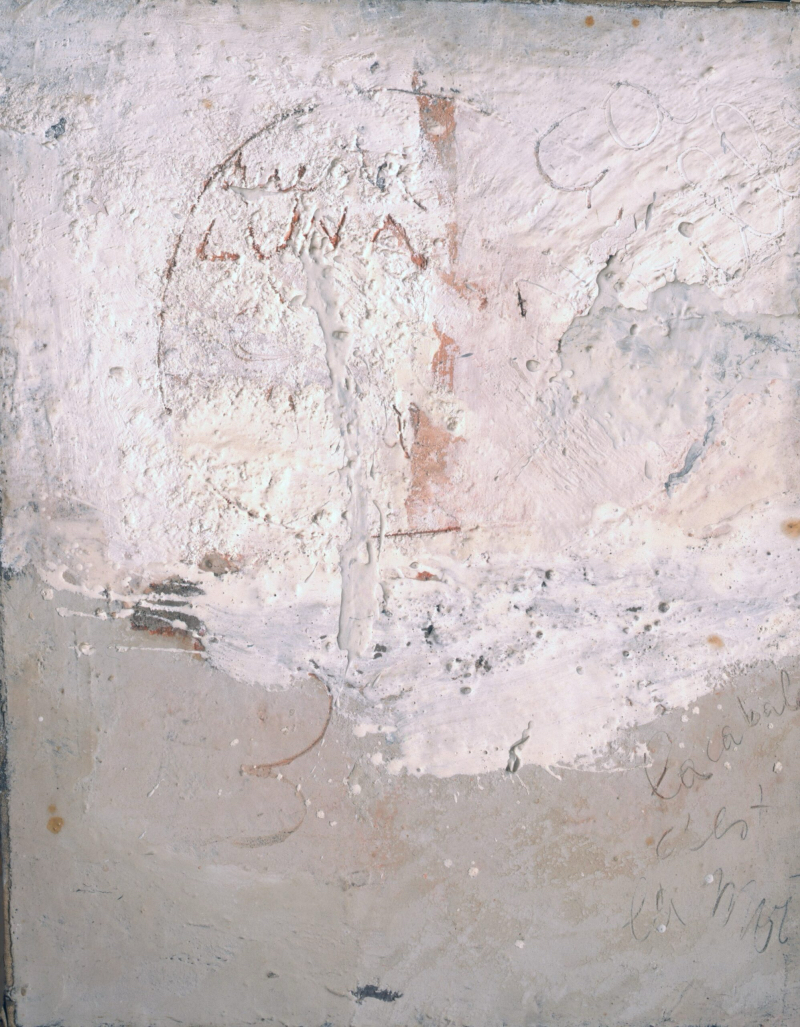
Gastone Novelli – Era glaciale – 1958
Gastone Novelli: artist and poet
If his name is new to you, let yourself be intrigued. I discovered Gastone Novelli in Saturnia during an exhibition that described his unique and rebellious artistic career.
On that occasion, I immediately understood that Novelli is not an artist to be contemplated in silence, but to be read, questioned and explored. His canvases are pages from a visual diary in which words, symbols, arcane signs and imaginary alphabets coexist.
Born in Vienna in 1925 and died prematurely in 1968, Gastone Novelli went through all the major artistic movements of his time in just over a decade, surpassing them each time.
In the 1950s, he approached Informal art, but immediately transformed it: matter became writing, gesture, thought. Works such as “Era glaciale” (1958) heralded a vision that mixed language and image in a mysterious dance that looked to Paul Klee, Licini and the European poetic avant-garde.
In the 1960s, his painting became populated with signs, letters, numbers and isolated words, often inserted into grids or boxes. The work thus becomes a mental atlas: the canvas as a blackboard, as a map, as a palimpsest in which jazz, linguistics, alchemy, psychology and literature coexist. Paintings such as “Thelonious”, “Dizzy” and “Il re delle parole” (The King of Words) are a universe to be deciphered, yet deeply evocative even at first glance.
The rebellious art of Gastone Novelli
Novelli was not only a lyrical and inventive artist, but also an intellectual deeply involved in his time.
His works often take a stand: from “Per una rivoluzione permanente” (For a Permanent Revolution, dedicated to Trotsky) to “Attenti al sergente Bond” (Beware of Sergeant Bond, inspired by the film “Thunderball”), everything in his work is a dialogue between imagination and reality, between dream and social criticism.
Then there is the symbolic and sensational gesture of 1968 when, during the Venice Biennale, Novelli turned his works towards the wall and wrote “La Biennale è fascista” (The Biennale is fascist) on the back. An act that consecrated him not only as an artist, but also as an uncomfortable and prophetic conscience.
A legacy yet to be discovered
Gastone Novelli was an alchemist of the sign, an artist who rejected all labels in order to construct a personal, layered and profound language.
His paintings are visual enigmas that seek not answers, but questions.
Today more than ever, in an age of facile messages and disposable images, his work invites us to slow down, decipher and listen. An artist to study, certainly, but first and foremost to feel.
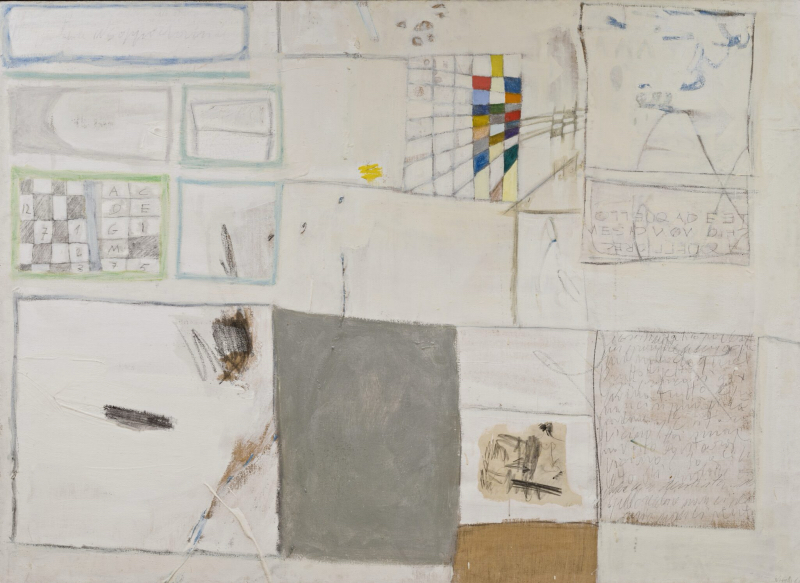
Gastone Novelli – Dizzy- 1960
Where to see Gastone Novelli’s works today
Gastone Novelli’s works can be found in various Italian and international museums and cultural institutions.
Here I will mention just one example, the 1961 work “Ari”, which is housed at the Museion Foundation, Museum of Modern and Contemporary Art in Bolzano. There are also numerous works by the artist in Milan, at the Prada Foundation. Abroad, Gastone Novelli’s works have become part of the British Museum in London and The Museum of Modern Art in New York (MoMA) and many other prestigious museums.
Until 1 March 2026, Ca’ Pesaro – International Gallery of Modern Art in Venice is dedicating a major monographic exhibition to him: an unmissable opportunity to retrace the highlights of his career in one of the city’s most evocative museums.
The exhibition is spread over eight rooms on the second floor of the museum and features around sixty works, including paintings, drawings and sculptures.

Follow me on:
About me
In this blog, I don't explain the history of art — I tell the stories that art itself tells.