

Giacomo Balla and the dynamism of a dog on a leash: when art runs fast
If you have ever taken a photo while moving and ended up with a blurred trail, you may have unwittingly captured the essence of an entire artistic revolution.
It was precisely there, in that simple, everyday gesture, that Giacomo Balla found the inspiration for one of the most striking paintings of Futurism: “Dynamism of a Dog on a Leash,” painted in 1912.
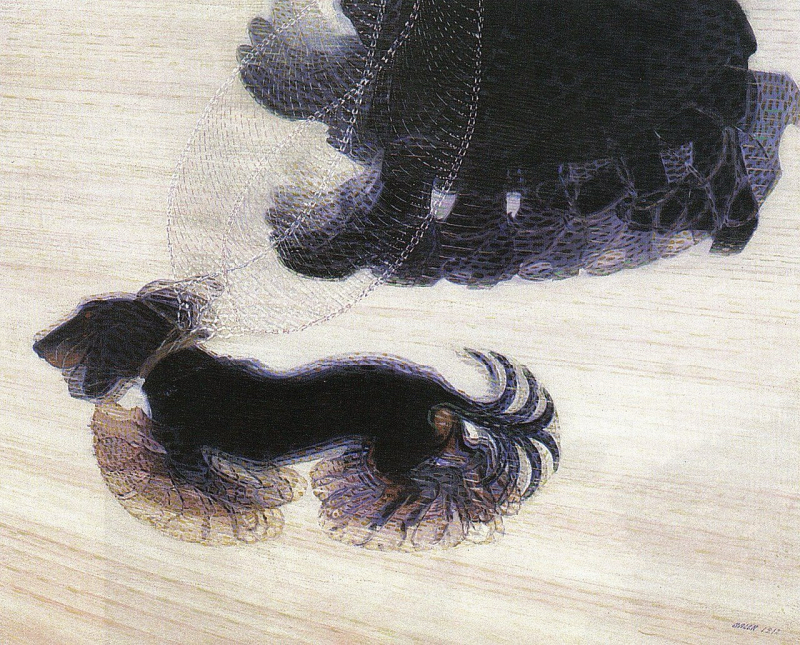
Giacomo Balla, Dinamismo di un cane al guinzaglio
Giacomo Balla and the dynamism of a dog on a leash: when art runs fast
The painting is small in size (only 89 × 109 cm), but it exudes extraordinary energy as Giacomo Balla depicts a simple scene: a woman walking a small dog on a leash. So far, nothing exceptional.
Yet, looking at the canvas, it is impossible to remain still: everything moves.
The dog’s paws, its owner’s legs, the tail, the leash… are multiplied as if in a photographic sequence. The result is a simultaneous vision of movement, almost as if the artist had painted every moment of a walk in a single image.
Staticity is banished. Everything vibrates. Everything runs.
Futurism and the race towards tomorrow
Dynamism of a Dog on a Leash by Giacomo Balla is not just a curious painting, but a manifesto of Futurist thought.
These were the years when Italian artists led by Filippo Tommaso Marinetti extolled speed, progress, machines, and expanding cities.
Balla, who joined Futurism in 1910, asked himself a question that was as simple as it was revolutionary: how can movement be represented in art?
With this painting, he gave a clear and visually powerful answer.
There is no need to paint a speeding train or a car because even a small dog can become a symbol of modernity, if observed with the right eye.
Painting or photography?
The technique used by Balla is clearly influenced by chronophotography, a photographic technique that broke down movements into sequences.
The most direct influence comes from the experiments of Étienne-Jules Marey and Eadweard Muybridge, pioneers of motion photography.
Balla, however, does not limit himself to imitating the photographic medium. He surpasses it.
In painting, in fact, he manages to synthesize and multiply movements, creating a sort of visual choreography that photography alone cannot reproduce.
A curiosity: why did he become the most famous dog in Italian art?
This tiny dachshund has become a pop icon.
Over time, he has been referenced, reinterpreted, animated, and even transformed into gadgets and posters.
It is not uncommon to find him in artistic memes or advertisements, and he is the perfect example of how a simple image can become a symbol of an entire era.
The beauty of it is that there is nothing heroic, monumental, or celebratory about it: it is just a dog walking as seen through the eyes of an artist capable of breaking the mold, and for this reason, it becomes a revolution.
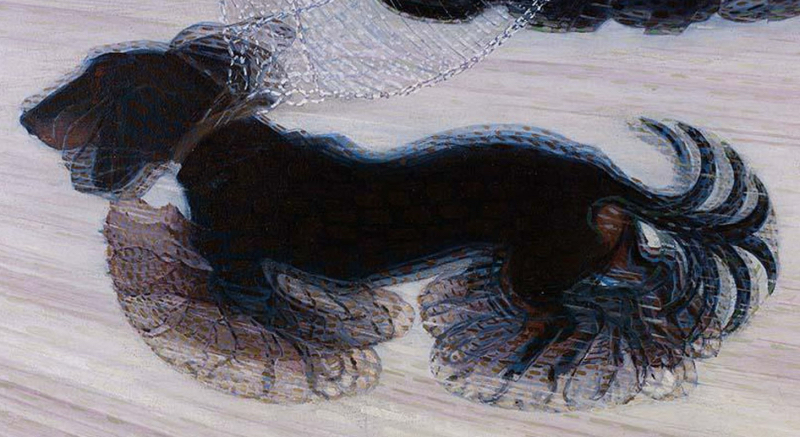
Giacomo Balla, Dinamismo di un cane al guinzaglio (dettaglio)
Why it is still a highly relevant work
“Dynamism of a Dog on a Leash” is a work that still speaks to us today.
In a world where everything moves too fast, where images flash across our screens, Balla shows us movement as visual poetry, not frenzy.
He teaches us that art can capture the moment and make it eternal, and that even the most mundane routine can hide a new vision.
Perhaps the next time you walk your dog, you will look at it with different eyes.
Have you ever seen this work in person?
It is housed at the Albright-Knox Art Gallery in Buffalo, New York, but it is so famous that it occasionally returns to Italy for temporary exhibitions, and when that happens, it is really worth going to see it.

Follow me on:
About me
In this blog, I don't explain the history of art — I tell the stories that art itself tells.