

Giorgione: life, works and style of a mysterious artist
At the heart of the Venetian Renaissance shines an enigmatic and poetic figure: Giorgione, born Giorgio Barbarelli da Castelfranco, a silent but revolutionary protagonist of sixteenth-century art.
Little is known about him, and it is precisely this aura of mystery that has fuelled the fascination that still surrounds his figure and his works today.
According to Giorgio Vasari, the nickname “Giorgione” derived from his imposing features and greatness of spirit.
His life was short, cut short by the plague in 1510, but intense and artistically fertile, to the point of leaving an indelible mark on Venetian painting.
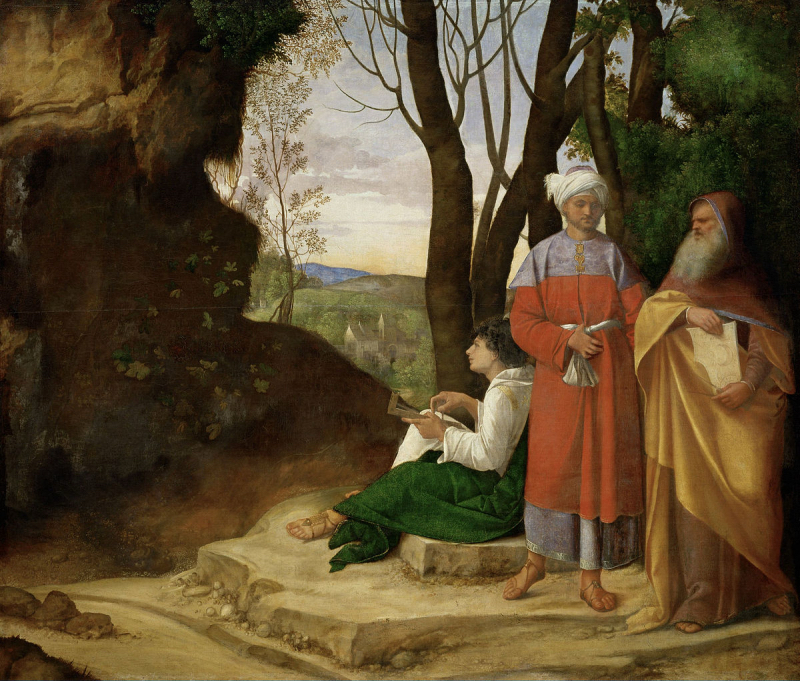
Giorgione, I tre filosofi
Giorgione: the artist of mystery and light
Very little is known for certain about Giorgione.
Born in Castelfranco, of humble origins, he began painting with a local master whose name we do not know. Only later did he move to Venice, coming into contact with refined and cultured artistic circles. He worked independently, without his own workshop, accepting private commissions and forging links with intellectuals and enlightened merchants. Among his pupils was a young Titian, who was destined to surpass his master but always remained indebted to his style.
Contemporary sources describe him as a cultured man, a lover of music and poetry, attentive to detail and sensitive to the beauty of the world around him.
Giorgione: few paintings and many mysteries
The corpus of Giorgione’s authentic works is small. The attribution of many of his paintings is still the subject of debate among scholars. A valuable testimony is a notebook by Marcantonio Michiel, a young Venetian aristocrat who, in the 16th century, noted down works and attributions in the private collections of the city of Venice.
Among his most famous works are the Castelfranco Altarpiece (1503-1504), the Sleeping Venus, The Tempest, The Pastoral Concert and The Three Philosophers.
Religious paintings such as The Trial of Moses and The Judgement of Solomon (now in the Uffizi) immediately show a strong focus on the landscape, which is never a simple backdrop but a silent protagonist of the scene.
Giorgione produced few works for the public. These include the canvas for the audience chamber of the Doge’s Palace (now lost) and the frescoes in the Fondaco dei Tedeschi, painted in 1508 in collaboration with Titian. Only a few fragments remain of the latter work, such as the figure entitled Nude.
Most of his works were therefore intended for the aristocracy and commissioned personally from the artist.
Tonal painting and the absence of drawing
Giorgione’s true hallmark is his painting style, which was revolutionary for its time.
The artist abandoned preparatory drawings in favour of working directly from life and applying colour to create volume. This gave rise to tonal painting, a technique based not on contour lines but on chromatic variations that create depth, volume and atmosphere.
The effect is that of a soft image, enveloped in light, where subject and landscape merge into a single breath. The contours dissolve, the colours interact with each other, creating tonal harmonies that reflect the passage of light and air.
According to Vasari, the change took place around 1507, when Giorgione began to paint “without drawing”, following what he saw in real life.
This approach would profoundly influence the entire Venetian school and, in particular, the painters of the 16th century.
From Leonardo to Giorgione: the birth of a new sensibility
The influence of Leonardo da Vinci is clearly recognisable in Giorgione’s works.
Sfumato, attention to the movements of the soul, atmospheric rendering and technical experimentation are all elements that recur in his canvases. However, Giorgione reworks these insights with an autonomous voice, choosing a more poetic, quieter, almost whispered language.
His use of light, the fusion of figure and nature, and his sensitivity in sketching emotional landscapes make him a profoundly modern artist. There is never a single meaning in his paintings.
Every detail is thought out, meditated upon, full of symbols and allusions, and intended for a cultured audience capable of deciphering its codes.
The charm of the enigma in Giorgione
Giorgione’s works do not tell a story, they suggest. The subjects are often allegorical, sometimes indecipherable, almost always lacking a clear narrative. This is especially true of his secular paintings, intended for refined, lay patrons, free from the constraints of Christian iconography.
The artist constructs suspended worlds, populated by immobile figures, immersed in timeless landscapes.
It is precisely this ambiguity that makes his works so fascinating: The Tempest, for example, remains one of the most discussed mysteries in Western art. No one knows for certain the meaning of the scene, yet the painting continues to move and surprise with its evocative power.
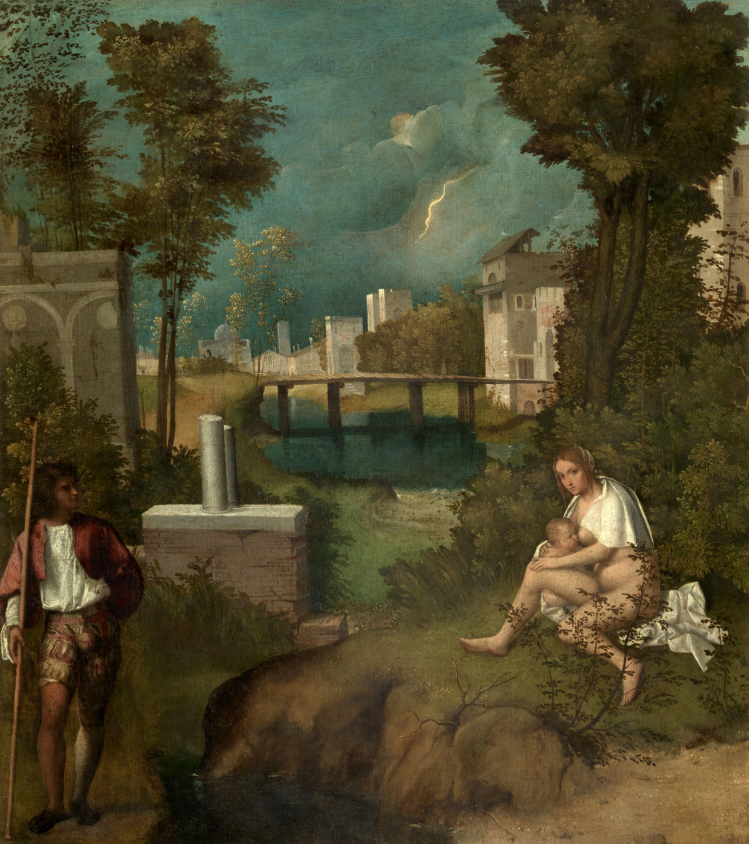
Giorgione, la Tempesta – Gallerie dell’Accademia di Venezia
Giorgione’s work had an immense impact on subsequent painting.
“Giorgionism” became a movement that influenced the entire Venetian school. Titian, his pupil and ideal successor, inherited from him a taste for colour, compositional freedom and attention to light.
His research was the starting point for the triumph of Venetian painting in the 16th century.
Giorgione transformed painting from a technical endeavour into an emotional and perceptive experience. He taught that beauty lies not in clarity, but in the harmony of tones, in the nuance of feelings, in the poetry of the unsaid.

Follow me on:
About me
In this blog, I don't explain the history of art — I tell the stories that art itself tells.