

Giotto and the stories of St. Francis in Assisi
There are works of art that strike you with their beauty and others that take your breath away because you know you are looking at something that changed the world.
The Stories of St. Francis frescoed by Giotto in the Upper Basilica of Assisi are both.
I will never forget the first time I looked up at those walls. It was like entering a living story, where the saints have dirty feet, their clothes move in the wind, and their feelings can finally be read on the faces of those who populate those wonderfully described scenes.
In this post, I want to take you with me among those masterpieces to discover why they are so revolutionary and why, even today, they speak to us with a power that spans the centuries.
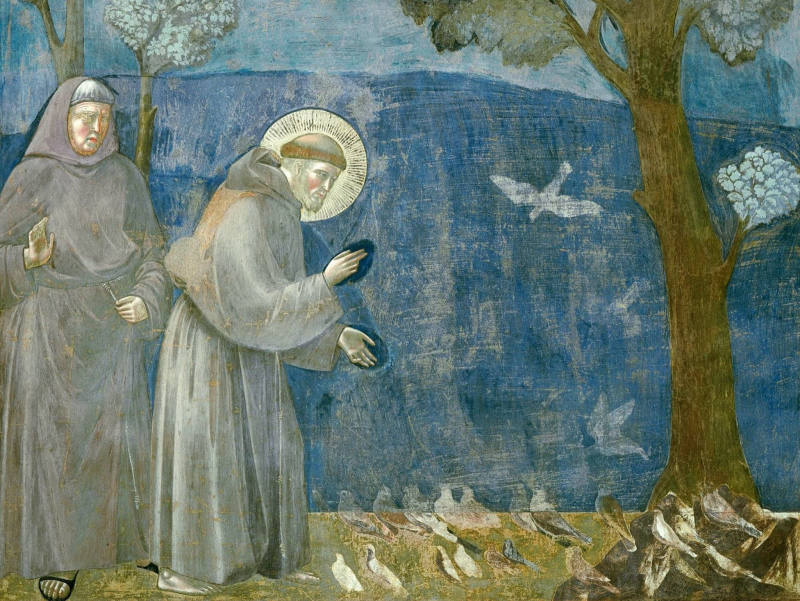
Giotto, predica agli uccelli di San Francesco
The stories of St. Francis by Giotto
Inside the Upper Basilica of Assisi, a cycle of 28 frescoes narrates the most significant episodes in the life of St. Francis. The cycle decorates the walls of the central nave, visually marking the saint’s earthly journey from youth to death.
Created between 1292 and 1296, these frescoes are attributed to Giotto, although the debate on their attribution is still open. What is certain is that the style, language, and humanity that transpire from each scene bear his unmistakable signature, or at least that of his revolutionary workshop.
Giotto does not merely illustrate a sacred story, but stages life with a narrative force never seen before.
Why Giotto’s stories of St. Francis are a masterpiece
Until these frescoes were created, medieval art was still highly symbolic, with majestic figures and gilded backgrounds. Giotto, on the other hand, places the characters in real landscapes, recognizable architecture, and three-dimensional environments. But above all, he gives emotion to the faces and weight to the bodies. The saints no longer float in the sky: they walk, embrace, and cry. They are human.
Each fresco is a poetic and powerful frame, a theatrical scene that draws the observer into a participatory narrative.
The most famous and unmissable scenes
It is difficult to choose, but here are some of the most iconic scenes that deserve a closer look:
The renunciation of possessions: Francis strips himself of his clothes in front of his father, the bishop, and the people. A radical gesture, recounted with theatrical intensity.
The dream of Innocent III: the pope dreams of Francis supporting the collapsing Church with his own hands. A powerful metaphor and a scene full of movement and meaning.
The sermon to the birds: perhaps the sweetest and most poetic of all. A moment of tenderness that encapsulates the entire Franciscan soul.
The death of St. Francis: a moving fresco in which the friars weep sincerely around the body of the saint, depicted with touching delicacy.
Curiosity: is it really all Giotto’s work?
As is often the case with great medieval masterpieces, the question of attribution is still being studied. Some scholars argue that only part of the frescoes were actually painted by Giotto, and that many scenes were executed by assistants or followers.
Beyond the signatures, what matters is the new vision that emerges from these images: an art that speaks to the heart, that recounts human frailty with simple and direct force. In this, Giotto left a mark on art that can also be seen in other masterpieces, such as the Scrovegni Chapel in Padua, and which has been an inspiration for all Western art.
In fact, Giotto marked the beginning of a phase of ‘rebirth’ in art, which would be completed in the 15th century with the start of the Renaissance.
Giotto’s pictorial cycle unfolds in a sequence that mirrors the official biography of St. Francis. All the frescoed scenes are framed by false architectural reliefs, suggesting to the observer that they are looking at windows open onto the events in the life of the saint of Assisi.
Each individual episode is set within a space that has depth and is constructed with a convincing perspective. In this way, the scenes appear real and inhabited by subjects who actually existed, moving within that same space, expressing reactions and feelings through gestures and facial expressions.
Where to see Giotto’s Stories of St. Francis
The Stories of St. Francis are located in the Upper Basilica of St. Francis in Assisi, an absolute masterpiece of Italian Gothic architecture.
Admission is free, but I recommend taking your time because each scene deserves to be viewed calmly, perhaps returning several times to catch the hidden details.
Personal tip: bring a small pair of opera glasses or use the zoom on your smartphone. Some of the frescoes are very high up and rich in detail.
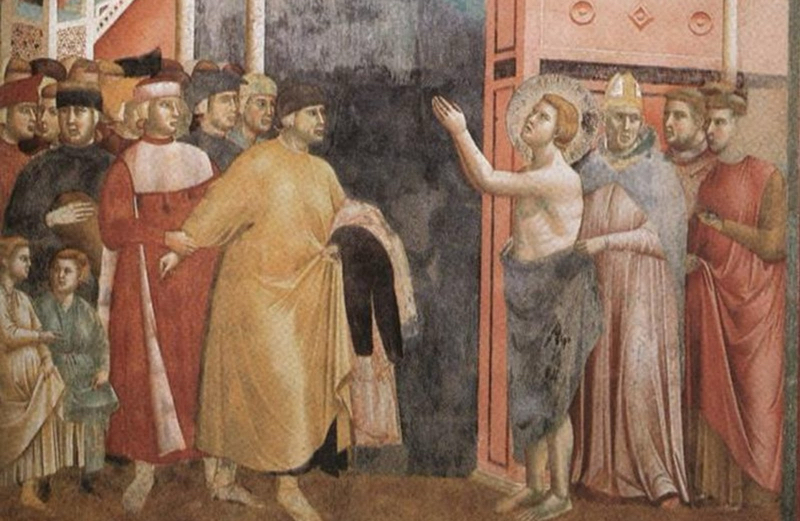
Giotto, La rinuncia ai beni di San Francesco
Why Giotto’s Stories of St. Francis still matter to us
Giotto’s Stories of St. Francis are not only an artistic masterpiece, but a visual manifesto of compassion, poverty, and the radical choice to love the world.
Looking at them, we are forced to ask ourselves many questions. We wonder what it means today to “renounce,” “believe,” “surrender to faith,” or simply live consistently.
In an age when images flash by and we observe them quickly and too superficially, these stories ask us for slowness, attention, and an open heart.
Take a trip to Assisi. You won’t regret it.
I go back there whenever I can.
🖌️ This article was published in 2015 and was updated on October 17, 2025, with new facts and insights.

Follow me on:
About me
In this blog, I don't explain the history of art — I tell the stories that art itself tells.