

Giulio Aristide Sartorio: the painter of the Poem of Human Life
There is an artist who, with symbolic brushstrokes and grandiose visions, has been able to transform painting into myth. His name is Giulio Aristide Sartorio, and no, it’s not a name you come across every day on social media, but if you love early 20th-century Italian art, you absolutely must know him.
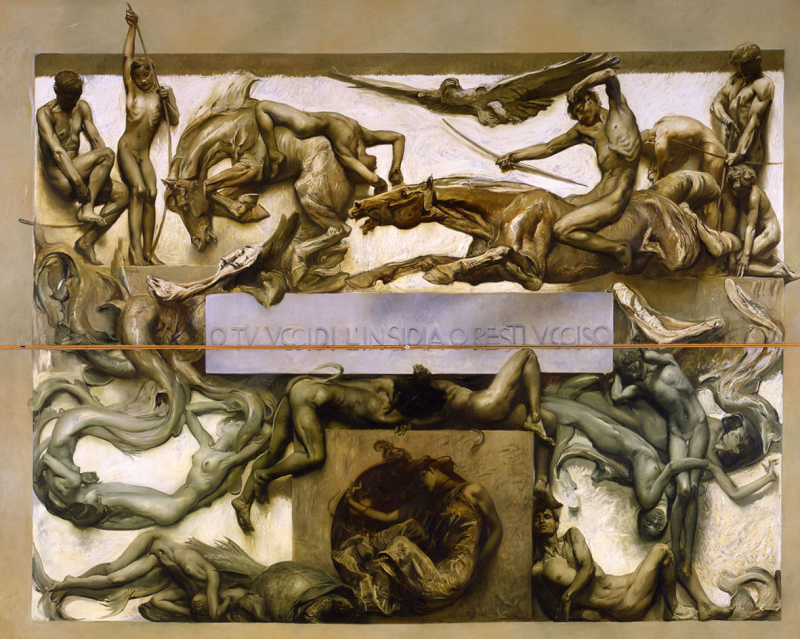
Giulio Aristide Sartorio: Le Tenebre, 1907, Tecnica mista su tela, 515 × 646 cm. Venezia, Ca’ Pesaro – Galleria Internazionale d’Arte Moderna
Who was Giulio Aristide Sartorio
Born in Rome in 1860, Giulio Aristide Sartorio was an eclectic character, painter, intellectual, director and teacher. He frequented the Caffè Greco, a crossroads of ideas and visions, and was one of the leading figures of Italian Symbolism, joining the association “In Arte Libertas”.
From a young age, he demonstrated extraordinary talent and a passion for cultured, mythological painting, rich in symbols and allegories.
Sartorio was not satisfied with canvas: he wanted to portray the entire human universe through art.
Sartorio and the Venice Biennale
Not everyone knows that Giulio Aristide Sartorio was present at the first edition of the Venice Biennale in 1895. Not only that, but he became a regular participant and an important collaborator.
The Biennale was, and still is today, a perfect international stage for those who want to speak to the world through art.
In 1906, on the proposal of Secretary General Antonio Fradeletto, Sartorio was given a monumental task: to illustratethe Poem of Human Life for the 1907 International Exhibition.
It was the opportunity of a lifetime.
The Poem of Human Life: art and myth in 230 square metres
Sartorio set to work and had only nine months to paint fourteen large scenes for the Central Hall of the Biennale. It was a titanic undertaking, which he decided to tackle using a quick but effective technique based on wax, turpentine and poppy oil, as recently confirmed by scientific analysis carried out by the Ca’ Foscari University of Venice.
The result? A masterpiece.
The decorative cycle is a powerful allegory of human existence, told through four main scenes – Light, Darkness, Love and Death – alternating with ten vertical canvases.
The figures move, dance and writhe, especially in the most dramatic scenes such as Darkness and Death, where everything becomes rotating, symbolic and eternal.
Between Eros and Himeros, good and evil love, Sartorio constructs a symbolic narrative that brings the Mediterranean world into dialogue with Nordic culture, creating a synthesis that is unique in its kind.
It is no coincidence that Gabriele d’Annunzio also approved the iconography of the work. The two men, after all, moved in the same circles, between decadent dreams and mythological passions.
The work was inaugurated with great success in 1907 and remained on display in the following edition of the Biennale. Then, in 1909, Vittorio Emanuele III donated it to the International Gallery of Modern Art in Venice, where it found a home at Ca’ Pesaro. But the story does not end there.
Between 2018 and 2019, the cycle underwent major conservation restoration, during which valuable scientific documentation was collected. Thanks to archival documents and works exhibited at contemporary Biennales, it has been possible to reconstruct the historical and artistic context in which Sartorio worked.
Today, the entire cycle is once again on display, accompanied by a wealth of information. It is a true immersion in Italian Symbolist painting.
Other works by Giulio Aristide Sartorio: between historical painting and auteur cinema
In addition to the famous Poema della vita umana, Giulio Aristide Sartorio created numerous other works that deserve to be rediscovered.
Among his best-known works are the decorative panels for the Palazzo del Viminale in Rome, in which he blends allegorical spirit with a strong civic and patriotic sense. Not to be forgotten is his extraordinary participation in the 1911 International Exhibition in Rome, where he presented a series of paintings dedicated to the history of humanity through the civilisations of the Mediterranean, demonstrating a narrative skill equal to that of a film director.
Sartorio approached cinema in the same years, making the silent film Il mistero di Galatea (The Mystery of Galatea) in 1910, a visionary and refined film that anticipated many of the ideas of symbolist cinema.
Even in his more pictorial works, such as “La Sirena” (The Mermaid), “Diana d’Efeso” (Diana of Ephesus) and “Gli schiavi” (The Slaves), the artist blends sensuality and myth with an elegant, theatrical style that still captivates today.
His figures, often elongated and immersed in ideal landscapes, seem to come from a suspended time, in which art becomes the language of the soul.
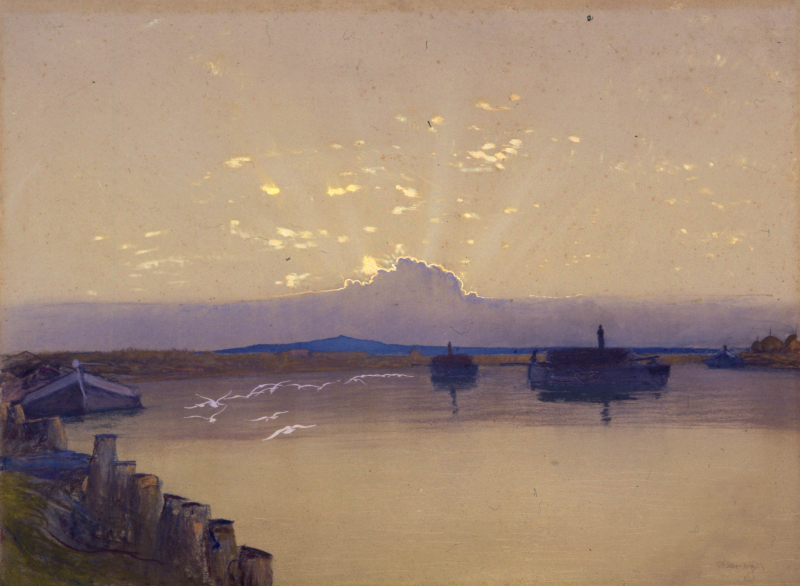
Giulio Aristide Sartorio: Alba sul Tevere, 1914, pastelli a colori, mm 564 × 760
Why Sartorio is still relevant today
Because he speaks to us about life, death, love and the mystery of existence, and he does so in a style that still fascinates us today.
In an age dominated by fast-moving, fleeting images, Giulio Aristide Sartorio forces us to stop, look closely, reflect and perhaps even dream.
Have you ever seen Sartorio’s works in person? Let me know in the comments! And if you enjoyed this article, please share it: art is even more beautiful when enjoyed together.

Follow me on:
About me
In this blog, I don't explain the history of art — I tell the stories that art itself tells.