

Impossible encounters: face to face with Vincent van Gogh
There are encounters that will never happen in reality, but which continue to occur every time we pause in front of a work of art.
It happens when time slows down, when the museum ceases to be a silent space and becomes a place of dialogue.
Impossible Encounters stems precisely from this.
From the desire to look at an artist not as a chapter in a textbook, but as a living presence, with a voice, questions and answers that never cease to intrigue us. It also stems from an inspiration, from the famous “Impossible Interviews” broadcast in the 1970s on Radio Rai, in Italy, by Alberto Arbasino. I had just been born, but I listened to them later and fell in love with this format, which I wanted to revive by imagining meeting, dining, having lunch or walking with an artist from the past.
In this first impossible encounter, I chose to sit in front of Vincent van Gogh, trying to let his paintings, his letters and his life speak for themselves.
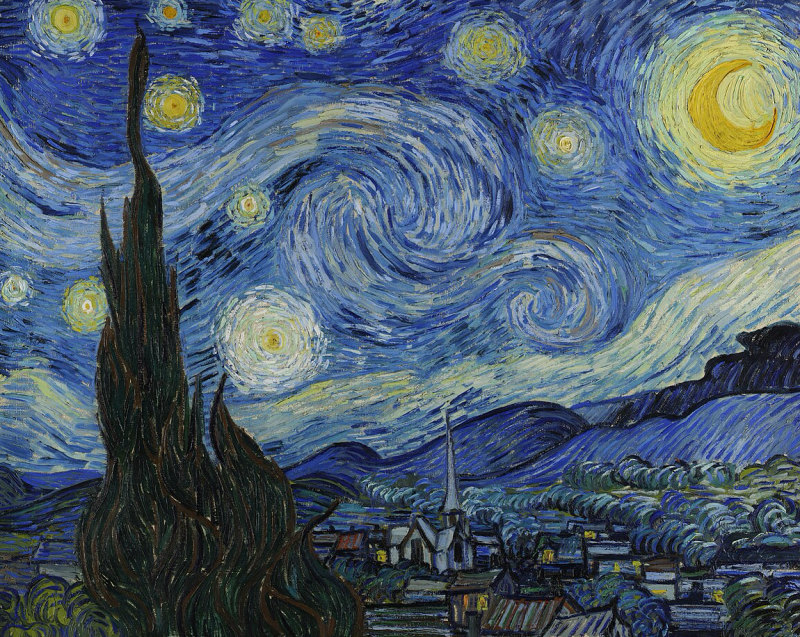
Van Gogh, Notte Stellata
Vincent van Gogh’s impossible answers
I chose an impossible dialogue with van Gogh not to seek definitive truths, but to listen to what still moves beneath the surface of colour today.
I am sitting in front of him.
Not in a museum, nor in his room in Arles.
I am sitting in front of Vincent van Gogh himself in a random café.
His gaze is attentive, restless and surprisingly kind.
He speaks softly, as if each word were meant to describe an entire world.
Vincent, if you could walk into a museum today and see people taking selfies in front of your paintings, what would you say to them?
I would tell them to really stop, not just with their bodies but with their gaze. I would say that a painting is not an object to take away, nor is it an image to use to say “I was there”. Painting does not work by subtracting time, it works by immersion. It takes minutes that become silence and silence that becomes attention.
When I painted, I hoped that someone would approach not to possess the work, but to let it wash over them. If a canvas does not slightly change the viewer, then it remains mute.
The museum should be a place of encounter, not of passage.
You wrote hundreds of letters to your brother Theo. If you could send him a thirty-second voice message today, what would you really say, without thinking too much about it?
I would say thank you for keeping me standing when everything else was falling apart. I would say that he never saved me from pain, but he saved me from surrender. Each letter was a way to remain human, to not feel completely cut off from the world. I would tell him that painting would never have become what it was without someone willing to listen to my obsessions, my enthusiasms and my defeats. I would tell him that I never painted alone, because another person’s trust, his in my case, can become a form of invisible colour.
Your skies seem to move, vibrate, almost scream. Did you paint what you saw or what you felt when the world became too noisy?
I painted what I felt in order to see better. Reality was never stable in my eyes, it constantly changed in intensity.
The sky was not a calm surface, but a place of forces, tensions and energy, and when the world became too noisy, colour became a way of giving structure to that noise. The brushstrokes followed the rhythm of thought, not that of appearance.
Painting was not imitating nature, but entering into its deepest movement, which is very similar to what happens inside a person when they feel emotions too great to contain.
Today we would call you a misunderstood artist. Did you ever feel truly misunderstood or simply alone?
Loneliness was heavier than misunderstanding. Not being understood is painful, but not being seen is a slower and deeper wound. I felt I was speaking a language that no one wanted to learn, yet I never thought of stopping using it.
I continued to paint because I believe that art must tell the truth even when it does not find consensus. Recognition was not the priority, sincerity was. Being alone while trying to be honest with yourself is a difficult condition, but sometimes necessary.
Last question. Which artist did you admire, for better or for worse? It could become our next impossible encounter.
Paul Gauguin. He was a friend, an exceptional artist, and I wanted to understand him completely, without idealising him and without constantly clashing with him. We shared a desire to go beyond academic painting, but we started from very different inner places.
Our coexistence was intense, fragile, full of expectations and misunderstandings. I would have liked to understand whether the distance between us was a question of art or character, of vision or an inability to listen. Some encounters are not meant to last, but they are meant to leave a mark, and ours left one forever.
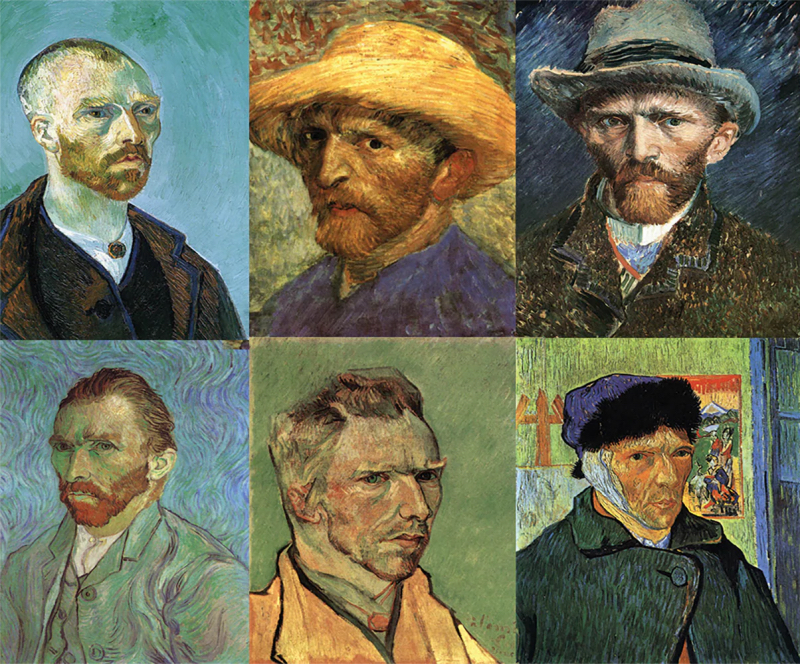
van Gogh, autoritratti
This encounter with Vincent van Gogh ends here, at least for now.
His words remain suspended, like the colour on the canvas.
If you were sitting in front of him, what question would you ask him?
Write it in the comments: it could become the next entry in this impossible encounter.

Follow me on:
About me
In this blog, I don't explain the history of art — I tell the stories that art itself tells.