Interview with Jago: art, vision and the courage to create – STUDI D’ARTISTA
There are encounters that are unforgettable, and this is one of them.
Studi d’artista today opens up a special conversation with Jago, an artist who needs no introduction, but who has agreed to really listen.
What you are about to read is not just a dialogue, but a real encounter with a man and an artist who does not just sculpt matter, but sculpts visions, questions and possibilities.
Meeting him and talking to him means questioning the meaning of creating, failing, starting over.
It means looking at art as a living gesture, as an act of birth, as a promise.
Today, I have the privilege of publishing the most intense interview ever.
ARTIST STUDIOS
A journey through Italy to discover contemporary artists
edited by Laura Cappellazzo
How do you interview an artist like Jago? Internationally renowned, always travelling the world designing, creating, imagining visions and perspectives that never fail to amaze and fascinate us.
How do you get to Jago, the artist who talks about himself on social media, who lets his hundreds of thousands of followers behind the scenes of his work… transforming even the creative process into art?
How do you do it? Just ask. Because behind the artist Jago is Jacopo Cardillo, a young man with a restless air and a generous heart. Because alongside Jago is a team of people who will bend over backwards to make an interview possible, even if it takes place in an airport waiting room.
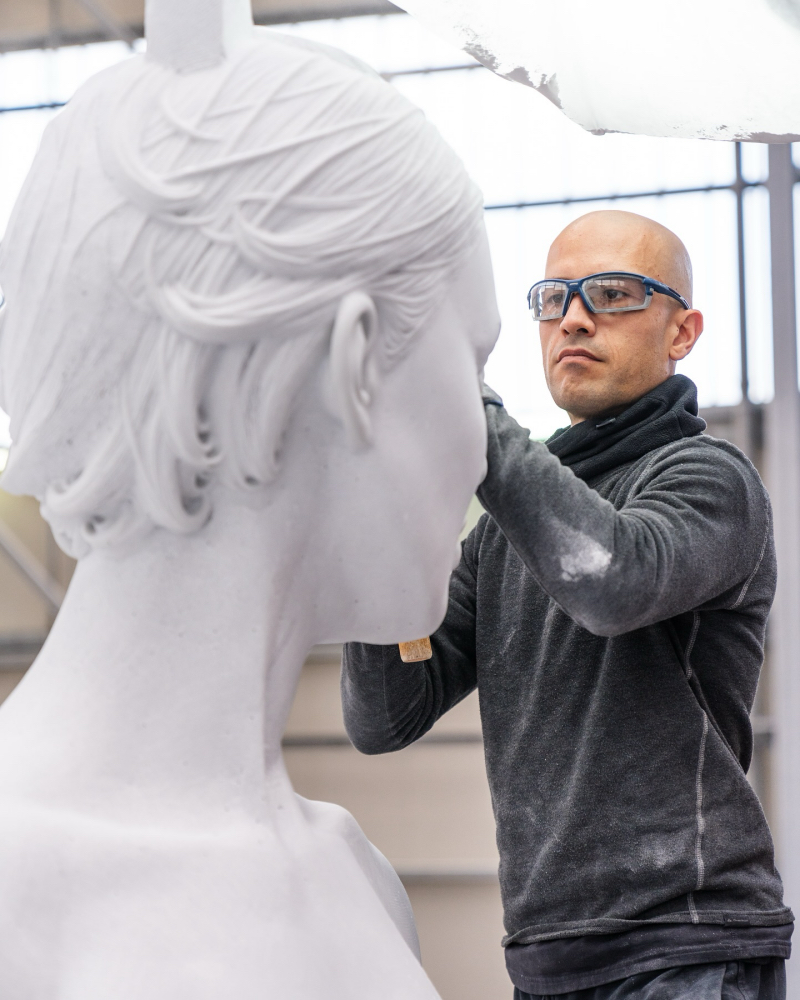
Just to give an idea to those who may not yet be familiar with him, Jago has been described as the contemporary Michelangelo by The Guardian: in February 2025, the exhibition of the David (plaster model) at the Gallerie d’Italia in Naples, and since April he has been present in the Italian pavilion at Expo Osaka 2025 with his work Apparato Circolatorio (Circulatory System). In May, he inaugurated the exhibition NATURA MORTA Jago e Caravaggio, due sguardi sulla caducità della vita (Still Life Jago and Caravaggio, two perspectives on the transience of life) at the art gallery of the Veneranda Biblioteca Ambrosiana in Milan. His Venus is elderly and bald, his Narcissus is a man who sees himself reflected in a woman, his Veiled Son is inspired by Giuseppe Sanmartino’s Veiled Christ, and David is a girl.
His works can be found in Thomas Paine Park in the heart of New York, in the desert of the United Arab Emirates, or in orbit on the International Space Station. Or at the Jago Museum, inaugurated on 20 May 2023 in the Church of Sant’Aspreno ai Crociferi in the Sanità district of Naples, where the artist also has his main studio.
IN JAGO’S STUDIO
Good morning, Jago, and thank you for taking the time to talk to our readers. To make the most of this opportunity and avoid falling into the trap of asking the “usual” questions, I thought I’d start with a few things you’ve said and try to explore them a little further. Is that OK with you?
Here’s the first one. “My father was an architect and set designer, my mother was an art teacher in secondary school. They knew how to explain the great masters to me by humanising them.” So art was a family affair in your home?
Meanwhile, I would like to point out that The Guardian’s statement is proof that even the best sometimes make mistakes or do not really know what they are talking about…
That said, yes, we can say that I grew up in a sensitive, attentive environment, not only in general to the world of art, but in particular to raising children’s awareness of issues such as beauty.
My parents were able to accompany both me and my brother, to indulge both of us in our predispositions, which always manifested themselves creatively, so to speak, so this was a great advantage. Then there is the personality of the individual, in this case mine, which has always had the need to assert itself and to find its own identity and path in a completely autonomous way in order to be happy and therefore, to the right extent, fulfilled.
“There are 7 billion artists ahead of me, and I know I am the last, but this is neither a problem nor an obstacle because I am going in exactly the opposite direction”.
How can one achieve such great self-awareness? I write, and I confess that when I think of the thousands of books published every year in Italy, I feel a little breathless…
These words are the result of an awareness that has to do with personal fulfilment, with the search for one’s own identity, with the awareness of having to express a totally free, crazy and in love, which is that of the child that lives within me and thanks to which I am able to capture images that I then transform into ideas and, through the use of my hand, return to the public and thus share in the form of a tangible value, in my case, being sculpture, three-dimensional. So, in reality, it is a very simple matter; I have much more to acquire in cultural terms than I have to give back.
What you see and what I do is nothing compared to my desire to fill an abyss.
“Anyone who is creative has a duty to art”. Perhaps this ties in with the previous question, but could you explain this duty to us?
As far as I am concerned, the meaning of the word art is simply doing, which is therefore inevitably linked to the word creativity.
Creativity, if we want to define it, going to the root of a meaning that concerns me, can be broken down into three fundamental ingredients, which are: the idea, the transformation of the idea through doing and finally sharing. These three ingredients are exactly the same as three other ingredients that have to do with gestation. So the work of the artist is comparable to the work of a mother, who, in order to bring a child into the world, and therefore to share it, give it, return it, must first conceive, then carry the child, and then give birth. And this is exactly the work of the artist, the creative person who deals with art, who understands, in my opinion, very well what it means to be a mother, to carry a work of art in her womb. And you cannot escape this natural mechanism. And if you cannot escape it at the moment of conception, a sense of unavoidable duty is triggered, which will inevitably accompany you wherever you go.
So there will be no holidays capable of distracting you from your child, from the idea. There will be no distraction whatsoever. You will also have to be able to exercise self-love in order to be able to deliver the best possible result and ensure an ideal future for your work of art. That is why duty is so important. When you discover you are a parent, and therefore a creator, you inevitably have to roll up your sleeves and cultivate a great sense of duty in order to realise your work of art.
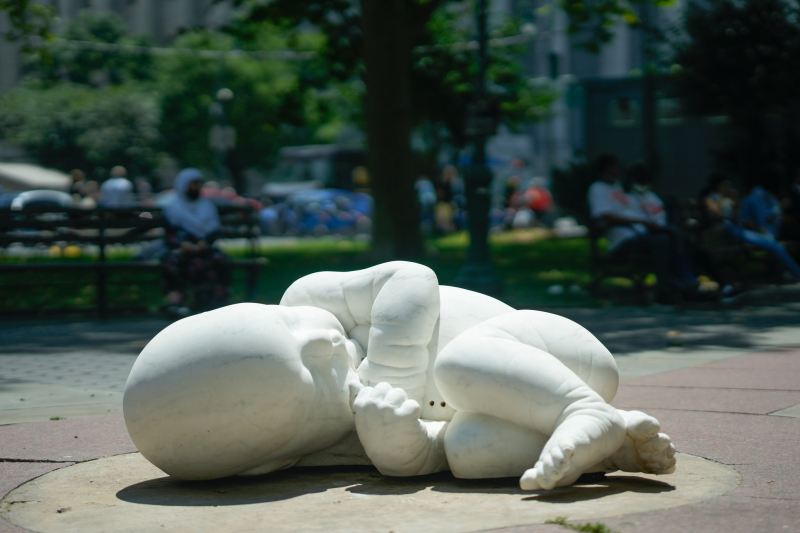
Jago, Look Down
“I prefer to have people who have failed on my staff. Because tomorrow we will fall, and so I will have the help of those who have already fallen”. This sentence struck me deeply, because working in social services, the strength of “those who have made mistakes” is something I understand immediately. How did you come to this realisation?
For my generation, I was born in 1987, you only have to look at the type of entrepreneurial attitude companies have towards innovation and new recruits. They must have experience, they say, and so you have a system bug that prevents anyone from entering.
We have created an ageing ruling class because young people cannot gain experience, they cannot get in because they have not yet done so and therefore will never be hired. They will simply invest their parents’ money to go to university and then eventually find themselves doing something else.
Today, very few young people manage to persevere in a profession that corresponds to their youthful investments, and so they experience enormous frustration.
I, on the other hand, prefer the shared path, because I experienced failure on many occasions at an early age, and I must say that I also like it, because I know that the only way to learn is to make mistakes. Those who do nothing make no mistakes, but they also learn nothing. So I am used to not worrying about mistakes and surrounding myself with younger people, who are just starting out but are driven by something primordial, something essential, which the “old”, to use a strong term, no longer have because they have lost it in the monotony of their constructed lives. They have enthusiasm, and enthusiasm is the divinity that dwells within us.
Young people are the manifestation of divinity, they are crazy, they are brilliant, and so we need to give a voice to this age group, surround ourselves with this energy to create a perspective. Then they will make their own choices in the world.
But if we think that creative ability occurs mainly between the ages of 15 and 26, and the greatest discoveries have been made in that age group, what do we do when a young person is that age? We don’t give them opportunities, we don’t give them a say, we don’t give them roles of responsibility because we don’t trust them. And I’m talking about my peers. It’s chilling, and so it is in politics.
This means that when you lose your enthusiasm, you grow old, you lose your inner child, and you end up playing power games, waging war and doing terrible things, which we see being done by leaders all over the world. Instead, there are a few, very rare elderly people who keep that spark alive. You need to surround yourself with people who have already failed, with young people, give space to young people because you have ideas and vision when you are young, then you lose them.
“I am not looking for buyers, but rather partners, associates, to whom I can sell only a percentage of the sculpture.
It is more interesting that way. That is how I create opportunities.” Art and business are two words that we are not used to hearing in the same sentence, almost as if the second word took away the poetry of the first. Instead, you talk about it and have even shared some of your choices along the way. Would you like to tell us about it?
Creating a museum is not easy. And even more difficult is answering this question:
How can a young, unknown artist, starting from scratch and without any financial resources, become a collector and manager of his own works, in order to create and collect values that become the content of an exhibition format that we will call Jago Museum?
Well, they must literally invent a new business model: one that is sustainable and consistent with their personal ambitions, knowing that no one, and I repeat, no one, will give them credit for a long time.
All this preamble to say that if I had taken a “normal” path (albeit legitimate and sacrosanct), represented by a dealer or intermediary, with the aim of turning my art into a job, I would almost certainly never have been able to realise my entrepreneurial vision.
Today, I produce and market, through my own channels, a very limited number of new works each year. I share monumental projects exclusively with accredited partners or collectors who are part of our group, because they must be people with whom we have established a deep human relationship.
We are not interested in speculators: they are linked to immediate returns. We think in terms of eras and safe-haven assets. For this reason, new projects intended for museum display are not for sale in their entirety. Instead, we offer highly selected investors the opportunity to become 50% co-owners during the design phase, with the aim of enhancing an asset to which we attribute a time horizon of “forever”. This way of working has allowed me, little by little, to establish myself creatively with total freedom, without having to ask anyone’s permission to do what I want. And if no one buys or participates? Well, I still create the work, on my own.
As far as I’m concerned, being able to say “no” is the highest peak. Every “no” represents a saving of time, and the time saved becomes an asset to be invested in the creation of a larger work, perhaps intended for a community project, set in an exhibition context: a new museum, in fact. A museum managed by talented young people who, with their individuality, contribute to the project, triggering circular economy mechanisms that result in the redevelopment of a church that had been abandoned for decades and which today, two years after opening, has already exceeded 250,000 visitors.
My goal is to protect my creative freedom by building, thanks also to the few who participate in it, an alternative system that is always new, scalable and replicable.
Is it simple? Absolutely not. But it’s worth it.
It gives me joy to have a few people of the highest human calibre on my team, who share the project and invest their resources to build a common cultural perspective.
In conclusion, my role with regard to co-owners, collectors and investors who decide to become my 50% partners in museum projects is a management role: aimed at ensuring appreciation over time, a multiplier that then allows, when a common will emerges, to offer the work to the secondary market. As a group, we know every collector, every partner and every co-owner personally. This allows us to maintain a healthy, wonderful, personal and familiar conversation, which, in the long term, makes all the difference in the world.
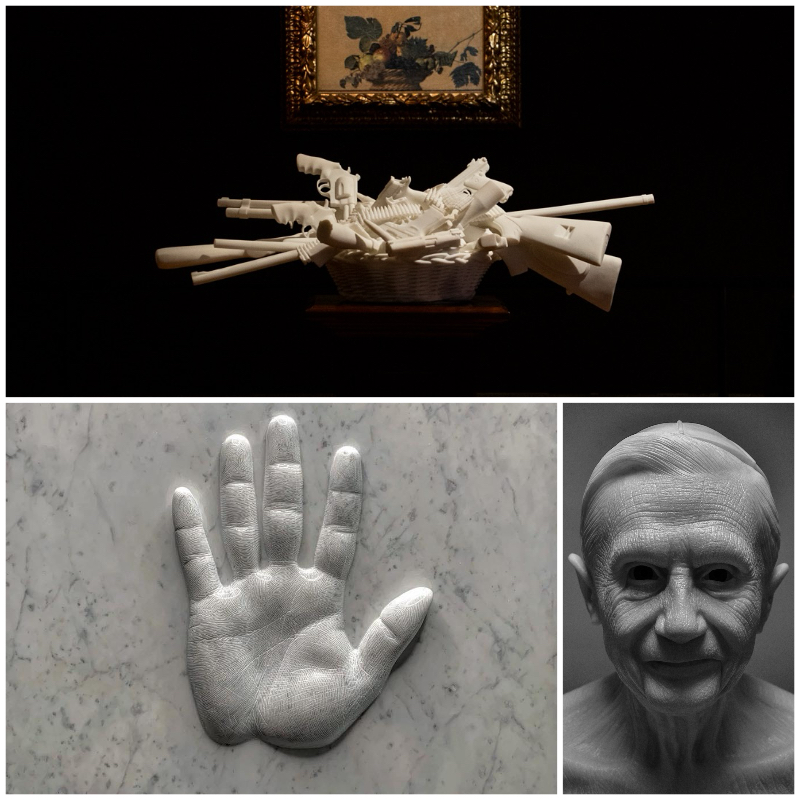
The work ‘I am ready for the scourge’ was destroyed; ‘The abandoned foetus’ was vandalised (and she then invited those young people into her workshop). This reminds me of Martalar’s Drago Vaia (Martalar, an artist who mentioned it in our interview, by the way), which was intentionally burned but then reborn thanks to the efforts of an entire community. It speaks to us of this relationship between art and social responsibility, between art and the people who live it, who not only look at it but appropriate it as part of their lives.
A work of art, understood as an object, obviously lives exactly like a human being in relation to the dynamics of the context in which it exists. A work of art installed in a museum will be subject to the rules and dynamics of the museum, bearing in mind that the museum is also a place of experimentation, so anything can happen even in the museum, and bearing in mind that human beings can act or react to a work of art in many different ways, whether it is exhibited outdoors or indoors.
Therefore, leaving or installing, abandoning a work outdoors requires the artist to be aware that the interaction will obviously be different, freer, more sincere, and this must be understood and interpreted as a value.
Whatever happens should not be interpreted as an aggression, but as an added value that gives the possibility of insisting on a narrative, because whatever happens is a mirror of reality, and the artist himself, through that work installed in that square, which will be burned, will be destroyed, becomes a witness to a contemporaneity that speaks, acts, discusses, loves, protects, rejects the context, the values and things that are proposed or thrown in his face, as can be the case with a work that is installed in a square at night.
That said, I am grateful for the attention that another wonderfully gifted artist has shown me, because it is one of the most illustrious examples of this generosity in wanting to cite someone else’s work, which must inevitably be treasured, so I express my great gratitude.
“Tomorrow I will be gone, but I hope that my works will stand the test of time”. What does time mean to you? Anxiety? A challenge? An opportunity?
Every now and then, it’s nice and fun to write catchy phrases to joke around, generate a reaction, but also to say important things and say them lightly. Time is an opportunity, especially when you have the chance or decide to use it to its fullest.
The time of our lives is a wonderful and free asset. So we must choose to use it consciously so that we get something wonderful in return, which is nothing more than a reflection of the results that, with a little effort, we can achieve.
For me, it is a great opportunity and, above all, it is relative, because it passes quickly when you do enjoyable things, but never ends when you are bored. Fortunately, however, boredom is also necessary for creativity, indeed fundamental.
So instead of scrolling through the internet or social media, let’s spend our empty time being bored, it would be a great driver for our creativity’.
I would like to conclude with you, as I usually do at the end of interviews, by asking you: if you could ideally take us to meet an Italian artist with whom we could continue our conversation on the meaning of art today, who would you take us to see?
In my opinion, an extraordinary artist who deserves to be known is Athar Jaber. He is a highly talented sculptor, engaged in truly profound and original research into language. Although he is Italian, he carries within him many lives and many places: he is, to all intents and purposes, a citizen of the world. His story is incredible and I think it is really worth telling.
What is striking, in addition to his technical skill, is his human sensitivity, which is fully reflected in his works. Each sculpture is imbued with his affection and his ability to listen, and conveys a rare humanity. For this reason, I feel confident in recommending him: in a complex era such as the one we live in, Athar embodies an art that unites different worlds and restores them with delicacy and truth.
All images in this post are taken from Jago’s Facebook profile. To view more of his work and stay up to date with his projects and exhibitions, visit the official website Jago.art.
Post a cura di: Laura Cappellazzo

Follow me on:
About me
In this blog, I don't explain the history of art — I tell the stories that art itself tells.