

Man Ray exhibition in Milan: when light becomes art
Have you ever thought that a simple shadow could be transformed into a work of art? Or that an everyday object, when viewed with different eyes, could become visual poetry?
If the answer is no, it’s time to remedy that. From September 24, 2025, to January 11, 2026, Palazzo Reale is hosting “Man Ray. Forms of Light,” an unmissable retrospective dedicated to one of the most influential artists of the 20th century.
Man Ray in Milan: when light becomes art
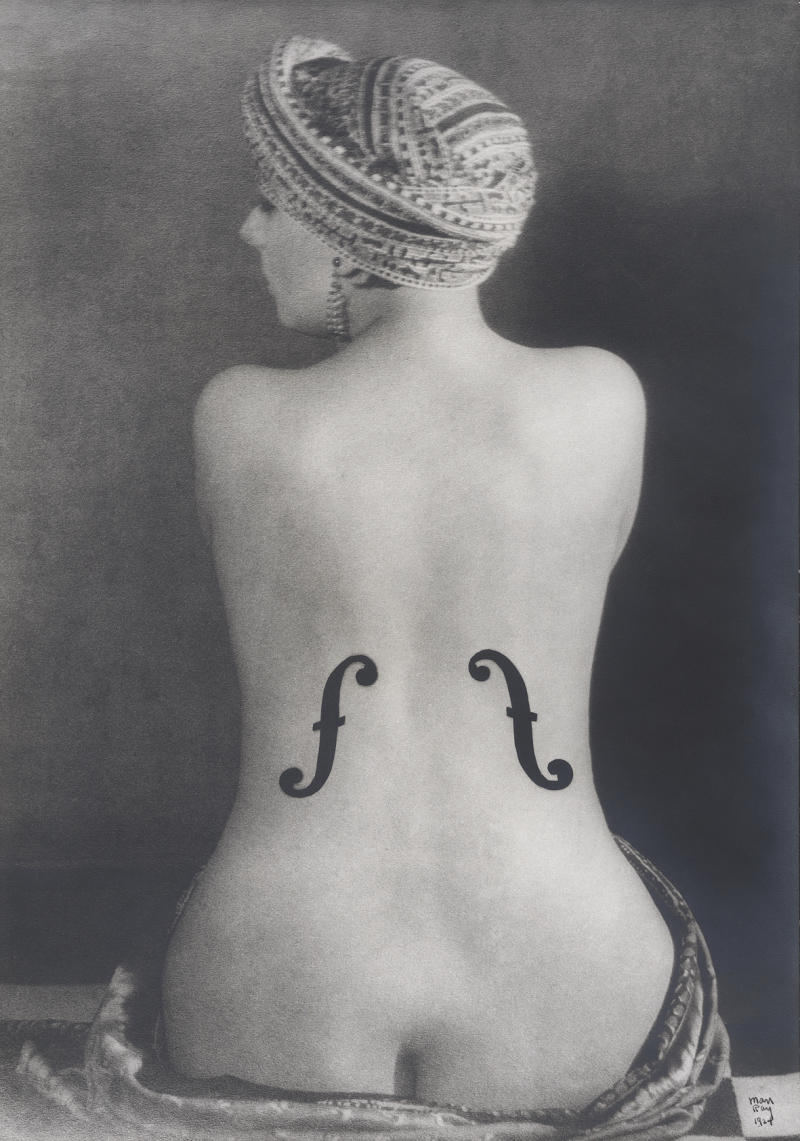
Man Ray , Le Violon d’Ingres, 1924, stampa ai sali d’argento, 39×30 cm. Collezione privata © Man Ray 2015 Trust / ADAGP-SIAE – 2024, image: Telimage, Paris
Born Emmanuel Radnitsky, Man Ray made light his signature.
A painter, photographer, filmmaker, and creator of absurd and poetic objects, he revolutionized the languages of art,blending techniques and styles, between the irony typical of Dadaism and the refinement of Surrealism.
His pseudonym was not chosen at random: “Man” refers to man, while “Ray” refers to a ray of light, and indeed, each of his works is a luminous explosion of creativity.
The exhibition in Milan, curated by Pierre-Yves Butzbach and Robert Rocca, is a true immersion into his universe. Over 300 works—including vintage photographs, drawings, objects, documents, and films—will guide you through the career of an artist who was able to continually reinvent himself without ever losing his playful and experimental streak.
From rayographs to fashion: a genius without boundaries
Entering the rooms of the Royal Palace, you will retrace the key stages of Man Ray’s life: from New York to Paris in the 1920s, where he met extraordinary figures such as Duchamp, Breton, and Kiki de Montparnasse. With the latter, his muse and companion, he created some legendary shots, including Le Violon d’Ingres, which became a symbol of surrealist photography.
You will also discover rayography, an ingenious technique that consists of exposing objects to photosensitive paper without a camera, creating abstract and poetic images. Or solarization, developed with photographer Lee Miller, in which photographs are transformed into spectral and hypnotic apparitions.
Through nudes, self-portraits, ready-mades, fashion photographs, avant-garde films, and portraits of intellectuals, you will understand how deeply Man Ray influenced what we now call “contemporary visual imagery.”
Fashion, cinema, and the avant-garde: art in all its forms
One of the most fascinating sections of the exhibition is dedicated to fashion photography.
As early as the 1930s, Man Ray brought an ironic and sophisticated eye to international magazines, collaborating with designers of the caliber of Elsa Schiaparelli and Coco Chanel. Elegance and avant-garde in an explosive mix that has inspired generations of creatives.
Cinema could not be left out.
His films—such as Le Retour à la raison, Emak Bakia, and L’Étoile de mer—are small masterpieces of visual freedom, ironic, sensual, and totally unconventional. You can see them screened in the exhibition, as if in a total art room where everything—light, form, sound—becomes an experience.
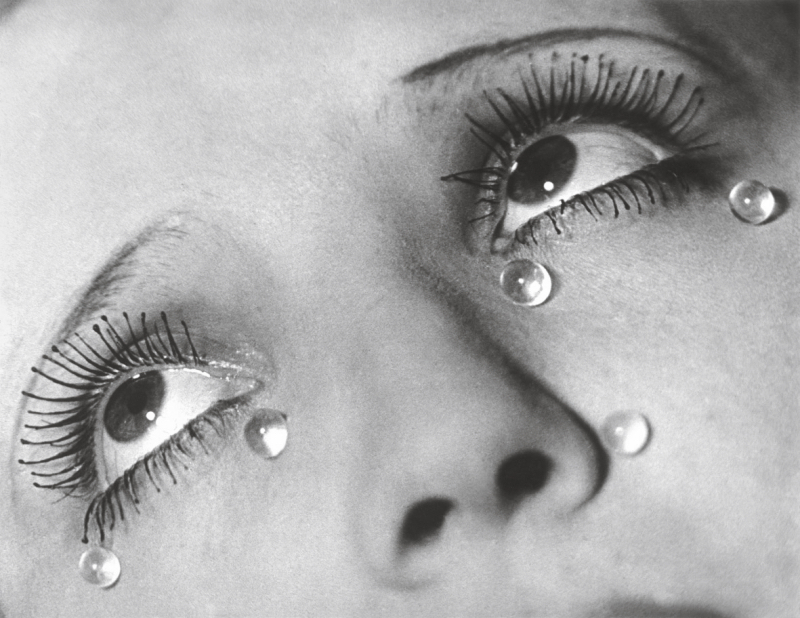
Man Ray, Larmes 1932 © Man Ray 2015 Trust / ADAGP-SIAE – 2024, image: Telimage, Paris
Why you should visit the exhibition
Because Man Ray is not just an artist from the past, but a constant reference point for those who work with images, fashion, graphics, design, and video today. His vision is still incredibly relevant, and the exhibition at Palazzo Reale is not just an exhibition, but a journey into a mind that knew how to play with reality like few others.
Besides, seeing light become form is not something that happens every day!
This exhibition will make you see the world with new eyes.
EXHIBITION INFORMATION
MAN RAY. Forms of Light
Curated by Pierre-Yves Butzbach and Robert Rocca
Milan, Palazzo Reale
September 24, 2025 – January 11, 2026
Opening hours
Tuesday, Wednesday, Friday, Saturday, and Sunday 10:00 a.m. – 7:30 p.m.
Thursday 10:00 a.m. – 10:30 p.m.
Last admission 1 hour before closing time.
Closed on Mondays.
Tickets
Reservations are recommended.
The exhibition is part of the Milan Cortina 2026 Cultural Olympics, a project that intertwines art, sport, and culture in the run-up to the Winter Olympic and Paralympic Games.

Follow me on:
About me
In this blog, I don't explain the history of art — I tell the stories that art itself tells.