

Mario Stefano and art that resists the digital image – ARTIST’S STUDIOS
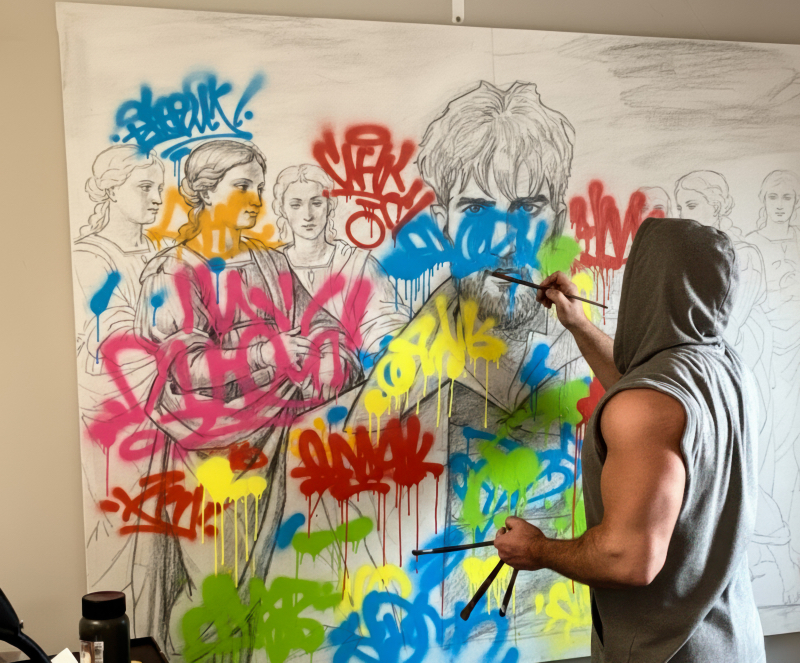
In an age where everything moves quickly — images, scrolls, digital content — artist Mario Stefano chooses slowness. His paintings are not shown in their entirety on social media, nor are they captured on a screen: they are experienced live, breathed in up close.
In this new interview for Studi d’artista, Mario Stefano tells us about his radical and poetic way of restoring value to matter, gesture and presence.
A counter-current journey that speaks of visual education, the body of work and the truth of seeing.
An approach that, in some ways, dialogues ideally with the works of Mauro Patta, who was the protagonist of the previous interview.
ARTIST STUDIOS
A journey through Italy to discover contemporary artists
curated by Giuseppina Irene Groccia
In the contemporary landscape, saturated with instant images and digital content that flow without leaving a trace, Mario Stefano’s painting stands out as an act of poetic resistance. His research restores the value of matter, gesture and physical presence to art, at a time when direct contact with the work seems to be becoming increasingly rare.
In recent years, the artist has chosen to no longer publish his works in their entirety on the web, sharing only the maximum amount of detail. This decision stems from a profound reflection on the meaning of seeing and the authentic experience that only a live encounter with painting can offer. “A handmade painting,” he says, “is not just an image, but a living body, sedimented time and embodied gesture”.
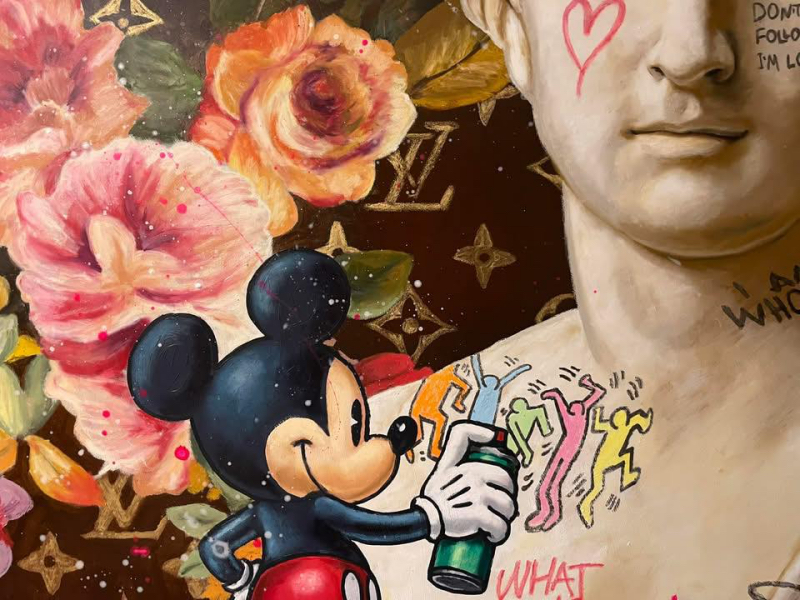
This idea of painting as body and presence runs through all his research, which moves rigorously between different languages — from the Renaissance to Pop, from Picasso to comics — to create a personal language capable of blending memory, experience and innovation. His canvases become layers of signs, corrections, pauses and decisions, where every colour is a thought and every shape is time made matter.
For Mario Stefano, painting means re-educating the gaze, giving the public back the opportunity to pause, to perceive the vibration of colour and the physicality of the mark. It is no coincidence that his words strongly convey the urgency of a new visual education, capable of bringing the viewer back into direct contact with the work, beyond the screen and the reproduced image.
In the following interview, the artist talks about his vision of painting, the role of authenticity in art and the challenges of a communication dominated by digital technology. His reflections invite us to rediscover painting as a living experience, as a gesture that resists the ephemeral and still preserves, today, the truth of seeing.
IN MARIO STEFANO’S STUDIO
Mario, let’s start here: what is a handmade painting for you?
A handmade painting is not only the result of a successful composition, but also time sedimented, physical presence and intention embodied in the gesture. For the artist, therefore, the painting is not just an image, but a living body. A body that carries with it layers, corrections, pauses and decisions.
We live in an age where images are everywhere. What difference can a painting still offer?
In an age of ubiquitous images, it is the material that makes the difference. The mark, the pigment, the worked surface become an act of resistance and authenticity. Authenticity is the key word. It is not enough for an image to be beautiful: for a work to be alive, it must convey to the public the gesture, the vibration of colour, the presence of the artist.
Yet this difference is not always perceived. Why do you think this is?
The difference between a “beautiful” image and a “living” work of art is not always obvious to those who have no direct experience with real painting. Many have never looked closely at a canvas, the layering of colour, the smell of the materials, the subtle vibration of the mark. This observation leads to another crucial issue: the role of visual education.
What do you think can be done to bridge this gap with the public?
I believe that, now more than ever, we need places and moments for visual education. Opportunities where the public can really look again. It’s not just about exhibitions, but experiences that bring people into direct contact with the material: workshops, open studios, encounters that restore the physicality of the work.
And what, ultimately, is the role of painting today?
True art — the kind that has a body, a breath, a gesture — is once again becoming a deep need for those who know how to see. A need that is growing even as the digital image dominates.
Last question… how does digital communication affect contemporary art?
Today, there is an overexposure that often empties images of their meaning: works become “content”, and their value is reduced to how much engagement they generate. The risk is that the work is reduced to an image, and the image to content.
Discover Mario Stefano’s work on Instagram and on his official website.
Post edited by: Giuseppina Irene Groccia @l’Arte Che Mi Piace

Follow me on:
About me
In this blog, I don't explain the history of art — I tell the stories that art itself tells.