

In Martalar’s works: wood, land art, and memories of the mountains – ARTIST STUDIES
Some interviews start off on the wrong foot, like a mountain trail. The meeting with Martalar—aka Marco Martello—was like that, but it was precisely that initial sense of bewilderment that allowed our Laura Cappellazzo to find the right questions.
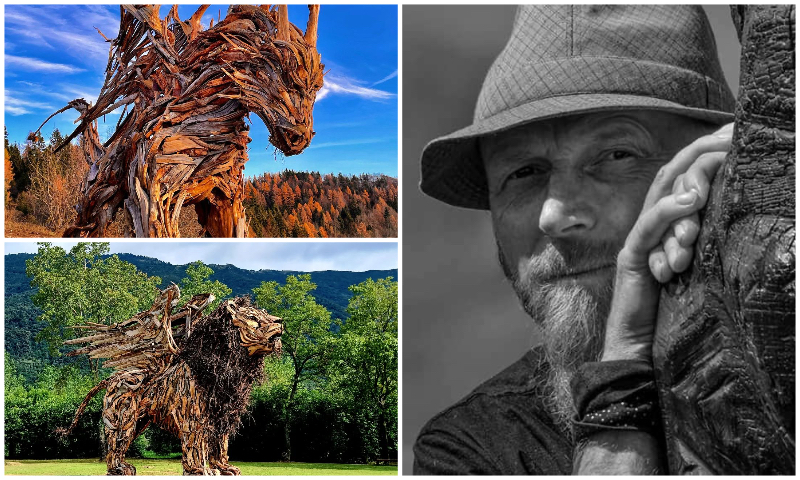
Martalar’s monumental wooden works, from the Vaia Dragon to the Lagorai Wolf, are not just sculptures, but life lessons, reminders of nature, collective gestures.
In this interview, conducted with emotion and gratitude, we discover what it means to create with your hands, your heart, and the echo of the forest.
Step by step, as in the previous interview with Giorgio Vazza, we delve into an art that leaves real traces.
STUDI D’ARTISTA
Viaggio in Italia alla scoperta degli artisti contemporanei
a cura di Laura Cappellazzo
Usually, before interviewing an artist, I research them: I look at their works, their artistic career over time, and their biographical notes, which, given my training and approach, are a source of very important information. In short, I try to read the traces that the artist-person has already left behind during their work, both to be more relevant with the questions I will ask them and to try to explore aspects that have not yet been investigated. This preparation also helps me, I confess, to feel more confident when I meet them.
With Martalar (the pseudonym of internationally renowned artist Marco Martello), the opposite happened: the more information I gathered, the more intimidated and inadequate I felt. Perhaps it was because his works have a very personal meaning for me, or because the places where they are located are part of my new family history, or because the philosophy of Land Art and the art form that Martalar developed from it is, in my opinion, something so true and profound that it transcends aesthetics and becomes a lesson in life… In short, at a certain point, I almost wanted to give up.
Then I remembered that Martalar describes himself as a “self-taught mountain man,” so I took a deep breath and decided to start from this simplicity typical of mountain people, a simplicity that is a well of wisdom, never superficiality. I imagined myself there, walking with Martalar in Vetriolo, in Valsugana, to admire the Lupa del Lagorai. Or in Strembo, in the city park to see the majestic Halfiger horse, or in Mafrè, to honor the Drago Vaia Regeneration. And between one step and the next, questions arise and answers flow.
IN MARTALAR’S STUDIO
Good morning Marco, and thank you for agreeing to let our readers get to know you a little better. Our column is called “artists’ studios.” Can you describe yours? I imagine it must be quite unique… I picture it more like a workshop, am I wrong?
Artist’s studio is exactly the right name because my workshop is everywhere! About ten years ago, I was with my daughter at a museum where, at one point, a huge dinosaur skeleton invaded a gigantic room, much larger than my dragon. I said to myself, “I have to make a big animal… but first I have to build a sturdy structure that resembles these enormous bones.” So I started and gradually perfected the creation of my works. Observing nature is the basis of everything; it is the true teacher.
Wood has always been part of your life. My father was also a carpenter, and I know that wood is a living material. It must be listened to. What is built is the result of a sort of dialogue between man and material. Is this also true for you?
Yes, wood is a living material, constantly changing, smelling in the forest and smelling at home… I couldn’t use anything else, it’s part of me.
Who knows what the roots you collect in the woods tell you, sometimes just a few meters from where the new work will be built… But where did you learn the technique? From someone, perhaps in a craftsman’s workshop? By studying on your own? It should be explained that your works conceal a precise engineering project within them, which must ensure that the creation stands upright, to put it simply.
Let’s say it’s curiosity, the desire to find the solution that transforms a simple pencil drawing into something real: something you can touch, see, and smell. I am self-taught, I struggle to have teachers. I’ve done everything in my life: carpenter, gardener, crane operator, book seller, designer, and in the end, this knowledge has allowed me to create and teach myself how to build a work. But what is needed most is imagination combined with the ability to observe nature.
Can you tell us about the process that leads us to admire one of your new artistic creations, and how much time passes between the idea and the inauguration?
It takes a long time… from the first emails with the client, then the meetings, the idea, the design, the project, the steps with cultural, environmental, and landscape authorities, engineers, and various technicians… Then the construction, even though I’m confident now and have my own technique, in the end it takes up to two years.
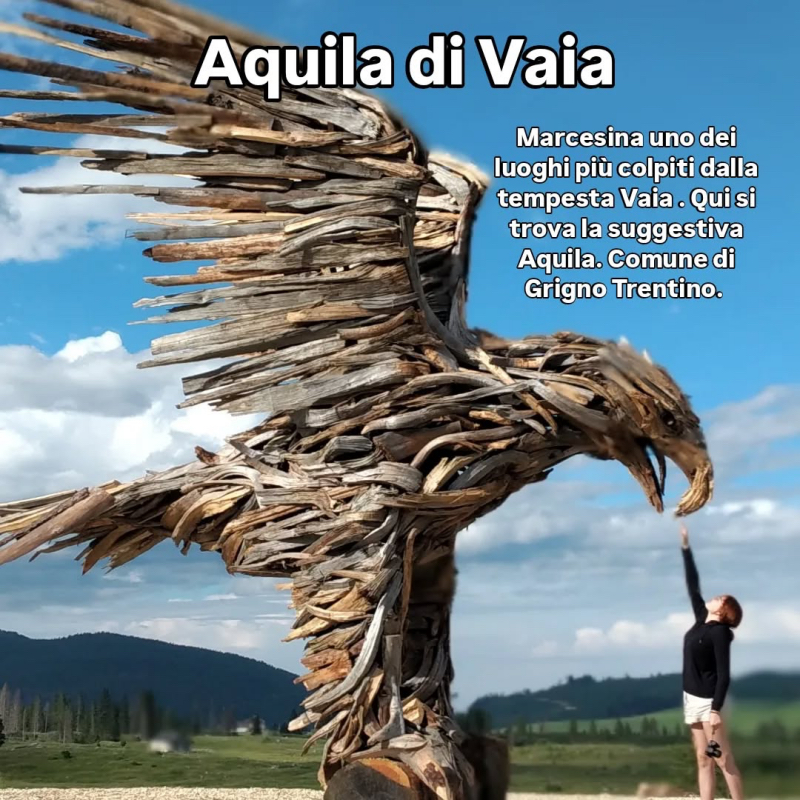
Martalar, Aquila di Vaia. Immagine tratta dalla pagina Facebook dell’artista
What fascinates us about his creations is also their grandeur: they make us feel small. This is also the effect created by the surrounding mountains, which, for those who love nature, leads to respect for what we see: feeling small and admiring the majesty of nature in order to respect it, not dominate it. Are his works succeeding in this? Do they somehow manage to challenge the perspective of the ‘devouring’ tourist in favor of the sustainable tourist?
Good question… I think it takes time, it takes culture. I hope that art helps in this. It is perhaps a generational process. For example, it used to be common to see violets and edelweiss in the hands of tourists in the mountains, but now you hardly see them anymore; there has been an increase in awareness.
The burning of the first Vaia Dragon was an event that greatly shook public opinion. Seeing it reborn, certainly angrier than the first, was an equally significant collective moment. Did you expect art to have this power? To create a sense of community and belonging?
No, to be honest, I couldn’t have imagined such affection. The new dragon was reborn thanks to 3,000 donations from ordinary people who did not accept what had happened.
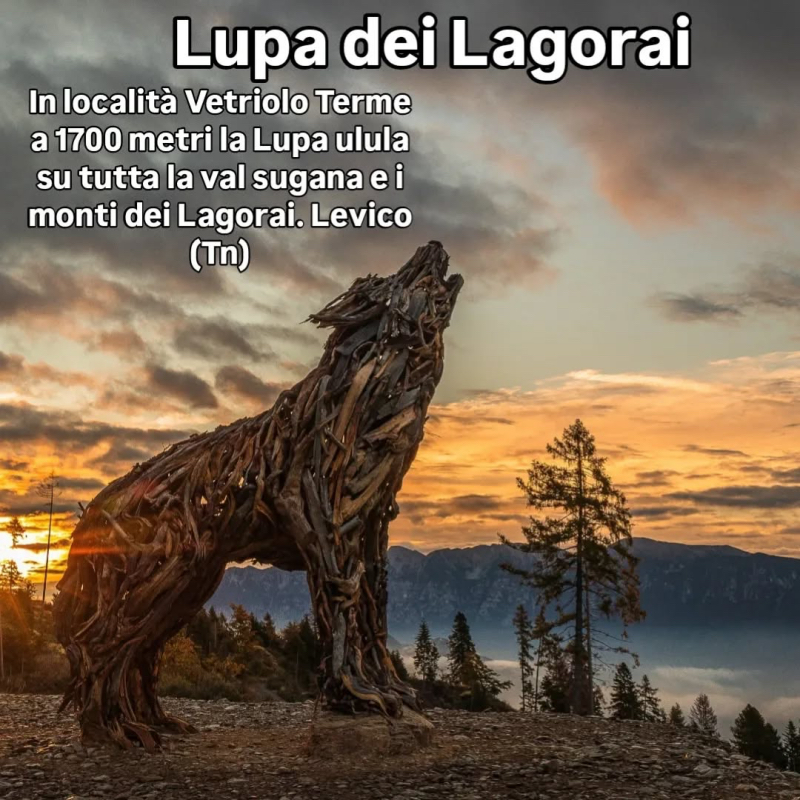
Martalar, LUPA DEI LAGORAI. Immagine tratta dalla pagina Facebook dell’artista
Now I can only mention your new project, which I personally find brilliant in the true sense of the word. Can you explain what “Echo In” is?
It’s an idea in collaboration with Lavarone Green Land, a work that involves everyone, everyone can contribute, and I hope it will become something that expands beyond my art.
Martalar, from up here, from your mountains, from your perspective, as someone who has weathered Storm Vaia and experienced firsthand what it means to disrespect the land and have to deal with the consequences… do you think we as humans will be able to improve our relationship with the environment, or is it already too late?
As long as we are here on this planet, as human beings, it is never too late. By not respecting the balance, we are not harming the planet, we are harming ourselves. The planet can live without us… we cannot live without it. Mars will not save us.
We usually end our interviews with a kind of game, a sort of passing of the baton. If we could ideally go to another artist’s studio to interview them, who would you take us to?
Jago, I would go to him: he has made it clear that art, the kind made with your hands, is not dead, and neither is the figure.
On the Martalar page on the artsharing.org website, there is a map showing the location of all his works.
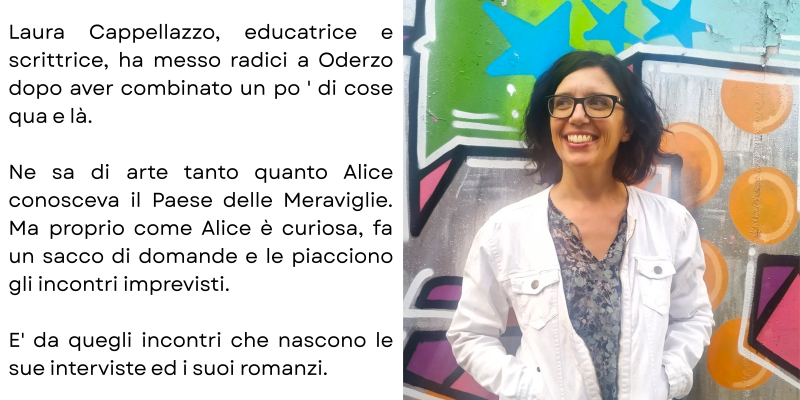
Post a cura di: Laura Cappellazzo

Follow me on:
About me
In this blog, I don't explain the history of art — I tell the stories that art itself tells.