

Max Ernst: the visionary artist who transformed the unconscious into art
Imagine walking inside a dream, but not just any dream, a bizarre, disturbing, unsettling dream. A dream in which birds talk, furniture floats, and the laws of reality elegantly bend to those of imagination.
Welcome to the world of Max Ernst.
I first encountered Ernst in a quiet gallery. It was one of those days when you just want to take refuge in art, hoping that a painting or sculpture will say something you can no longer hear in the world around you. And that’s where Max Ernst spoke to me loudly, using his visions.
That’s why today I’m taking you with me to discover him.
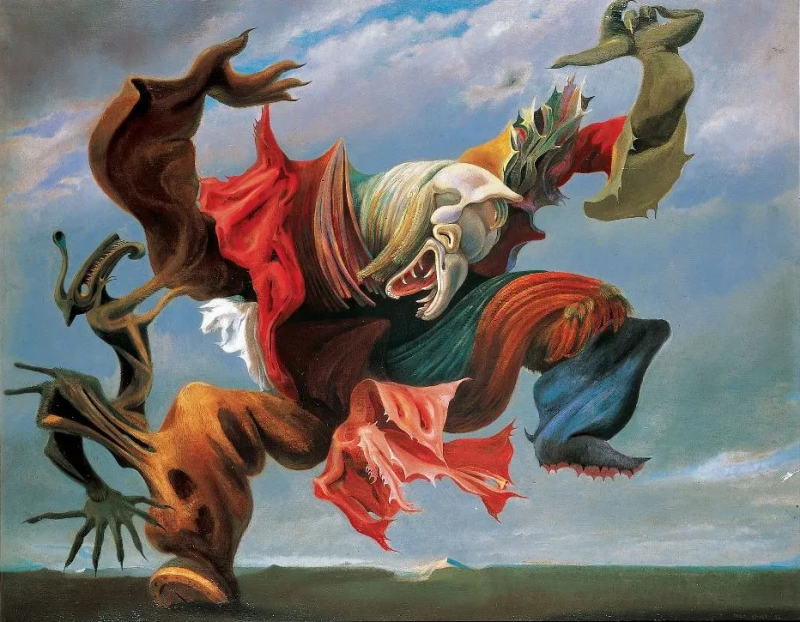
Max Ernst, L’angelo del focolare
Max Ernst: the visionary who transformed the unconscious into art
Max Ernst was born in 1891 in Brühl, near Cologne, and grew up in a middle-class family, with a father who was a teacher and amateur painter.
Marx’s path would be anything but smooth because, after studying philosophy and psychology, World War I broke out and he left to serve as a soldier, returning from the front profoundly changed.
The experience of war became a wound from which new, unsettling images began to flow, charged with mystery and springing from his unconscious.
In the 1920s, he moved to Paris and became a key figure first in Dadaism and then in Surrealism.
Max Ernst was a tireless artist and a visionary experimenter. He lived between Europe and the United States, experiencing wars, loves, and artistic revolutions, and his career was a very long one.
He died in Paris in 1976, leaving the world with a body of work that is as rich as it is difficult to label.
Max Ernst, surrealist, but in his own way
Max Ernst was one of the fathers of surrealism, but he never allowed himself to be confined to a single definition. He loved to play with techniques, materials, and above all, levels of reality.
His art does not seek to depict the world as it is and as he saw it with his own eyes, but as it could be if we gave free rein to our unconscious.
He was the inventor of frottage, a technique that involves rubbing a pencil on an uneven surface to bring out hidden shapes, and grattage, a painting technique involving scraping and abrasion. Max Ernst was also a master of collage, ready-made art, sculpture, and even automatic writing. For him, any medium was valid for giving shape to the invisible.
Max Ernst’s most important works
It is difficult to choose just a few, but these are the ones that captivated me and, in my opinion, best describe his world:
“The Dressing of the Bride” (1940): one of the most famous and disturbing images of his universe, between eroticism and mythology.
“The Angel of the Hearth” (1937): a monstrous being amid devastation, a metaphor for war and madness.
“Celebes” (1921): a sort of elephant-mechanism, an absurd hybrid that seems to have come out of a Dadaist nightmare.
“The Forest” (1935-39): a series of paintings in which nature becomes wild, primordial, and dense with symbols.
“Beware of Miracles” (1948): an enigmatic canvas, full of religious references and dreamlike visions, painted during his American period.
Max Ernst and the bird Loplop (an irresistible curiosity)
There is a recurring character in Max Ernst’s paintings: an anthropomorphic bird named Loplop.
Who is he? He is the artist’s alter ego, his inner voice, his guiding spirit.
Ernst loved birds since he was a child, and it seems that on the day his sister was born, his parrot died, leaving him forever troubled.
Loplop is a dreamlike creature who appears and disappears among the canvases, tells absurd stories, dresses up as a prophet or a jester, and accompanies Ernst throughout his life. A kind of surreal conscience, but with feathers.
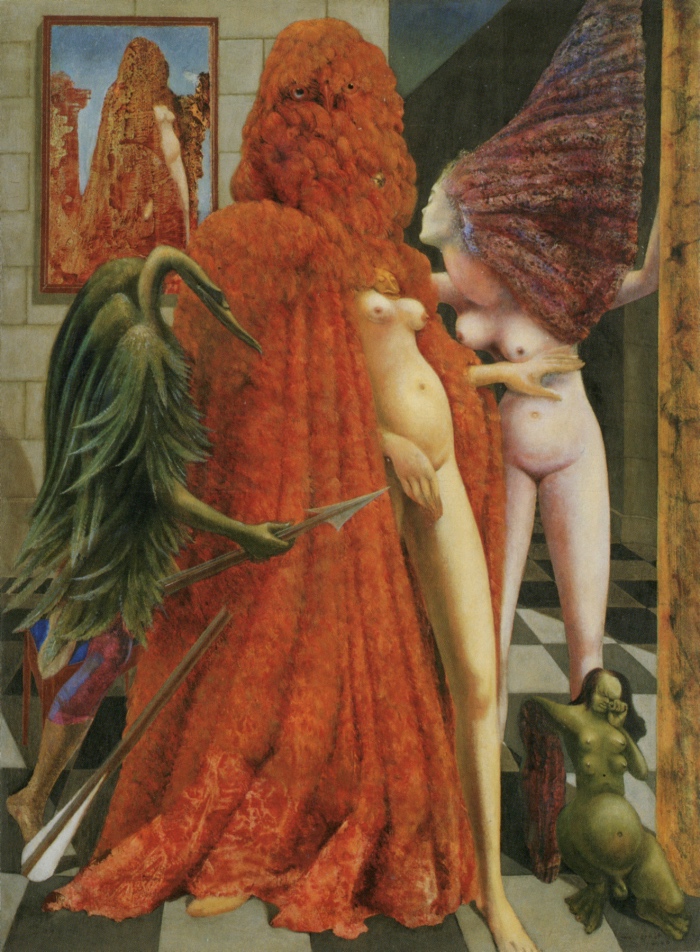
Max Ernst, La vestizione della sposa, 1940-1941
The importance of Max Ernst today
In a world that often rewards controlled, rational art that requires little explanation because everything is clear in the image on the canvas, Max Ernst reminds us of the power of ambiguous images, of dreams that are not immediately understood, of stories that refuse to be linear.
Looking at a work by Ernst means risking getting lost and accepting that you won’t find all the answers.
Isn’t that the beauty of art?
Have you ever seen a work by Max Ernst in person?
I recommend you do so, even if only once. Because certain images are unforgettable.
🖌️This article was published in 2015 and was updated on September 18, 2025, with new facts and insights.

Follow me on:
About me
In this blog, I don't explain the history of art — I tell the stories that art itself tells.