

Michelangelo’s Pietà Rondanini: meaning, history, and where to see it
The Pietà Rondanini is Michelangelo Buonarroti’s last work, and perhaps also his most intense and moving.
An unfinished masterpiece that does not showcase the artist’s technical perfection, but rather his profound spirituality, human fragility, and the urgency to leave behind an artistic and inner testament.
Today, it can be admired at the Castello Sforzesco in Milan, but its history is long, fascinating, and full of mysteries.
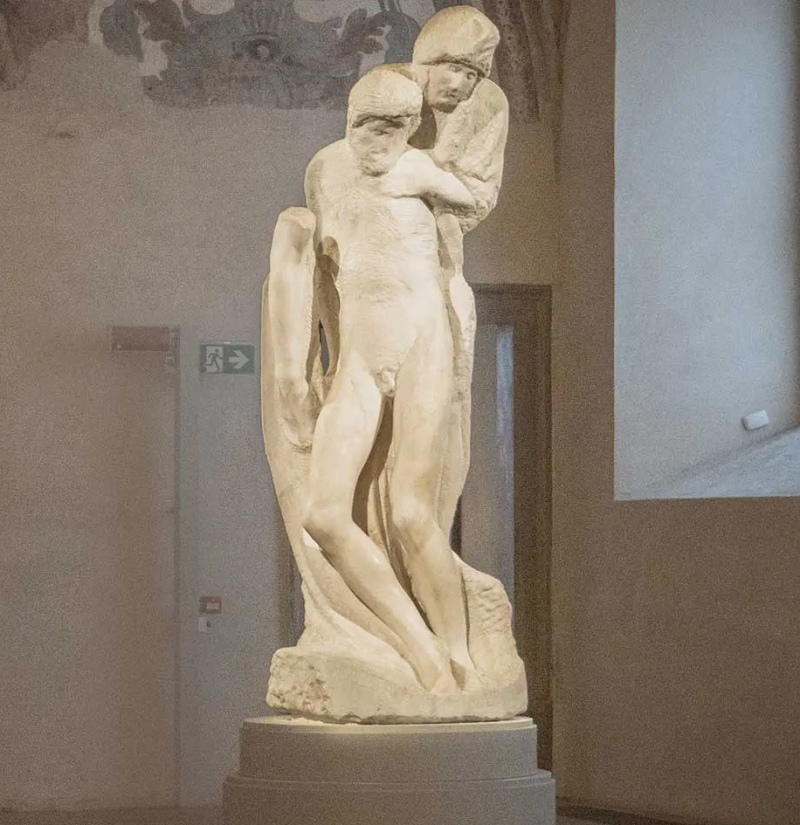
Michelangelo, Pietà Rondanini
Pietà Rondanini: last work by Michelangelo
Michelangelo most likely began working on the Pietà Rondanini in 1552, but interrupted the work several times before returning to carve his last Pietà from that marble in the last year of his life: 1564.
There are three drawings, preserved in Oxford, that reveal Michelangelo’s initial idea, which immediately appears ambitious because both the Madonna and Christ are in an upright position, with the body of the dead Christ collapsing under his weight as Mary tries to lift him.
In the Pietà Rondanini, the two figures rest on a Roman funerary urn dating back to the 1st century AD, and the representations of the spouses Mark Antony and Julia Filomena Asclepiade can still be seen.
An unfinished and spiritual work
The Pietà Rondanini is very different from Michelangelo’s early sculptures, such as the Vatican Pietà.
Unlike the other Pietàs, here Christ and Mary are standing in a vertical and dramatic position.
Christ’s slender, elongated body seems to collapse under its own weight, while Mary supports him with a gesture that is no longer just maternal, but universal.
Here we do not find classical perfection, but an essential, almost mystical beauty.
Michelangelo sculpted by removing material, as if trying to free the soul from the stone.
It is the work of an elderly man confronting the end of life, God, and eternity.
The figures appear fused in a single painful embrace, with no clear boundaries between mother and son, between love and death.
A spiritual testament
The Pietà represents Michelangelo Buonarroti’s spiritual testament.
It was found in his Roman home and was lost for many years until it appeared in the home of the Rondanini counts, from whom it derives the name by which we know it.
After several changes of ownership, the sculpture was put up for sale in 1952 and many international museums began to compete for it, but in the end it was purchased by the Municipality of Milan for 135 million lire.
Since the mid-1950s, it has been housed in the Castello Sforzesco, and since May 2, 2015, the Pietà can be seen in a specially designed room called the Museo della Pietà Rondanini.
Where to see the Pietà Rondanini
Museo della Pietà Rondanini
Piazza Castello – 20121 Milan
Castello Sforzesco
Admission is included with the single ticket for Castello Sforzesco.
Michelangelo and the journey towards eternity
The Pietà Rondanini is a work that speaks softly but goes straight to the heart.
Michelangelo no longer wanted to amaze the world with his talent, but sought the essence.
In that fragile fusion between mother and son, between death and resurrection, he left us his last gesture of love towards humanity and towards God.
If you are passionate about the world of Michelangelo, I also recommend reading the post in which I describe 7 interesting facts about Michelangelo Buonarroti.
🖌️ This article was published in 2017 and was updated on October 4, 2025, with new interesting facts and insights.

Follow me on:
About me
In this blog, I don't explain the history of art — I tell the stories that art itself tells.