
Ruth Orkin in Bologna: the photographer who dreamed of cinema
Have you ever thought about how much cinema there can be in a photograph?
If you are fascinated by the boundary between still images and movement, between storytelling and captured moments, then this exhibition is for you.
From 5 March to 19 July 2026, Palazzo Pallavicini in Bologna is hosting the largest retrospective ever held in Italy on Ruth Orkin, an extraordinary American photographer and filmmaker, a true pioneer of the 20th century. The exhibition is entitled The Illusion of Time and promises to amaze you with 187 photographs, two original cameras and precious documents that tell the incredible story of an artist who transformed photography into a cinematic narrative.
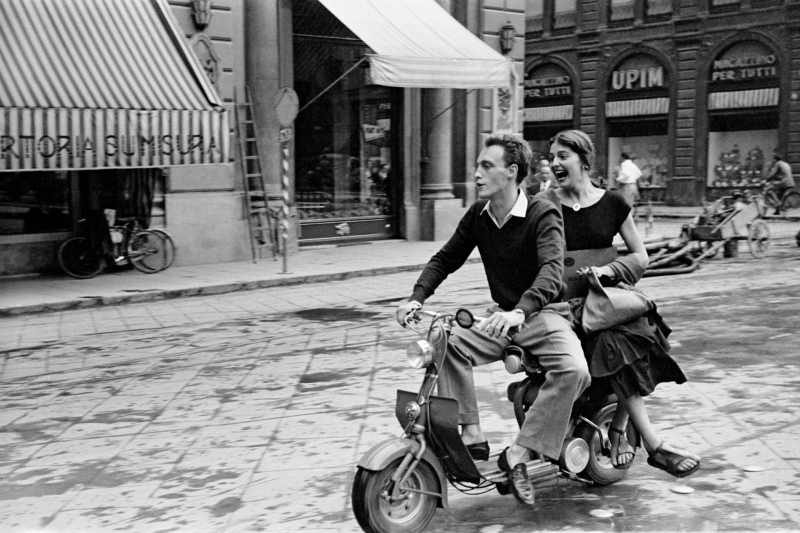
Ruth Orkin, Jinx and Justin on Scooter, Florence, Italy, 1951
Ruth Orkin: a life of dreams, travel and lenses
Ruth Orkin had a dream: to become a film director. Growing up in Hollywood in the 1920s, with a mother who was a silent film actress, she was immersed in the glamour of the silver screen from an early age. However, at a time when female directors were rare, that dream had to take a different form. So, when she received her first camera as a gift (a 39-cent Univex), she found another way to tell stories.
Each of her shots retains the rhythm of cinema. This is evident from Road Movie, the visual diary of her bicycle trip from Los Angeles to New York in 1939.
Her photos become frames of a flowing narrative, guided by handwritten captions and sequences conceived as scenes. It is as if the film had been transformed into photographic paper.
Bologna hosts a unique exhibition
The retrospective is curated by Anne Morin and promoted by Pallavicini srl, in collaboration with diChroma Photography and under the patronage of the Municipality of Bologna, FIAF and AIRF. After solo exhibitions dedicated to Vivian Maier, Tina Modotti and Lee Miller, Palazzo Pallavicini continues its journey into the world of great female photographers with a powerful and poetic exhibition.
During the exhibition, you will discover the most intimate and cinematic side of Orkin’s work.
In particular, the series “From Above” will allow you to see the world through her eyes: the photographer would look out of the window to capture everyday life passing benea
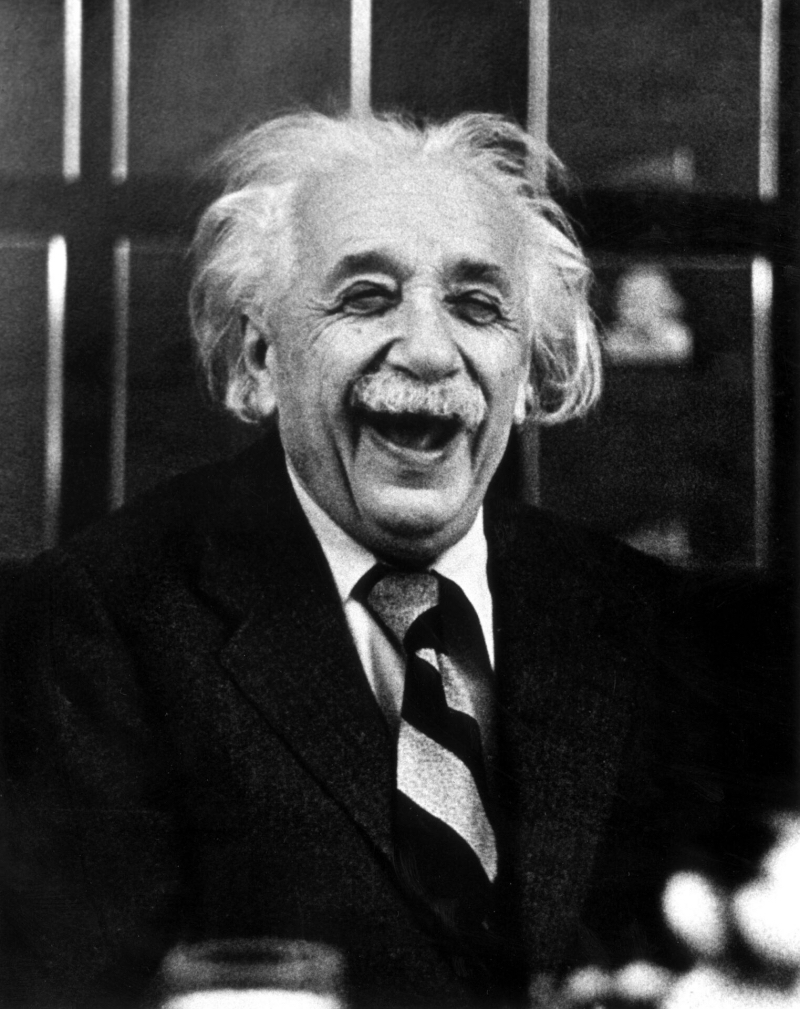
Ruth Orkin, Albert Einstein at a Princeton Luncheon, Princeton, New Jersey, 1955
th her, as if it were an improvised set. Unaware that they were being observed, people became the protagonists of an invisible script made up of gestures, silences and movements.
The exhibition is completed by a gallery of breathtaking portraits of celebrities: Marlon Brando, Albert Einstein, Alfred Hitchcock, Orson Welles and Robert Capa. These are not just photos, but encounters.
Ruth Orkin knew how to capture people’s souls, even when they were true legends of her time.
Her style is direct, intense, never banal. Every face tells a story, every setting seems to be constructed with the precision of a film set. Ruth Orkin’s talent lies precisely here: in making what is constructed with extraordinary visual intelligence seem natural.
Ruth Orkin, Albert Einstein at a Princeton Luncheon, Princeton, New Jersey, 1955
Why visit the exhibition
Visiting this exhibition means immersing yourself in a world of images that seem to move.
You will take home not only a lesson in the history of photography, but also a new perspective on the present.
Information about the exhibition
RUTH ORKIN. The Illusion of Time
Curated by Anne Morin
Bologna, Palazzo Pallavicini (Via San Felice, 24)
5 March – 19 July 2026
Tickets are available online and can be booked now.
Exhibition opening hours
Thursday to Sunday, 10:00 a.m. – 8:00 p.m. (last admission at 7:00 p.m.)
If you love photography, cinema or simply want to be surprised, don’t miss “Ruth Orkin. The Illusion of Time”. It will be a visual journey you won’t forget.
Have you seen other photography exhibitions?
Tell me about your experience in the comments or write to me: I enjoy talking to people who love art as much as I do.

Follow me on:
About me
In this blog, I don't explain the history of art — I tell the stories that art itself tells.