

Vittorio Matteo Corcos: the painter of women and gazes
There is an Italian painter who knew how to transform elegance into art and dreams into portraits.
His name is Vittorio Matteo Corcos, and he painted the grace, ambiguity, and desire of an era like no other.
Born in Livorno in 1859, Corcos trained first in Florence, then in Naples, where he came into contact with the more realistic and restless painting of Domenico Morelli. It was there that he produced intense works such as L’arabo in preghiera (The Arab in Prayer) and Il boia (The Executioner), two paintings that already show an extraordinary talent for composition and drawing.
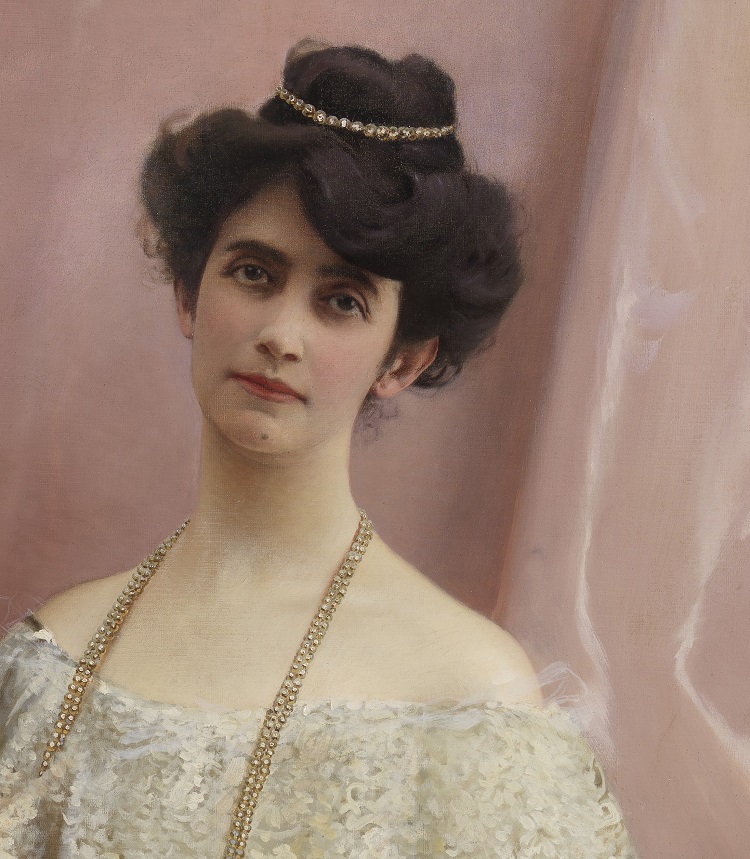
Corcos, Yole Biaggini Moschini (1904)
Vittorio Matteo Corcos: an artist between Livorno, Paris and the salons of high society
However, the real leap forward came in Paris, where from 1880 he worked for fifteen years with the famous art dealer Goupil. In this cosmopolitan and fashionable environment, Corcos met artists such as Boldini and De Nittis and discovered the magnetic power of female portraiture. He exhibited successfully at the Salon and earned himself a nickname that says it all: the painter of beautiful women.
Women, dreams and painting as smooth as silk
Corcos is known for his refined and seductive female portraits, where every detail – from the dress to the gaze – is studied with almost maniacal care.
He painted women as society at the time wanted to see them: elegant, enigmatic, desirable. His most famous painting is undoubtedly Sogni (Dreams, 1896), housed in the National Gallery of Modern Art in Rome. A young woman sits with a distant air, lost in her thoughts. Her casual pose caused a scandal, but it was also the secret of its success.
The public loved that subtle boundary between reality and imagination, between innocence and seduction.
His technique is precise, brilliant, polished. Ojetti wrote that Corcos knew how to paint “silk like silk, straw like straw, wood like wood”.
His women seem alive, sculpted by light, protagonists of an era in which appearance was everything.
The official portraitist of Umbertine society
Returning to Italy, Corcos settled in Florence and became the favourite portraitist of the aristocracy and bourgeoisie. He portrayed countesses, actresses, intellectuals and sovereigns, including Giosuè Carducci, Giacomo Puccini, Queen Margherita and even Emperor Wilhelm II.
His art is not just about beauty. Behind every face lies a world, a social position, a subtle interplay between what one is and what one wants to appear to be. As he himself said:
‘A portrait of a woman must always make her look provocative, even if she is eighty years old.’
In addition to painting, Corcos also devoted himself to writing and illustration.
He collaborated with newspapers and magazines, published short stories and participated in publishing projects related to Giovanni Pascoli.
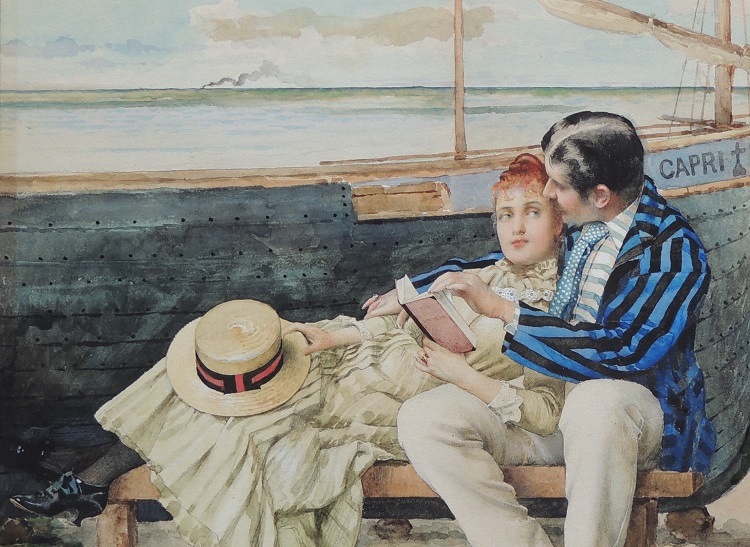
Corcos, Luna di Miele
A legacy to be rediscovered
Corcos died in Florence in 1933, after leaving a self-portrait at the Uffizi Gallery.
Many of his works are now in private collections, but some are preserved in important Italian and foreign museums. His images remain etched in the memory: expressive gazes, dreaming hands, poses that tell stories.
Looking at a painting by Corcos means diving into an elegant, sensual and at the same time fragile world. A world in which art is not only representation, but also a way of life.

Follow me on:
About me
In this blog, I don't explain the history of art — I tell the stories that art itself tells.