

The Pantheon
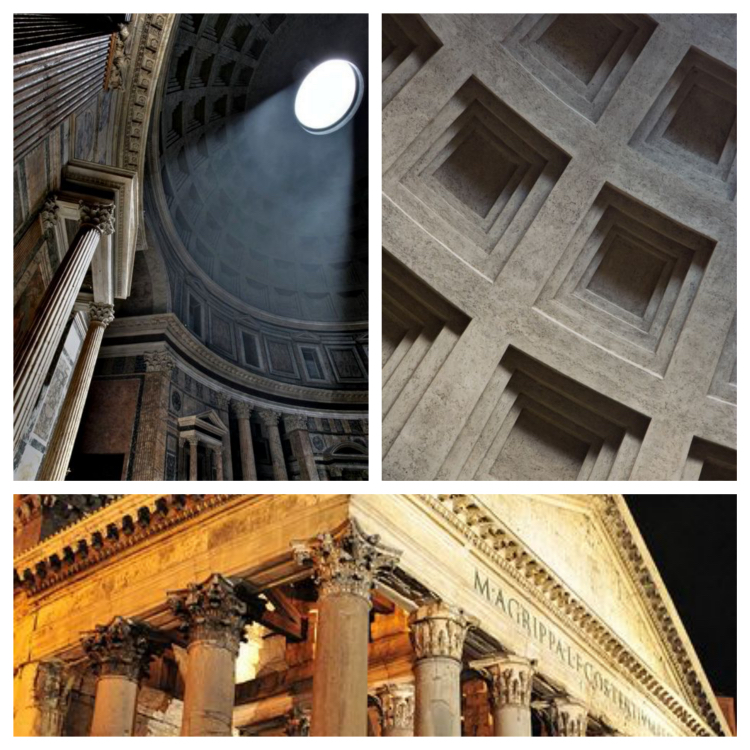
There is one place I never fail to visit when I am in Rome: the Pantheon.
The Pantheon is impressive and has inspired architects throughout the ages because of its structure, its construction technique and perhaps also because it is the only architectural monument of ancient Rome that has remained intact.
Rome. The Pantheon
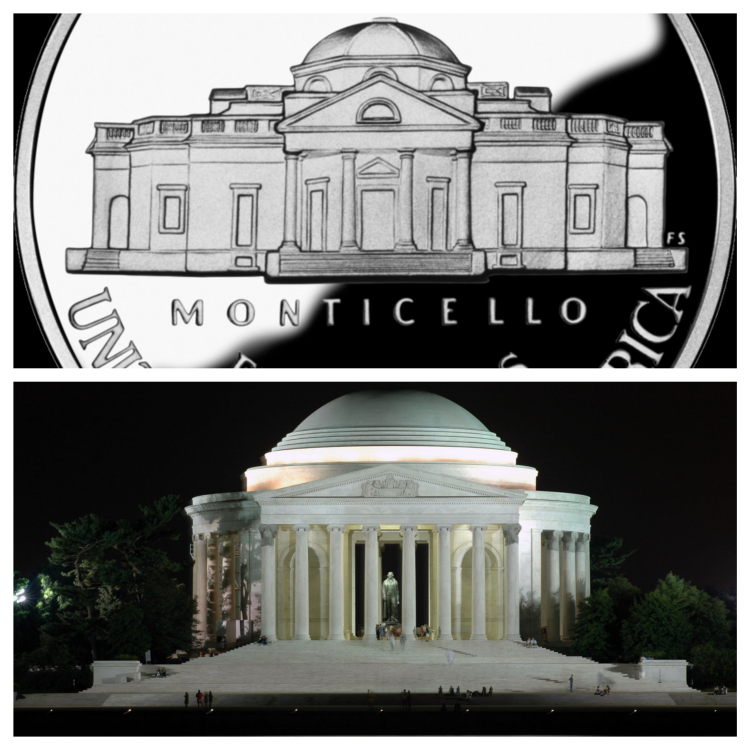
From above: detail of the American 5-cent coin and the Jefferson Memorial. In both cases, the buildings depicted are inspired by and almost reproduce the Pantheon in Rome.
The fortune of the Pantheon
The Pantheon has fascinated many artists and did not leave Renaissance architect Andrea Palladio indifferent. He always drew inspiration from classical style to adapt it to the lifestyle of his time, and his Rotonda in Vicenza was inspired by the structure and dome of the Pantheon.
There are many churches, libraries and buildings around the world that recall the magnificence of this building, and it would be impossible to list them all, but it is certainly curious how some of the most important buildings in the United States of America reproduce the structure of the Pantheon thanks to the close relationship between Palladio and Thomas Jefferson, which led to the construction of the New World.
That is why when we hold an American 5-cent coin in our hands or see the University of Virginia Library and the Jefferson Memorial, we see buildings that seem familiar to us!
History and description of the Pantheon
On the façade of the Pantheon, we read “M. Agrippa L. F. Cos. tertium fecit”, reminding us that this building was founded in 27 BC by Agrippa. In reality, however, what we admire today is the reconstruction of the building carried out by Emperor Hadrian between 120 and 124 AD, as several fires had damaged the structure.
The main reason why the Pantheon has remained intact to this day is due to its change of use.
In 609 AD, Boniface IV transformed the temple into a Christian church (the first case of a pagan temple being converted to Christian use), dedicating it to “Santa Maria dei Martiri” (also known as “Santa Maria della Rotonda”) and placing the bodies of many Christian martyrs inside.
The building is still a church where religious services are regularly celebrated by the Canons of the Pantheon Chapter.
The portico consists of 16 granite columns, and the tympanum once featured a bronze bas-relief depicting the Battle of the Gods and Giants, which was removed in the 17th century by Urban VIII and given to Bernini to melt down and use in the creation of the Baldacchino di San Pietro and other works.
The bronze doors, on the other hand, are original.
The distinctive feature of the Pantheon, which gives the interior a solemn and grandiose appearance, is the dome and its “eye”, which allows light and air to enter.
Its dome is the model for all the domes built in subsequent centuries in Europe and around the world, both in Christian churches and Muslim mosques.
The dome of the Pantheon is an architectural work of exceptional size (43.44 m in diameter) built using a construction technique based on the use of coffers and increasingly lighter materials as it rises upwards.
The basic material is concrete, but in the lower part it is mixed with brick chips, higher up it is combined with tuff chips and in the upper part it is mixed with volcanic lapilli.
Starting in the fifteenth century, the Pantheon was enriched with frescoes, the most famous of which is the Annunciation by Melozzo da Forlì (located in the first chapel on the right near the entrance), but it is also the place where some of the most important artists were buried.
This is another reason why I visit the Pantheon every time I am in Rome, because Raphael Sanzio (next to his betrothed, who died three months before him) and Annibale Carracci and the architect Baldassarre Peruzzi are buried here.
This building also houses the tombs of Vittorio Emanuele II of Savoy (first King of Italy), King Umberto I of Savoyand Queen Margherita.
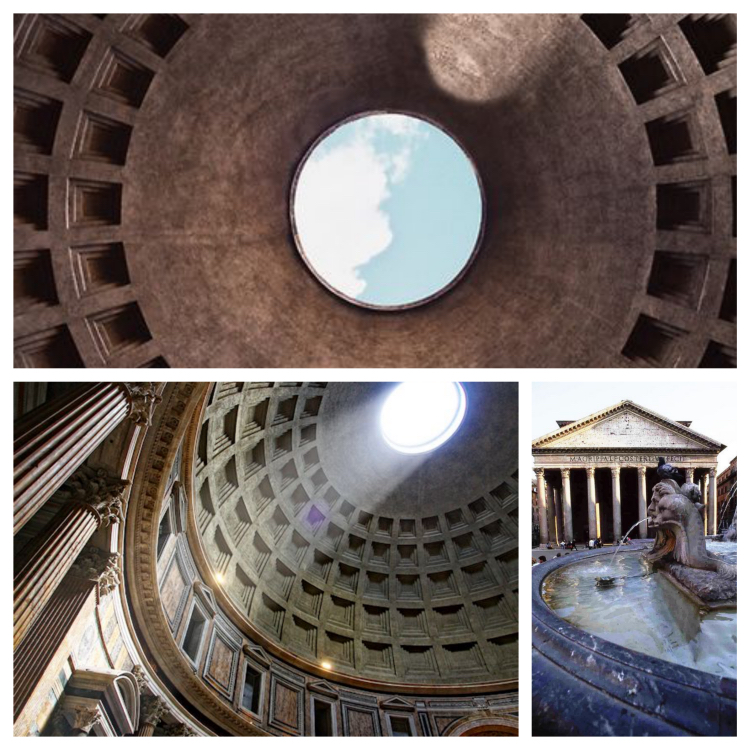
Some interesting facts about the Pantheon
- The Dome and its Oculus: The dome of the Pantheon is still the largest unreinforced concrete dome in the world. At its centre is an open oculus measuring 8.8 metres in diameter. This not only serves to illuminate the interior of the temple, but also has a symbolic function: it represents the sun and its light, a direct link between the temple and the sky.
- The Mystery of Roman Concrete: Modern engineers are still fascinated by the technology used to build the Pantheon. The concrete used for the dome is light and strong, a combination that today’s engineers are still trying to replicate.
- A Temple Dedicated to All Gods: The name “Pantheon” means “temple of all gods”. Originally, the Pantheon was dedicated to the worship of all the gods of the Roman pantheon. Over the centuries, it was converted into a Christian church, but its original name remains a clear indication of its initial function.
- Rainwater and the Oculus: A common question is: what happens when it rains? Surprisingly, rain entering through the oculus rarely wets the floor, thanks to a well-designed drainage system and wind speeds that often deflect the rain.
- The Pantheon as a Source of Inspiration: The architecture of the Pantheon has inspired numerous buildings around the world, including the Jefferson Memorial in Washington, D.C., and the Palazzo della Civiltà Italiana in Rome.
These interesting facts about the Pantheon add to the wonder and admiration for this timeless monument. It is a symbol of the greatness of Rome and of architectural genius that has stood the test of time, continuing to inspire and fascinate.
When you visit the Pantheon (please note that you now need to book tickets to visit the Pantheon), remember these details and imagine the countless stories it has lived through and witnessed during its long existence.

Follow me on:
About me
In this blog, I don't explain the history of art — I tell the stories that art itself tells.