
The Miró Constellations: what they are and what they represent
Miró’s Constellations are a series of paintings, made between 1940 and 1950, in which the artist mixes painting and visual poetry.
The Constellations are characterised by an explosion of bright colours and fluid lines, creating a sense of movement and mystery. Each work seems to tell an abstract and symbolic story, with shapes that blend and overlap each other.
In this post I show you the most important works in the series and explain what they represent.
The Miró Constellations
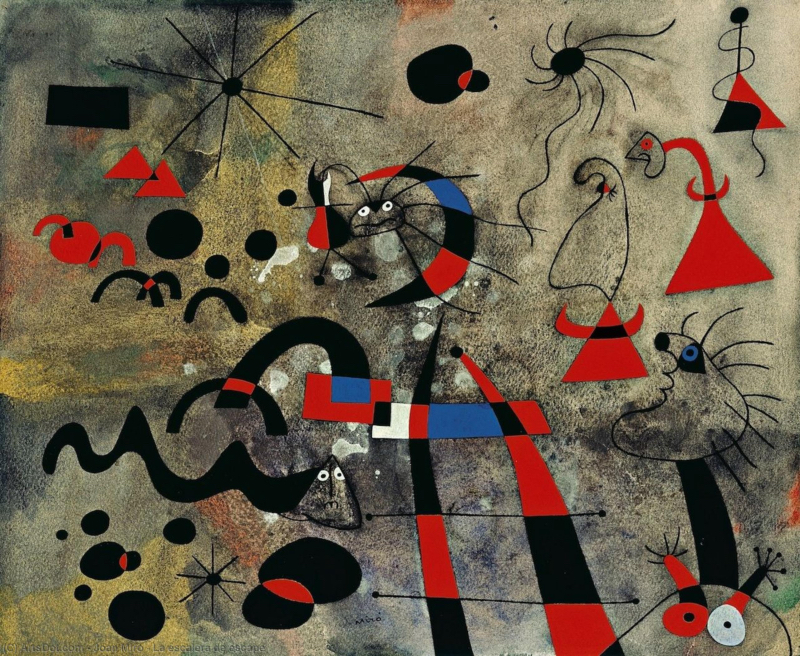
Mirò, La Scala della fuga
The inspiration for Miró’s Constellations comes from the artist’s observation of the night sky. Among the characteristics of Miró’s life and work is a formidable passion for astronomy and the stars, which evoke a sense of connection between the cosmos and his imagination.
The ‘Constellations’ works are composed of organic and abstract elements, such as stylised human figures, birds, stars and symbolic signs. These elements blend together in a poetic expression that invites the viewer to freely interpret the meaning of each painting.
MEANING OF THE CONSTELLATIONS OF MIRÓ
Mirò’s Constellations are an invitation to explore abstract worlds and to be carried away by the evocative power of the imagination. Through the combination of colours, shapes and symbols, Miró allows the viewer to take a real journey into his creative universe, in which painting becomes a means of exploring the boundaries of the human mind and soul.
Miró created a total of 23 paintings over a ten-year period: from 1940 to 1950.
This series represents an important phase of his artistic work and he conceived each ‘Constellations’ painting as an autonomous work. However, the works as a whole form a coherent collection of abstract creations that explore the connection between Miró’s imagination and the cosmos.
STYLE AND TECHNIQUE OF MIRÒ CONSTELLATIONS
The ‘Constellations’ series is characterised by a vibrant colour palette, fluid lines and a combination of stylised figures and abstract symbols. This series of paintings is widely regarded as one of the highlights of Miró’s career and represents his poetic and surreal vision of the world.
In Constellations, Joan Miró uses his distinctive abstract painting style, which combines organic and symbolic elements. His artistic technique for these works ranges from the application of bright, bold colours on canvas to the creation of fluid lines and abstract shapes.
Miró painted spontaneously, letting his imagination guide the creative process. He used a variety of tools, such as brushes, palette knives or even his fingers, to apply paint on the canvas. In some cases, he also used the dripping technique, dripping paint onto the surface to create random effects and a feeling of movement.
This combination of elements creates a dreamlike and mysterious atmosphere, in which the cosmos and the imagination merge into a unique poetic expression.
THE MOST IMPORTANT WORKS IN THE ‘CONSTELLATIONS’ SERIES
Each work in the series is autonomous but together they form a narrative.
Three of the 23 works are worth knowing.
- The Fugitive Staircase (1940). Private collection.
Of this period of his life Mirò recalled that ‘I felt a deep desire to escape. I was freely enclosing myself within myself. The night, music and the stars began to play an increasingly important part in my paintings’.
Observing this painting, one seems to perceive the music that the artist listened to while painting and that allows the colours to arrange themselves harmoniously on the canvas. - Awakening at Dawn (1941). Private collection.
Music plays a crucial role in the Constellations series, especially that of Bach and Mozart. Each star or individual.are added day by day in a slow but steady progression that allows Miró to know exactly where each element should be placed.
In this painting, colour suggests the morning awakening in the delicate hues that emerge from the rough background. Female figures and birds can be spotted popping out between stars and crescents. - The Marvellous Bird reveals the unknown to a pair of lovers (1941). The Museum of Modern Art, MoMA New York.
In this painting, the space is overflowing with signs, the colours are pure, and the line connecting the shapes is extremely thin.
To create this painting, Miró uses the surrealist technique of free flowing images that call each other moon. everything is extremely fluid and seems to follow a musical rhythm.

Follow me on:
About me
In this blog, I don't explain the history of art — I tell the stories that art itself tells.