

Giuseppe De Nittis: the elegance of light between Italy and Paris
There are artists who paint reality and others who transform it, then there is Giuseppe De Nittis, who manages to do both with luminous and silent grace.
When I first saw one of his paintings, a street in Paris with elegant ladies and galloping horses, I thought: it’s like stepping into a period film, but shot in the natural light of morning.
In this post, I’ll take you with me to discover this often underrated but absolutely unforgettable artist.
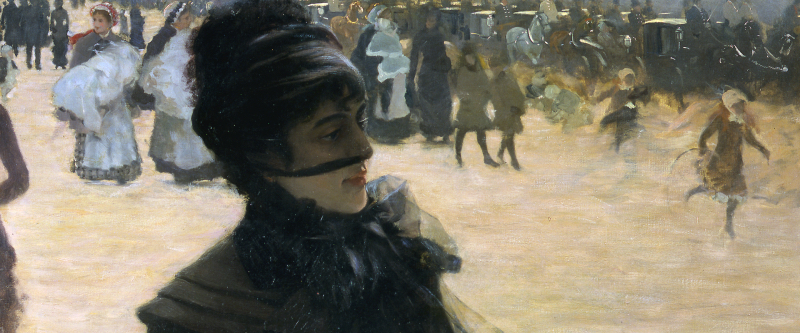
Giuseppe de Nittis, Signora col cane -dettaglio
Giuseppe De Nittis: the elegance of light between Italy and Paris
Giuseppe De Nittis was born in Barletta in 1846, in a Puglia still far from the artistic ferment of the great capitals.
He studied at the Academy of Fine Arts in Naples, but was expelled for insubordination. An early sign of his creative independence.
After a period in Naples spent painting landscapes and making decisive encounters (such as with the “Macchiaioli” group), De Nittis decided to seek his fortune elsewhere and in 1867 moved to Paris, where he fell in love with the city and was quickly noticed by collectors.
De Nittis became friends with Degas, Manet, and Caillebotte and exhibited with the Impressionists in 1874, but he maintained his own elegant and cosmopolitan style.
His career was rapid and brilliant. He traveled extensively, painting modern life, boulevards, horse races, but also the intimacy of bourgeois salons.
He died prematurely in 1884, at the age of only 38, leaving behind a refined, profound, and surprisingly modern body of work.
The most important works of Giuseppe De Nittis
Although many know him only for his Parisian landscapes, De Nittis’s output is wide-ranging and varied. Here are some of his most representative works:
“Breakfast in the Garden” (1883) – A painting that combines domestic intimacy with the brilliance of the open air. A true symphony of light.
“Place des Pyramides” (1876) – An iconic Parisian scene, with carriages racing by and fashionable women. A masterpiece of urban elegance.
“Self-Portrait” (1875) – Intense and direct, it is one of the most fascinating portraits of the Italian 19th century.
“The Horse Race at Longchamp” (1881) – A painting that anticipates the modernity of movement, amid dust, speed, and impeccable details.
“Snow in London” (1875) – For me, one of his most poetic canvases. White has never been so full of nuances.
Painting style: a bridge between two worlds
Many critics define De Nittis as an Italian Impressionist, but this label has always been a little restrictive.
His style is, in fact, a synthesis of Italian realist tradition and French innovation.
From the Macchiaioli, he absorbed an interest in light and outdoor painting. From the Impressionists, he learned freedom of expression, freshness of vision, and attention to modern life.
Unlike Monet or Renoir, however, De Nittis remains more attached to composition and drawing.
His paintings are elegant, refined, often “salon-like,” but never banal.
He looks at the world through the eyes of a gentleman attentive to detail and transforms it into images that seem to breathe.
Some interesting facts about Giuseppe De Nittis
He was a collector of Japanese art, like many artists of the time. In some of his works, the influence of Hokusai and ukiyo-e can be seen, especially in the use of line and framing.
De Nittis was highly appreciated during his lifetime, especially in Paris and London, where he exhibited in the most exclusive salons. He was considered a fashionable artist… but not a passing one.
He left behind over 300 pastels, many of which are extraordinary in their freshness and immediacy. If you can, take a close look at “Portrait of his wife Léontine”: you won’t be able to take your eyes off her gaze.
Today, there is a museum in Barletta entirely dedicated to him: the Pinacoteca De Nittis, housed in the Palazzo della Marra. It’s a must-see if you want to get to know him better.
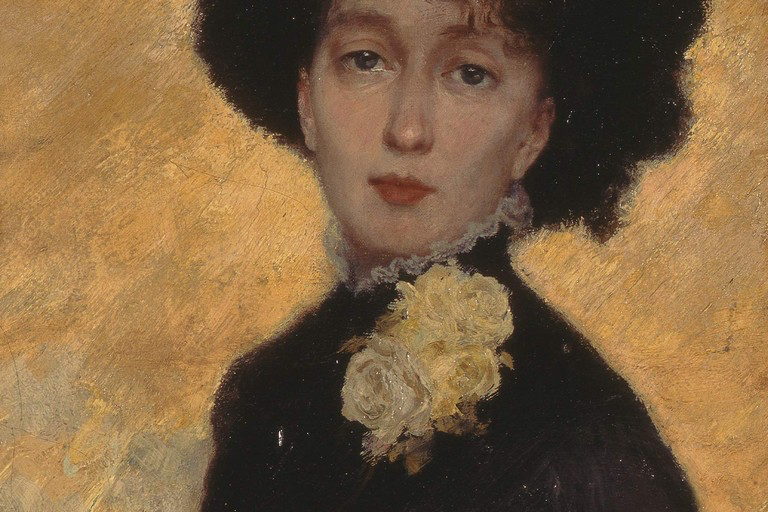
Giuseppe de Nittis, Ritratto della moglie Léontine – dettaglio
Why (re)discover De Nittis today?
Because his art teaches us that beauty does not need to shout and because he manages to portray modernity without losing its poetry. Furthermore, because in an often confusing world, looking at a painting by De Nittis is like bringing order with light.
Finally, because it reminds us that Italy has been able to dialogue with Europe even with painters who lived within its borders and transcended them, bringing our sensibility to the heart of modernity.
If you want to learn more about other Italian artists who lived between the 19th and 20th centuries, I also recommend the article dedicated to Giovanni Boldini.

Follow me on:
About me
In this blog, I don't explain the history of art — I tell the stories that art itself tells.