

In the works of Mauro Patta: murals, identity and Sardinian memory – ARTIST STUDIES
After our journey through the wooden works of Martalar in the mountains of northern Italy (read the interview here), we return to the south to meet another artist deeply connected to his land: Mauro Patta.
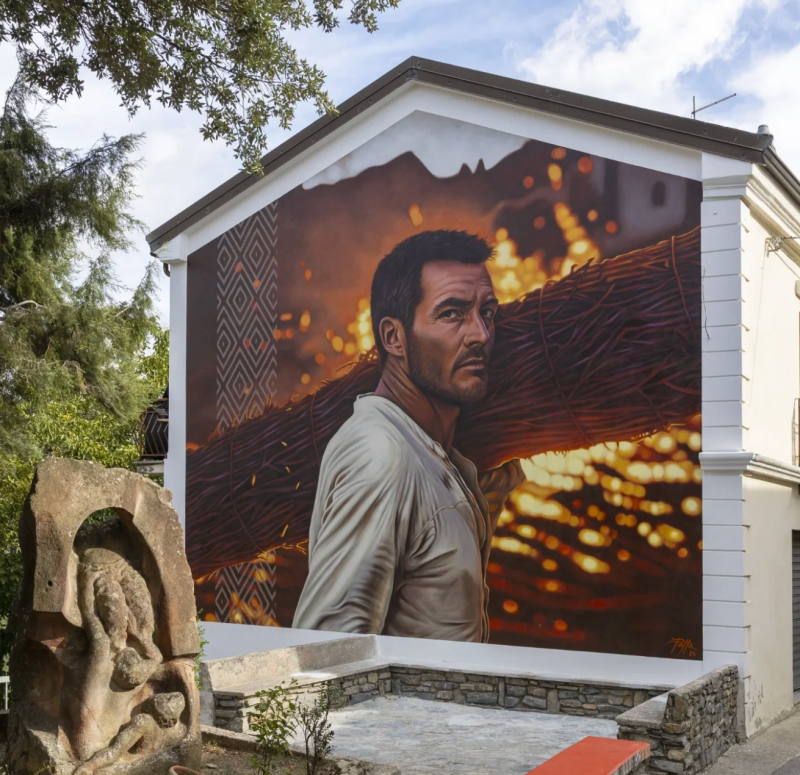
We are in Sardinia, the most authentic Sardinia, far from the postcards and close to the truth. Mauro welcomes us to Sorgono, in the heart of the island, where he creates monumental murals that tell the story of the past, the present and the soul of the territory.
His works are women, nature, beauty and resistance.
Join us in his studio and his vision of the world.
ARTIST STUDIOS
A journey through Italy to discover contemporary artists
curated by Laura Cappellazzo
Sardinia is a region that is as complex as it is little known, as neglected as it is rich in traditions, knowledge and history. Many leave Sardinia in search of work, fortune and opportunities in other places, perhaps on the “mainland”. Yet many others seek it out as a holiday destination, fascinated by something pure and wild that remains even in the areas most domesticated by tourism. A constant coming and going of people, ships and aeroplanes affects Sardinia, which stands there, still in the middle of the sea, watching these human migratory journeys with the wise smile of someone who knows that, in the end, all this fuss is pointless.
Mauro Patta has personally experienced this journey of discovery. He was born in Atzara, a tiny Italian village of 970 inhabitants in the province of Nuoro, and currently lives in Sorgono, which has just over 1,400 inhabitants, right in the centre of the region. Yet between the five kilometres that separate these two villages lie Florence, Russia, Sicily and the search for meaning that Mauro found and brought back with him to his homeland.
IN MAURO PATTA’S STUDIO
Mauro, thank you for giving us the opportunity to meet you and introduce you to our readers. Let’s start here, in Sorgono: why would an internationally renowned artist, one of the most acclaimed in the world, choose to live in a small village literally far from everything?
First of all, thank you, Laura, for your interest in my art.
When we decided to return to live in Sardinia, we had no doubts: we wanted to return to the heart of the island, to Mandrolisai. I grew up here, I feel at home, it is where I recharge my batteries.
Another important factor is that I travel a lot for work, I meet lots of new people and when I take a break from one project to another, I come back to our hills to rest. Life here is slow, nature is everywhere, and all this is deeply regenerating for me.
In your interviews, you say that you started creating murals in 2014 and that you have become part of a deeply felt artistic tradition in Sardinia. Can you explain this to us? Generally, street art is thought of as something “modern”… something associated with big cities.
In that case, I was referring to the art of muralism, which began in Sardinia in 1967 with Pinuccio Sciola in San Sperate. Soon after, the Orgosolo phenomenon arrived, where art took on a political connotation, giving voice to resistance and class struggle.
Since then, murals in Sardinia have never stopped, even if over time they have taken on a more nostalgic meaning, linked to an agro-pastoral life that no longer exists. I became part of that context when I started painting walls.
How did you train? Did you have any teachers?
I have always drawn, ever since I was a child. I didn’t have the opportunity to attend art schools for children, but I had some great examples. For those who don’t know, I grew up in Atzara, a small village which, despite its size, had deep links with art. At the beginning of the 20th century, it was frequented by costumbrista painters such as Antonio Ortiz Echagüe and Eduardo Chicharro, and later by Filippo Figari. Atzara is also the birthplace of Antonio Corriga, an important painter on the Sardinian scene in the 20th century. I believe that all this stimulated me to continue. I then attended the Art School in Cagliari, but interrupted my studies to work. At the age of twenty-five, I realised that I had strayed from art, and at that moment I decided that if I didn’t start again then, I probably never would. So I enrolled at the Academy of Fine Arts in Florence.
Your murals are artistically refined, with human figures often superimposed on decorations that are no less important than the subject: sometimes they look like real fabrics, other times they are natural elements. Can you tell us about this?
I found my own visual language by combining the realistic with the decorative. I think this stems partly from my four years’ experience as a porcelain painter at the Richard Ginori factory in Sesto Fiorentino, and partly from the inspiration I draw from Sardinian culture, which offers a wealth of material to reinterpret.
Where does this attention to detail come from, considering that your works are several square metres in size?
Of course, the size of the work is a significant factor when studying the composition, but for me it is important that the work functions as a whole. Every detail has its own function: it can speak to the theme, or it can be a way of giving a more romantic or proud interpretation, for example. The important thing is that, as a whole, harmony is achieved.
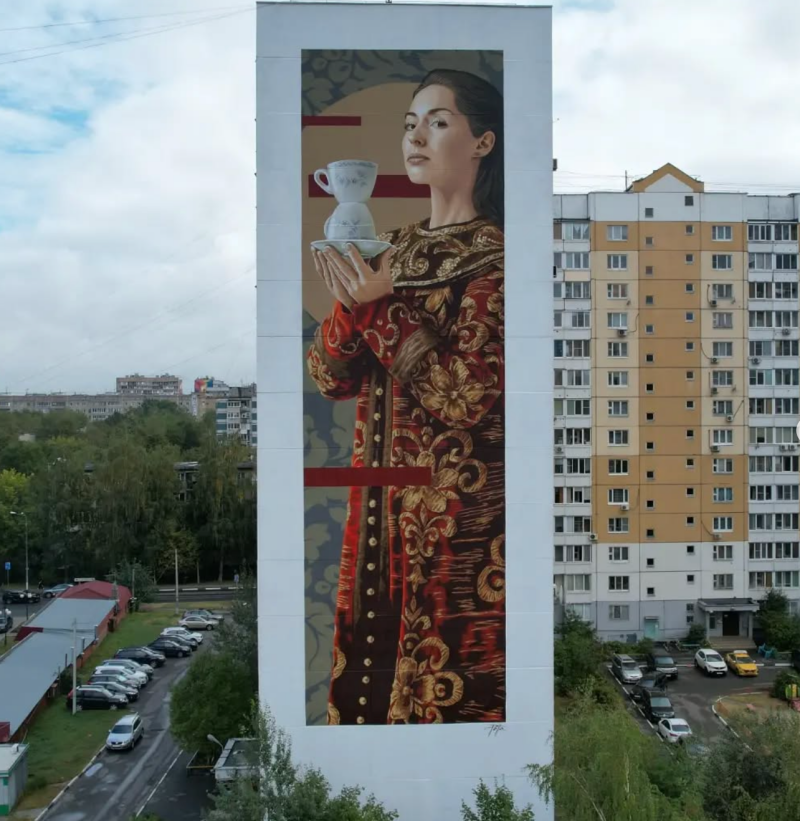
You have a huge work, 400 square metres, of impressive beauty called “Tea Time” located in Balashikha, near Moscow. Why Russia? Would you like to tell us about it?
I love painting in Sardinia and telling its story, and this takes up a lot of my time, but that doesn’t mean I’m not open to experiences elsewhere. On that occasion, I was invited by the “Urban Morphogenesis” street art festival to participate and, coincidentally, I had some free time, so I decided to go.
Street art festivals are very interesting events, not only because you go to a new place to paint, but also because you meet people from all over the world who do the same job. You exchange words and friendships are formed. It’s an experience that must be lived.
We really like the stories behind the works. You said that “Behind each of your murals there is a woman who inspired me”. Who are your muses?
It’s true, I often seek out the feminine aspect in my works. I do it spontaneously, I’ve always done it. Then it depends on the theme: it could be a woman in traditional dress, to convey the pride of a place, or the female voice of the nature that surrounds us.
Now a more technical question: how do you draw on square metres of wall? In other words, how does a work of this type come about?
The work starts with a sketch based on the proportions of the wall, a very demanding and often underestimated phase. Only after achieving a satisfactory result can you move on to painting, naturally on a surface that has already been prepared.
To tackle the size of the wall, I use the oldest technique, the grid. The draft, created beforehand, is scaled down: first I sketch the design and then I start painting.
So there is work that comes before the scaffolding, the paints and the outdoor drawing. Our column is entitled “artist’s studios”. Can you describe your studio? A studio says a lot about its artist…
I have a studio where I paint and keep all my work materials. At home, on the other hand, I have a space set aside as a studio, a sort of office where I also devote myself to creating sketches. To be honest, it’s a bit chaotic: full of notes written on scattered sheets of paper, doodles, reminders. Every now and then I try to tidy it up, but the chaos always returns.
What does making art mean to you today?
Essentially, I believe that, today as yesterday, art is nothing more than a way of expressing oneself. The important thing is that this way of expressing oneself is sincere. However, we live in a time when art can reach the public directly, without intermediaries as was the case in the past. This has been made possible by social media and the Internet in general. In muralism, perhaps, this peculiarity is even more evident because these are not gallery works, but urban spaces that are experienced on a daily basis.
We usually end our interviews by asking our guest to name another artist we can ask questions about their work and art. Mauro, who would you like to introduce us to?
Skan is a Sardinian street artist, a friend and colleague who breaks down images with great skill in the use of spray cans in figurative painting.
A very interesting artist.
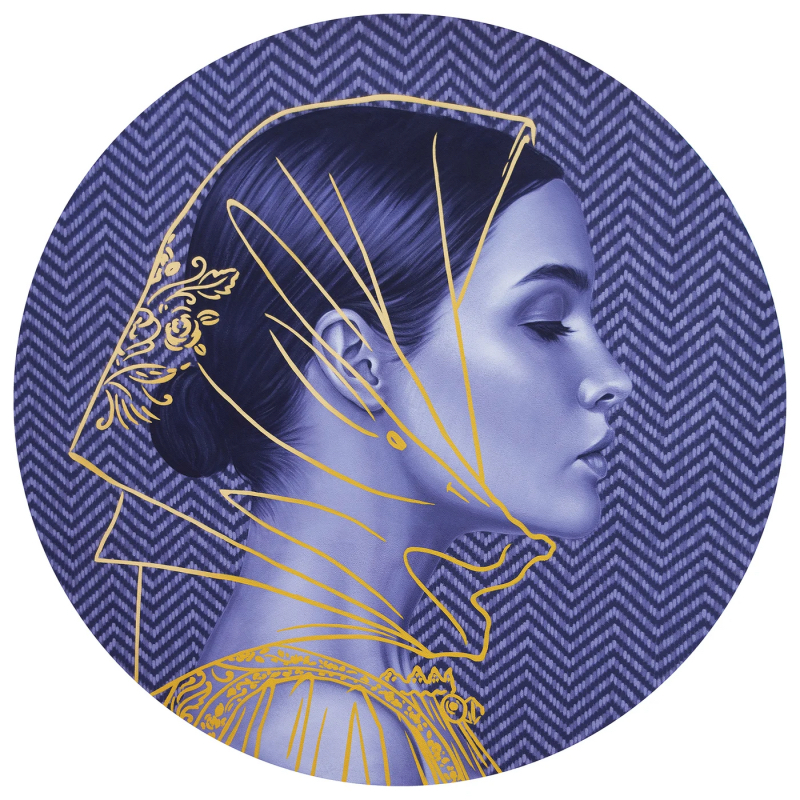
Discover Mauro Patta’s work on Instagram and on his official website.
Post a cura di: Laura Cappellazzo

Follow me on:
About me
In this blog, I don't explain the history of art — I tell the stories that art itself tells.