

Laocoonte: descrizione e curiosità di un capolavoro
There are works of art that stay with you forever. Some strike you with their beauty, others with the power of their story. For me, Laocoon did both.
I studied it in secondary school for a surprise assignment, and since then I have realised that art was not just a passion, but something that would change my life. In a way, if I am involved in art today, it is all his fault.
Laocoon: history, meaning and interesting facts about the masterpiece that changed my life
The discovery of Laocoön: when and where
The modern adventure of this masterpiece began in 1506, when during some excavations in Rome, a gigantic and fragmentary sculpture was found. It was immediately clear that it was an extraordinary work. The best artists in the city were called to study it.
Among them was a certain Michelangelo Buonarroti, who needs no introduction. The sculptural group was unearthed near the Esquiline Hill and was soon identified as the Laocoön mentioned by Pliny the Elder, who had seen it in the house of Emperor Titus.
The work is attributed to three sculptors from the school of Rhodes: Agesander, Polydorus and Athenodorus.
After its discovery, it was decided to keep it inside the Vatican. It was this decision that led to the creation of the collection we now know as the Vatican Museums.
What does the Laocoon represent?
The Laocoön tells a dramatic story, taken from the second book of Virgil’s Aeneid.
Laocoön is a Trojan priest who tries to warn his fellow citizens about the deceitful gift of the Greeks: the famous Trojan Horse. He throws a spear at it, trying to reveal the deception. For this gesture of truth, he is punished by the hostile gods.
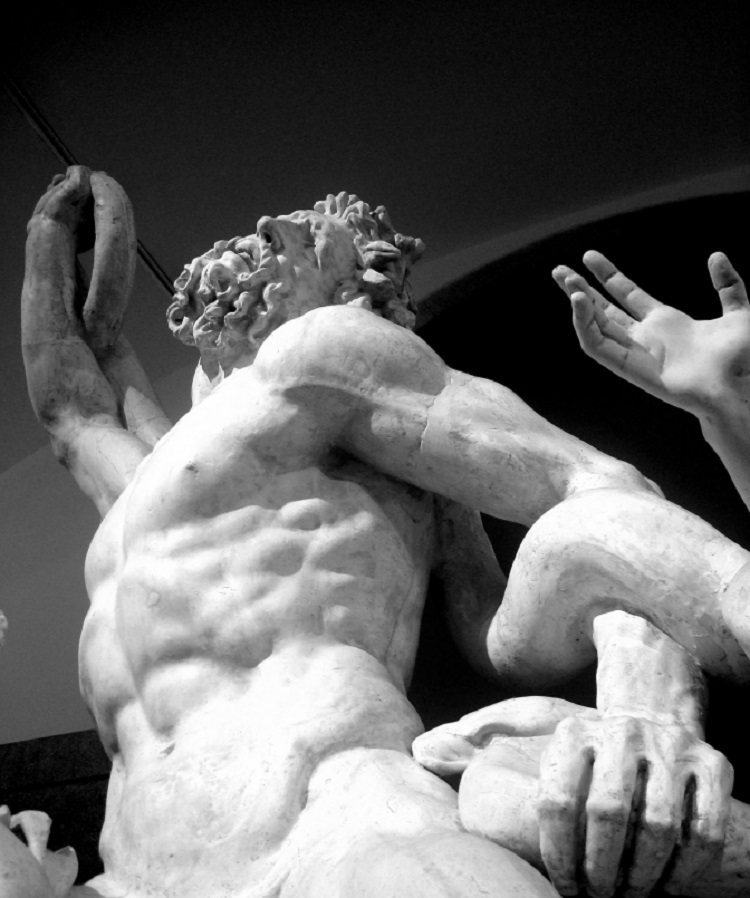
Two sea serpents, Porcete and Caribea, attack him and his sons, Antiphanes and Timbreus. The sculpture captures that very moment: the desperate struggle against fate, the deadly embrace of the serpents, the extreme twisting of the bodies.
Every muscle, every expression, every detail is sculpted with such precision that the scene seems alive. The pathos is unbearable, but there is also a tragic composure that goes beyond the mere description of pain.
Is Laocoon screaming or silent?
This is the question that many have asked themselves for centuries. I also asked myself this question during that famous high school research project. After observing the work for days, I came to a conclusion that still accompanies me today: Laocoon is not screaming.
His half-open mouth is not a scream, but a form of restrained pain, of acceptance. He is not agitated by the ferocity of the snakes, but by the shame of not being believed, by the responsibility of having involved his children in an unjust fate. His is a noble death, a surrender to unheard truth. For this reason, it is a work that still speaks today to anyone who has felt the weight of misunderstanding.
An eternal masterpiece
More than two thousand years later, Laocoon retains an emotional and formal power that is difficult to match. Every time I see it, in books, in photographs or in person at the Vatican Museums, I feel that original connection resurface. It is, without a doubt, my favourite ancient sculpture. Because of its history, its meaning, and what it has represented in my life.
Where to see the Laocoön today
The Laocoön sculpture group is located in the Vatican Museums in Rome, inside the Octagonal Courtyard.
It has been there since it was found, because it was decided to place it in a location that would enhance its beauty and importance. In a sense, it can be said that the Vatican Museums were created around this sculpture. If you have never seen it in person, add it to your list immediately: it is worth every second of contemplation.

Follow me on:
About me
In this blog, I don't explain the history of art — I tell the stories that art itself tells.