

Damien Hirst’s most famous works: sharks, diamonds, and provocations
Between provocation and reflection, Damien Hirst has built a powerful imagery that revolves around four major themes: death, religion, science, and love.
A British artist born in 1965, he is now a key figure in international contemporary art, capable of dividing, shocking, and fascinating.
If you are looking for an overview of his life and career, here is an article dedicated to him: Who is Damien Hirst.
In this article, however, I will take you inside some of his most famous works, those that have defined his style and sparked debate around the world.
Damien Hirst’s most famous works
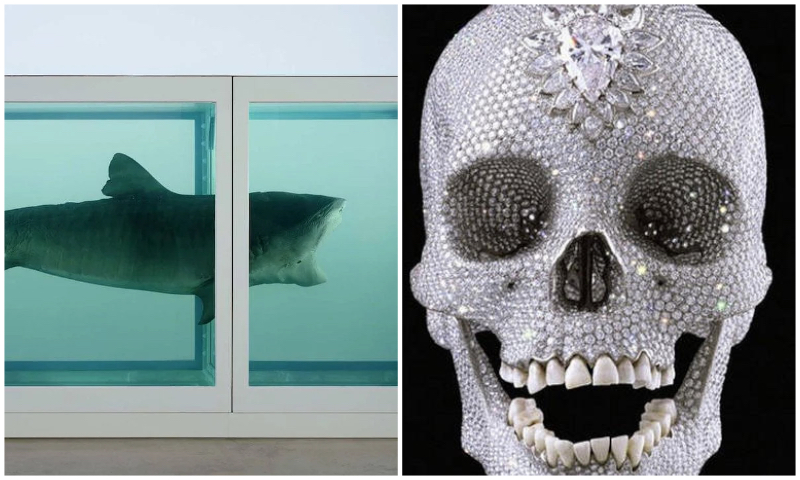
1. The shark in formalin: ‘The physical impossibility of death in the mind of someone who is alive’ (1991)
It’s impossible not to start here.
A real tiger shark over four metres long, immersed in a tank of formaldehyde, with its mouth wide open and its gaze fixed.
This is the work that catapulted Hirst onto the international scene and still represents the essence of his poetics: bringing the viewer face to face with death in a real, disturbing and impossible to ignore way.
2. ‘For the Love of God’ (2007): the diamond-encrusted skull
A platinum human skull covered with over 8,000 pure diamonds, including a 52-carat pink diamond set on the forehead.
‘For the Love of God’ is a contemporary memento mori, combining irony and blatant luxury.
Hirst plays with the idea of eternity: can man perhaps avoid death by covering it with gold and precious stones?
3. Dissected animals: the ‘Natural History’ series
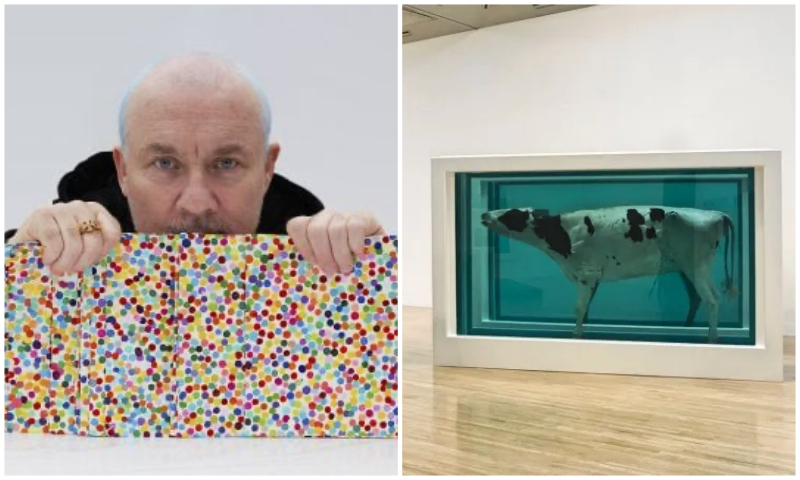
Not just sharks. Cows, calves, sheep, even butterflies and insects: Hirst creates compositions in which life and death coexist, often dissecting animals in half and showing the inside of their bodies.
The result? A short circuit between scientific fascination, disgust and meditation on the body as an object.
Each work is a sort of artistic autopsy of existence.
4. ‘Spot Paintings’ and the rationality of chaos
Colourful and geometric, the polka dot paintings are the opposite of his more macabre works.
They appear cheerful and orderly, but Hirst uses them to question repetition, perfection and control.
The fact that they are often produced by assistants, following strict mathematical rules, also raises the question: who is the author of the work? The idea or the hand?
5. ‘A Thousand Years’ (1990): life and death in real time
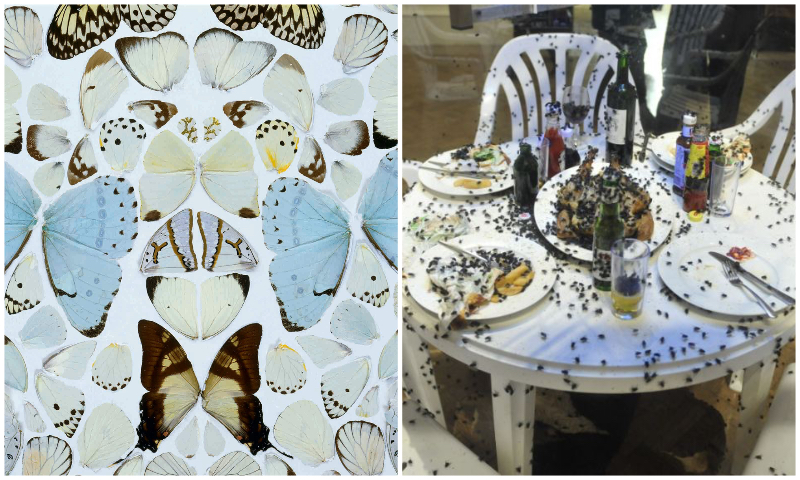
A display case divided in two: on one side, a decomposing cow’s head; on the other, a colony of flies.
The flies feed on the flesh, reproduce, and die.
A raw, vivid, disturbing work.
Hirst transforms the exhibition space into an artificial ecosystem, where death generates new life.
6. The butterfly series
Real butterflies, embedded in fresh paint or used to create crosses and religious motifs on large panels.
Beauty and violence coexist in these works.
Butterflies, symbols of the soul and rebirth, are immobilised forever, transforming the moment into eternity.
Art as a tool for navigating darkness
“Science, art, love and religion are the tools with which we try to navigate the darkness of existence,” Hirst said in one of his most famous statements. However, none of these tools really work: they help us find our way, sometimes they deceive us, and often they leave us alone.
Hirst’s works offer no consolation. They force you to look — really look — at what you usually avoid: fragility, finitude, fear.
Damien Hirst today
Whether you love him or hate him, Damien Hirst has marked an era and redrawn the boundaries between art, science, marketing and provocation.
Each of his works continues to ask us a simple, uncomfortable question: what are you really willing to look at when you look at a work of art?
🖌️ This article was published in 2013 and was updated on 25 August 2025 with new facts and insights.

Follow me on:
About me
In this blog, I don't explain the history of art — I tell the stories that art itself tells.