

Corcos’ dreams: the painting that expressed freedom of thought
There are paintings that are unforgettable. Works that do not merely represent a figure but, in the silence of a glance, open a door to an entire inner universe.
‘Dreams’ by Vittorio Matteo Corcos is one such painting.
Created in 1896 and now housed in the National Gallery of Modern Art in Rome, this painting captivated and scandalised the society of the time, becoming an icon of fin de siècle femininity.
What made this portrait so famous?
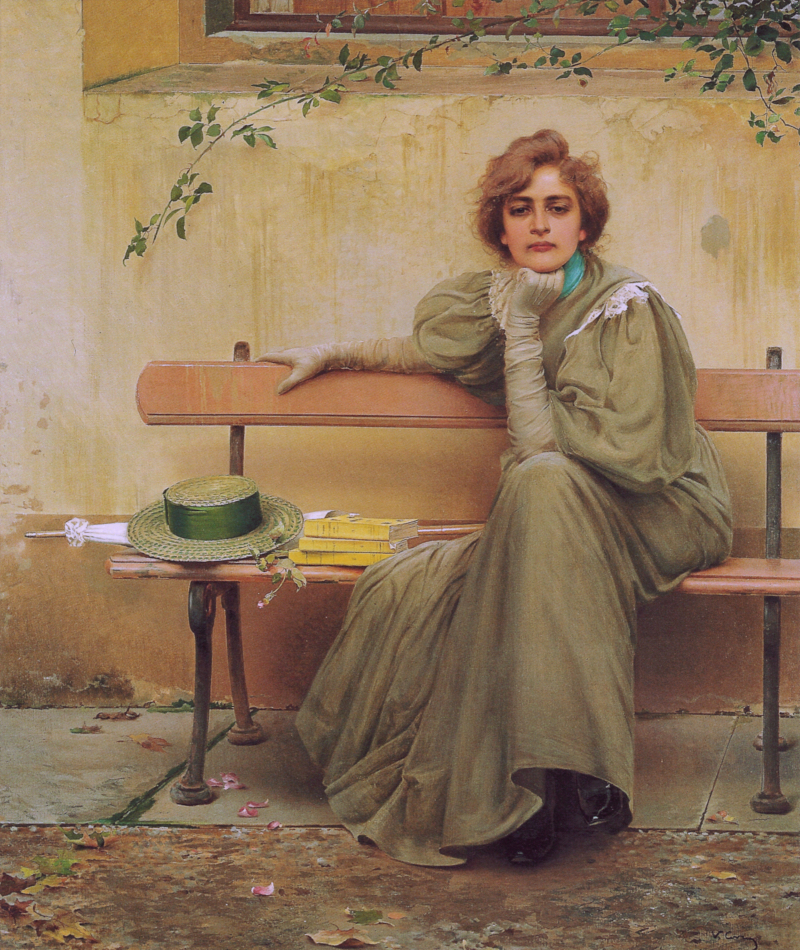
Dreams by Vittorio Corcos: a gaze that caused a scandal
The protagonist of Dreams is a young woman, elegantly dressed, sitting with her arms crossed and her gaze suspended. She does not look at the painter, nor does she look at the viewer. She looks elsewhere, and it is precisely in that elsewhere that the mystery arises.
Is she lost in her thoughts, or is she challenging us? Is she naive, or aware of the power she wields? The answer is never clear, and this is precisely the strength of the work.
Corcos portrays a suspended moment, a mental intimacy that becomes universal. It is the representation of dreams, yes, but also of desire, boredom, youth and anticipation.
A girl, a pose, a thought: an elegant scandal
When it was first exhibited, Dreams got everyone talking. Not because of nudity or explicit provocation, but because of something more subtle and dangerous: freedom of thought.
The girl portrayed by Corcos is not ashamed to show herself immersed in her dreams. She has a relaxed, perhaps even sensual, certainly modern attitude.
For the moralists of the time, it was too much. For the public, however, it was love at first sight.
So much so that the image was even reproduced on a picture postcard, a sign of its resounding success. Everyone wanted that enigmatic face, that casual pose, that unexplained dream.
Corcos, the psyche and painting
With Sogni, Vittorio Matteo Corcos proves himself to be much more than just an elegant painter.
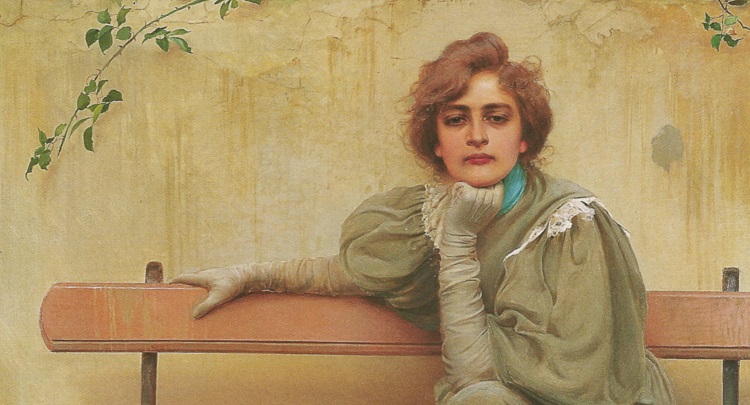
He enters the psychology of his model, the depths of her inner world, and conveys it to us with smooth, brilliant painting, capable of making us “feel” the fabrics, the skin, the silence.
The light caresses the face and hands, the neutral background amplifies the focus on the subject. Every detail is carefully crafted, but nothing is rigid. Everything vibrates. Everything lives.
The dream, in short, is also ours, and perhaps that is why Sogni continues to speak to us today. It shows us that behind every face there is a story, a thought, an invisible elsewhere. And it invites us to stay there, to look, to imagine.
Where is Sogni today?
Sogni is kept at the National Gallery of Modern and Contemporary Art in Rome.

Follow me on:
About me
In this blog, I don't explain the history of art — I tell the stories that art itself tells.