

Paul Cézanne: the artist who changed the way we see the world
If modern art exists, it owes much to Paul Cézanne. A solitary, stubborn and deeply innovative painter, Cézanne was one of those artists who worked quietly, without fanfare, but with a very clear idea in mind: to reinvent painting starting from nature and the gaze.
Born in Aix-en-Provence in 1839 and died in 1906, Cézanne is now considered the true bridge between Impressionism and contemporary art. Without him, Cubism, 20th-century art and much of contemporary painting would probably not exist in the form we know today.
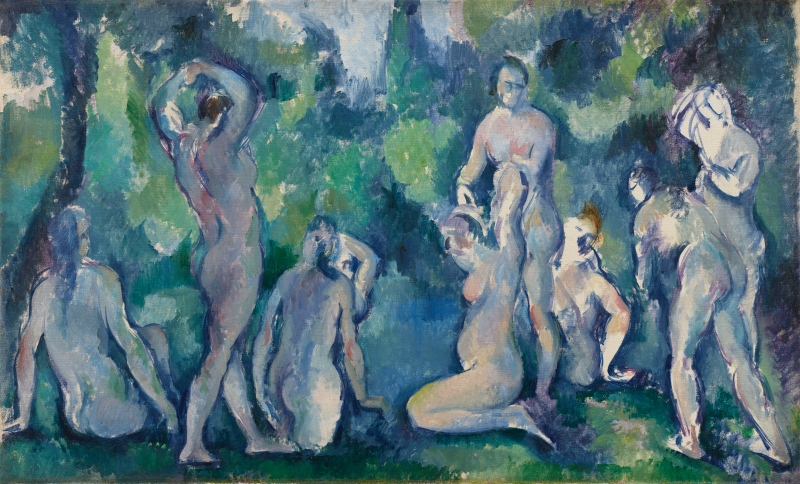
Paul Cezanne, Groupe de baigneuses, around 1895. Oil on canvas, 47 x 77 cm. Ordrupgaard, Kopenhagen. Photo: Anders Sune Berg
Why Cézanne was such an important artist
Cézanne lived for a long time in an uncomfortable position. He was not really an Impressionist, even though he shared some of their ideas, and he did not belong to any organised avant-garde movement. However, from the mid-1880s onwards, he found a personal language that made him a central figure of modernity.
His goal was not to imitate reality, but to understand how we see it.
Cézanne wanted to make the process of painting itself visible by analysing the relationship between light, colour and form. To do this, he questioned rules that were considered untouchable, such as central perspective and the illusionistic rendering of space.
For Cézanne, painting had to become an equivalent of nature, not a copy of it. This radical idea paved the way for a new way of constructing images, which profoundly influenced artists such as Picasso and Braque.
Cézanne and the landscape as a laboratory of modernity
Provence was not simply a place for Cézanne to paint, but rather a true experimental laboratory. In his landscapes, nature becomes structure, balance and rhythm. Trees, hills and skies are not decorative backgrounds, but elements of a completely new visual language.
His Provençal views helped to create the very image of the region as a place of light, silence and timeless beauty. Through intense colours and solid constructions, Cézanne transformed the landscape into a modern icon, capable of still speaking to the contemporary eye today.
Montagne Sainte-Victoire: a pictorial obsession
Of all the subjects Cézanne tackled, the Mont Sainte-Victoire occupies a special place. The artist painted it about thirty times in oils and numerous watercolours, always observing it from different points of view.
That rocky massif became the ideal testing ground for him to answer his fundamental question: how to paint the world as we perceive it. Cézanne did not represent what he knew about the mountain, but what he saw in the moment, translating visual sensations into brushstrokes of pure colour.
Through his famous taches colorées, he managed to construct forms using only colour. In this way, he attempted to reconcile the stability of the mountain with the changeability of perception, giving rise to a language that would influence all 20th-century art.
Bathers and still lifes
Another central theme in Cézanne’s work is that of bathers, which he addressed several times over the years. His figures are neither idealised nor heroic. Bodies and landscape merge silently, sharing the same rhythm and structure.
The bathers seem to grow out of the earth, bending like trees or following the curves of the river. This fusion creates a particular tension: the figures are present, but seem on the verge of dissolving into the environment. Cézanne thus combines the tradition of the classical nude with a modern vision of space and form.
Cézanne’s still lifes, seemingly simple, are in fact among his most revolutionary works. Apples, pears, bottles, plates and tablecloths become elements of a rigorous, almost architectural construction.
Each object has weight, volume and presence. Fabrics move like landscapes, fruit becomes chromatic mass, light shapes forms without ever losing solidity. Nothing is random. Even in small formats, Cézanne sought the internal order he pursued in the vastness of nature.
In his later years, Cézanne introduced the skull, a powerful symbol laden with meaning, into his still lifes. Here, the painting becomes more essential and meditative. The skull is not a simple object, but a reflection on the transience of life and the permanent structure of the world.
As in his other works, the skull is studied in its form, weight and shadows, transforming it into a silent and almost metaphysical presence. In these paintings, matter and thought merge in a profound and poignant way.
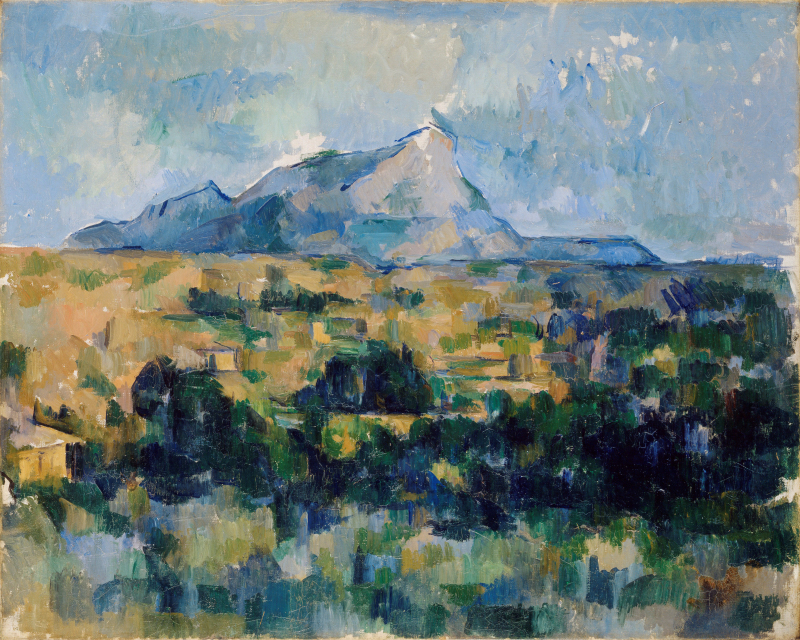
Paul Cezanne, La Montagne Sainte-Victoire vue des Lauves, 1902–06. Oil on canvas, 65 x 81 cm. Private collection. Photo: Dominic Büttner
The importance of Cézanne’s art
Paul Cézanne’s art is important because it changed not only what is painted, but how it is viewed. It freed painting from academic rules, paving the way for a new freedom of expression based on observation, perception and the artist’s personal language. His research laid the foundations for movements such as Cubism and influenced key artists of the 20th century, from Picasso to Matisse, Braque to Morandi.
Today, looking at a painting by Cézanne means taking a step back and, at the same time, a huge step forward: it is an invitation to observe more deeply, to grasp the relationships between things, to recognise painting as an act of world construction. Cézanne teaches us that every brushstroke can contain an idea, every fruit can be a thought-out form, and every landscape can speak the language of infinity.
Paul Cézanne never sought immediate success, but worked slowly, often misunderstood, but with absolute determination. Today he is recognised as one of the fathers of contemporary art, the artist who taught us to look at the world not for what it is, but for how we perceive it.
Understanding Cézanne means understanding a decisive passage in the history of art. Looking at his works means entering into a dialogue made up of balance, tension and silent depth.

Follow me on:
About me
In this blog, I don't explain the history of art — I tell the stories that art itself tells.