

Palazzo della Pilotta works and history
PALAZZO DELLA PILOTTA WORKS AND HISTORY
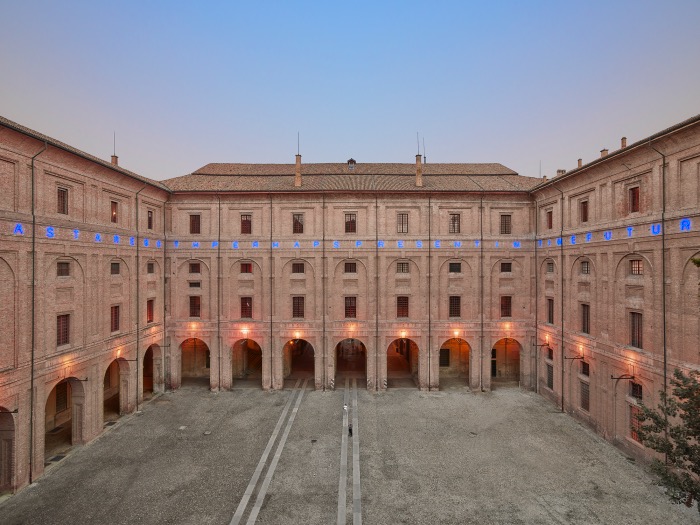
Palazzo della Pilotta is the symbol of the power of the Farnese family, but it is also the place where you can discover the history of Parma through the buildings that make it up and the works of art that are kept inside.
In this post I will tell you about the history of Palazzo della Pilotta and the works you can admire.
Pilotta Palace
Palazzo della Pilotta is actually a monumental complex originally designed to house the services of the Farnese court.
PALAZZO DELLA PILOTTA HISTORY
The complex of buildings has a strange name, which derives from the game of “pelota” that was played in its courtyards.
The history of the Palazzo della Pilotta began around 1583, during the last years of the duchy of Ottavio Farnese (1547-1586), based on a design by Francesco Paciotto.
The first nucleus of the Pilotta complex was the Corridore, an elevated gallery that is now the Petitot Gallery of the Palatine Library.
From 1602, Ranuccio I contributed to defining what is still today the structure of the Palazzo della Pilotta. A building organised to create a system of courtyards, connected to the Ducal Palace, which was destroyed during the bombing of Parma in the Second World War, and to the Giardino, located on the other bank of the Parma river.
The internal courtyards and wings, built from millions of bricks, were intended to house warehouses, stables, barracks and even a grand “multipurpose” hall, which was later converted into a court theatre.
The first phase of work on the Palazzo della Pilotta was completed in 1611, with the exception of the Farnese Theatre, which was built in 1618-1619 and inaugurated in 1628.
For years, the Palazzo della Pilotta was also the place where the works of the Farnese collection were kept, and it underwent various vicissitudes.
With the unification of Italy, the Palazzo della Pilotta underwent structural work that transformed the court system into a “monumental” complex in its own right, and the collections were divided by type and managed by three different institutions: the Gallery, the Museum and the Library.
In 1885, the ducal library took its current name of Palatina, while four years later, in 1889, the Music Section was established. Finally, in 1963, the Bodoni Museum was established, the oldest printing museum in Italy, which houses a vast collection of printing tools and precious volumes produced by Bodoni’s printing house.
Since 2016, these cultural institutions and the collections they house have been brought together, creating a unique monumental complex.
PALAZZO DELLA PILOTTA WORKS
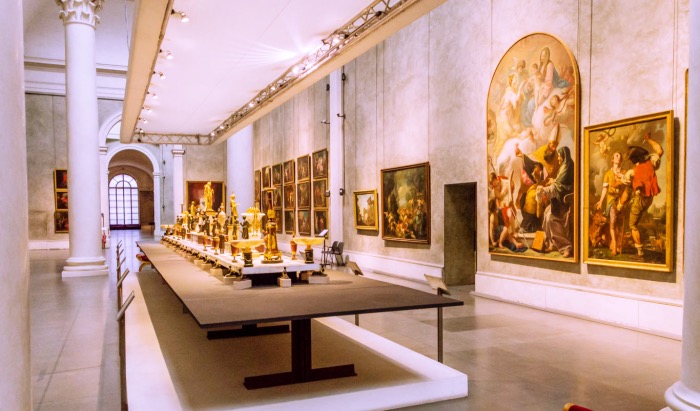
Palazzo della Pilotta is now home to works of art of the highest value, and the history of this collection has been marked by various vicissitudes.
During the 17th century, the art collections of the Farnese family, rich in masterpieces, were transferred from Rome to Parma: first the library and ancient coins, then the picture gallery and drawings, and finally some examples of ancient statuary, to which were added assets from acquisitions and confiscations from wealthy feudal lords of Parma and various churches and convents.
In 1734, Charles of Bourbon, son of King Philip V of Spain and Elisabeth Farnese, transferred the Farnese estate to Naples, leaving the Pilotta stripped of its artistic treasures. This remained the case until the accession of his brother in 1749, Philip of Bourbon (1748-1765), who took action to compensate for the loss and embarked on an enlightened programme of political and cultural renewal. Within a few years, a well-stocked library (the origin of the current Palatine Library) was established, along with an Academy of Architecture, Painting and Sculpture (whose artistic and archaeological collections form the core of the National Gallery and the Archaeological Museum) and the printing house of Giambattista Bodoni, an illustrious world-renowned typographer.
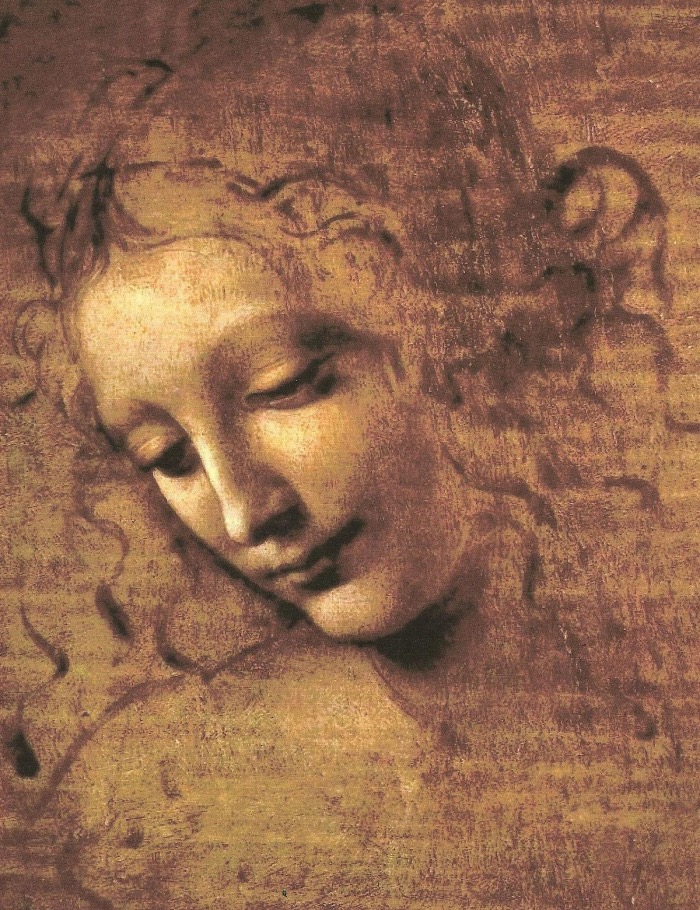
La Scapigliata di Leonardo da Vinci, Palazzo della Pilotta.
PALAZZO DELLA PILOTTA: THE WORKS OF THE NATIONAL GALLERY
The Farnese family, who were patrons and great collectors, accumulated one of the most important artistic and cultural heritages of their time between the 16th and 18th centuries.
Between Parma and Rome, their collection numbered around 3,000 works, including paintings, art objects and antiques.
Of the works currently preserved in the National Gallery, the portraits are a sign of self-celebration and, at the same time, the starting point for the future collection.
In particular, the “Portrait of Pope Paul III with a Nephew” by Sebastiano del Piombo is perhaps the most important in the entire collection.
In Parma, the Farnese family’s interest initially focused on paintings from the local school (Correggio, Parmigianino, Bedoli), then broadened to include works seized from local feudal lords. Subsequently, thanks to political relations and marriage alliances, it expanded to include works from all over Europe.
At the end of the 17th century, Ranuccio II created the “Ducale Galleria”, transferring much of the wealth accumulated in Rome to Parma and creating a museum that distinguished between court furnishings and works of art.
In 1731, the last duke, Antonio, died without an heir. His successor, his nephew Charles of Bourbon, remained in Parma for only four years and, crowned King of the Two Sicilies, transferred almost the entire collection to Naples, completely emptying the residences in Parma, with the exception of famous paintings such as “The Healing of the Blind Man” by El Greco and the aforementioned “Portrait of Paul III” by Sebastiano del Piombo.
With the arrival in Parma in 1748 of Duke Philip of Bourbon, Charles’ younger brother, and his wife Louise Elisabeth of France, daughter of Louis XV, a new cultural season inspired by Enlightenment ideas began. In 1752, the Academy of Fine Arts was established, which, with the essays of its students and the winning paintings from competitions, together with the ducal collections, contributed to the creation of the current Gallery and its spectacular collection of masterpieces.
The expansion of the public museum was due to Duchess Maria Luigia of Austria, who in the early 19th century commissioned architect Nicola Bettoli and engraver Paolo Toschi to design a new exhibition layout that would showcase the large altarpieces by Correggio alongside the numerous paintings and acquisitions made over the years.
In the second half of the 20th century, all the spaces of the current National Gallery, including the old barns in the north wing of the complex, were redesigned and restored.
The project, carried out in several phases by the Parma architect Guido Canali, aims to emphasise the spaciousness and original structure of the ancient palace, but also to restore and update the original layout of the nineteenth-century gallery.
Among the works still visible today in the Palazzo della Pilotta is the spectacular pair of “Colossi” in basanite from the 2nd century AD, depicting Dionysus and Heracles, discovered on the Palatine Hill and transferred by the Farnese family to Colorno to adorn the palace gardens.
In the 19th century, Paolo Toschi, a famous engraver and director of the Academy, convinced Duchess Maria Luigia to place them in the large, bright oval tribune of the Gallery, where they still stand today.
Other valuable antiquities include the “Torso dell’Eros”, a Roman copy of the famous Eros by Praxiteles, which, although incomplete, still shows the characteristic style of the great master of the classical age, and the “Testa colossale di Zeus”, a splendid sculpture of clear Hellenistic origin now on display in the vestibule of the Farnese Theatre.
If you want to get to know the Palazzo della Pilotta, you cannot miss the Farnese Theatre, built in 1618 as the first permanent venue for performances.
It is a masterpiece among masterpieces and deserves a dedicated article, which you can read in the post Farnese Theatre: history and curiosities.
However, perhaps the most interesting work to see at the Palazzo della Pilotta is Leonardo da Vinci’s famous Scapigliata, described in the Urbinate Vatican Codex with these words:
“Fa tu adonque alle tue teste gli capegli scherzare insieme col finto vento intorno alli giovanili volti e con diverso revoltare graziosamente ornargli, e non far come quelli che gli ’npiastrano con colle e fanno parere e visi come se fussino invetriati: umane pazzie in aumentazione, delle quali non bastano li naviganti a condurre dalle orientali parti le gomme arabiche, per riparare ch’el vento non varii l’equalità delle chiome, che di più vanno ancora investigando” (cfr. 404 nel Codice Vaticano Urbinate, lat. 1270).

Follow me on:
About me
In this blog, I don't explain the history of art — I tell the stories that art itself tells.